

Truxton Extreme Review: Old Rhythm, Modern 3D Shell
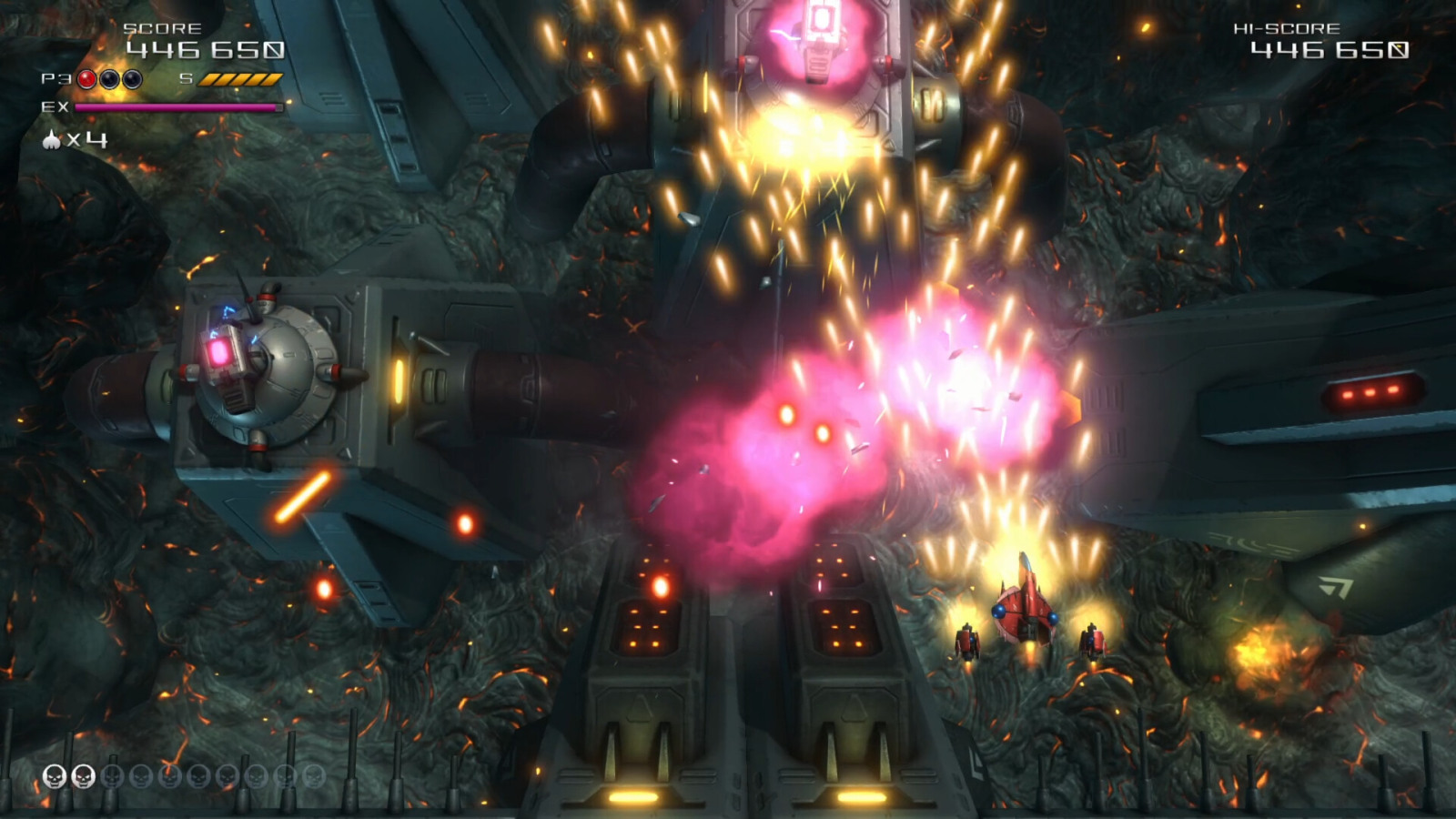
Truxton Extreme revives the series after a 38-year gap. Tatsujin has moved the familiar vertical shoot ’em up into fully 3D visuals, preserved its direct weapon foundation, and added modes for different skill levels. It launched July 30, 2026, on PC, PlayStation 5, Xbox Series X|S, and Nintendo Switch 2.
Readable Chaos
Truxton Extreme’s best quality is the clear relationship between threat and response. Power Shot, Truxton Beam, Thunder Laser, and Homing Shot differ through the shape of their control, not merely effects. One cuts a lane efficiently while another relieves pressure from the sides. A power-up choice changes the route through an enemy wave rather than only increasing a damage number.
Three-dimensional models do not erase the genre’s flat precision. Ships, mechanical serpents, and huge bosses gain volume while projectile boundaries and safe lanes remain legible. Bright impacts can obscure small threats during the busiest sequences, but the game rarely loses its visual hierarchy completely.
Modes for Learning and Mastery
Eight stages form the main campaign. Story Mode connects flights with animated comic scenes; Arcade Mode stays closer to a demanding traditional run; Heart Stopper raises the tension. Endless Challenge keeps increasing difficulty after a completed loop, turning memorized patterns into an endurance test.
Local co-op is useful not as an easy setting but as another way to read the screen. Two ships add firepower while forcing both players to share limited safe space. The Steam version also supports Remote Play Together, achievements, cloud saves, and leaderboards.
Difficulty Without Disguise
Truxton Extreme does not hide its arcade origin. Fast bullets, attacks from awkward angles, and physically large enemies demand memorization, while a mistake after a strong sequence feels costly. Its additional modes offer an entry point without turning the game into a sightseeing tour. Player improvement matters more than accumulated ship statistics.
A short session can consequently feel concentrated and tiring. A genre newcomer will see measurable progress across several attempts if failure is treated as information. Anyone expecting permanent meta upgrades and long role-playing progression will find the structure intentionally narrow.
Sound, Story, and the Cost of Returning
The soundtrack includes 78 pieces, bonus music among them, and supports the pace more effectively than the restrained narrative. Story mainly frames three characters and provides a pause between stages. It never competes with scoring and weapon systems for attention, which is an advantage in this genre.
The result is a confident sequel that modernizes presentation without rewriting rules for novelty’s sake. Precise control, distinct weapon patterns, modes, and leaderboards are its strengths. Its limits are equally plain: demanding play, repeated stages, and a relatively focused audience. Sources: Tatsujin; Clear River Games; Steam; Creative Bloq; NookGaming.
Редакция MBG
