
SpacemiT V100: New RISC-V Server Processor with 46 Cores and PCIe 5.0 Support
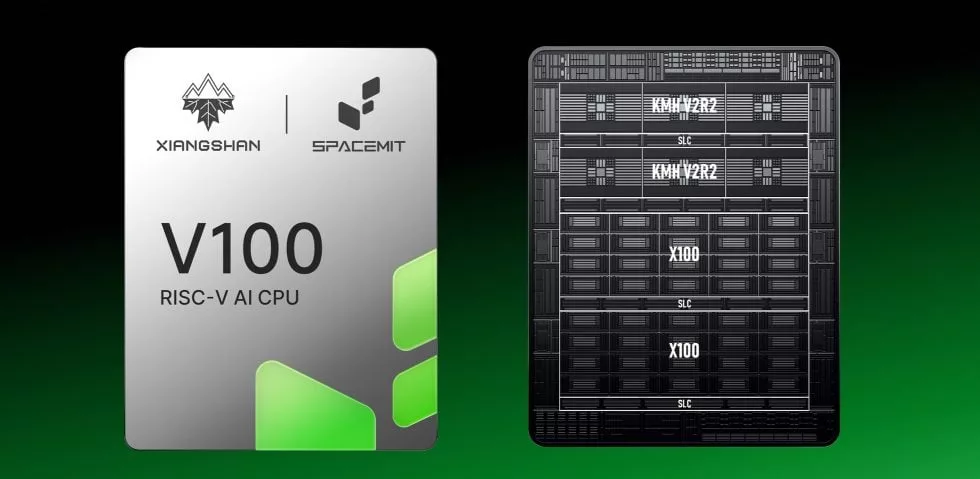
SpacemiT is aiming to move RISC-V beyond development boards and into the heart of the data center. At the RISC-V Summit China, the Chinese chipmaker introduced the SpacemiT V100, a new server processor designed for general computing, AI acceleration, and storage-intensive workloads.
Architecture and Core Configuration
The V100 utilizes a heterogeneous architecture developed in collaboration with the XiangShan project. It features a total of 46 cores: 6 high-performance Kunminghu V2R2 cores (based on XiangShan) paired with 40 proprietary SpacemiT X100 cores. The processor reaches a maximum clock speed of 2.4 GHz. This hybrid approach is intended to distribute varying workloads across the most suitable core types, though specific performance benchmarks for these workloads have not yet been released.
For enterprise scalability, the V100 supports dual-socket configurations, allowing up to 92 cores to be combined within a single server. The architecture ensures a coherent shared memory state between both processors, a vital requirement for multi-socket server environments.
Connectivity and Ecosystem
The hardware specifications are significant for a RISC-V platform, offering 8-channel DDR5 memory support and 52 lanes of PCIe 5.0. To complement the silicon, SpacemiT announced three dedicated server platforms: the C2201 for general-purpose computing, the G5201 for AI acceleration, and the S5236 for high-capacity storage applications. The G5201 is particularly notable for its ability to host eight full-height, full-length accelerator cards.
A major focus of the V100 is software compatibility. SpacemiT claims the processor has passed all Boot and Runtime Services compliance tests, aiming to allow standard Linux distributions to run without extensive kernel modifications. The chip includes hardware support for CPU, interrupt, and I/O virtualization, enabling the use of the KVM hypervisor. The company has already noted official support for Ubuntu 26.10.
While the hardware capabilities are impressive, independent measurements regarding power consumption (TDP), cache sizes, and pricing remain unavailable. The success of the V100 in professional environments will depend heavily on the maturity of the software ecosystem, an area where SpacemiT is actively contributing through upstream work in the Linux kernel and LLVM.
Гика
