
SiFive BigSky: RISC-V Server Runs CUDA on NVIDIA GPUs
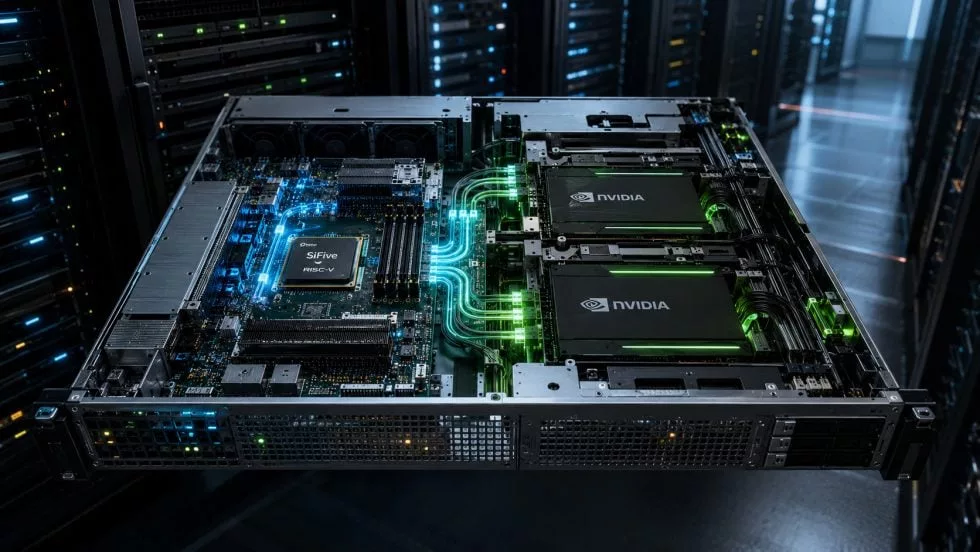
SiFive has introduced BigSky SF-2U870, a 2U rack-mountable server designed to port and validate professional applications on the open RISC-V architecture. The company positions the platform as the first enterprise-grade, rack-mountable RISC-V development server, targeting hyperscalers, chipmakers, and software developers rather than serving as a direct replacement for current AMD EPYC or "Intel" Xeon systems.
The BigSky platform is built on the SiFive P870-D processor design, which supports the RVA23 profile. This profile includes extensions required by modern operating systems, compilers, and server applications. SiFive lists Ubuntu 26.04 LTS and Red Hat Enterprise Linux 10 as supported operating systems, allowing developers to port, optimize, and test existing Linux applications on real RISC-V hardware instead of relying solely on emulators or smaller development boards.
CUDA execution on a RISC-V host
A key demonstration involves collaboration with NVIDIA. CUDA runs on the BigSky server, where the RISC-V system acts as the host and an attached NVIDIA GPU serves as the accelerator. The RISC-V processors handle the operating system and control tasks, while CUDA kernels execute on the NVIDIA GPU. This does not mean CUDA calculations run directly on the RISC-V cores. Instead, it marks the first demonstration of the CUDA software environment, traditionally oriented toward x86 and Arm systems, working with a RISC-V host for modern AI workloads.
Future integration with NVLink Fusion
SiFive and NVIDIA are also working on integrating NVLink Fusion into future RISC-V platforms. This would allow custom RISC-V processors to connect to NVIDIA accelerators with high bandwidth and coherent memory access. However, the first chips with this capability are not expected until 2027 at the earliest. BigSky therefore serves primarily as a development and validation platform, enabling the necessary software to be prepared before custom data center processors become available. If the collaboration succeeds, RISC-V could become a long-term open alternative to x86 and Arm host processors in AI servers. The BigSky server is not yet a mass-market breakthrough, but it represents a significant step from development boards to professional data center infrastructure.
Гика
