
Acer Predator Atlas 7: Arc B390, 120 Hz, 80 Wh
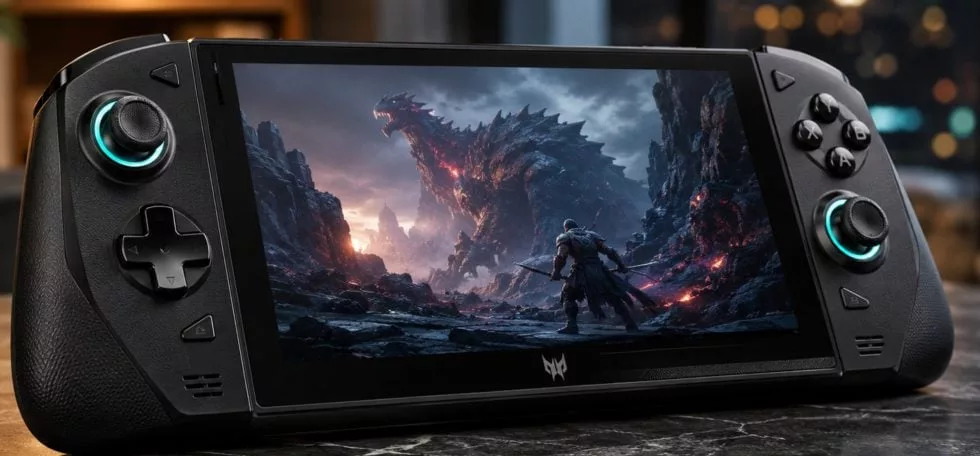
Acer has officially unveiled the Predator Atlas 7, a compact 7-inch Windows handheld that brings the hardware of its larger sibling, the Atlas 8, into a more portable form factor. Announced at IFA Berlin on September 2, 2026, the device features an Intel Arc B390 GPU, a 120 Hz display, and an optional 80 Wh battery, positioning it as a high-performance option in the growing market of Windows-based gaming handhelds.
The Predator Atlas 7, designated as the PA07-I51, is set to launch in Europe in November 2026, with a broader North American release expected in the fourth quarter. Acer has not yet disclosed pricing, leaving the device's market positioning relative to existing competitors open for now. The core of the system is a 7-inch IPS touchscreen with a resolution of 1,920 × 1,080 pixels in a 16:9 aspect ratio. The panel supports a refresh rate of up to 120 Hz with Variable Refresh Rate (VRR) technology. Acer specifies a peak brightness of 500 nits and full sRGB color gamut coverage. To protect the screen, the device features Gorilla Glass Victus and a DXC surface treatment designed to reduce reflections and resist scratches. A tempered glass screen protector is included in the box, a practical addition for a device that will likely be transported more frequently than a traditional laptop.
Under the hood, the Atlas 7 is built on the Intel Arc G3 Extreme platform, which includes the Arc B390 graphics chip. The system is equipped with up to 24 GB of LPDDR5X-7467 memory. For storage, Acer uses a PCIe 4.0 NVMe SSD with a maximum capacity of 1 TB. A notable design choice is the use of the standard M.2 2280 form factor for the SSD, which makes future upgrades significantly easier compared to the smaller 2230 modules found in many other compact handhelds. Cooling is handled by a dual-fan system. One fan is Acer's metallic AeroBlade unit, featuring blades that are only 0.1 mm thick, while the second is a plastic fan. Together with Vortex-Flow air channels, this setup is designed to direct hot air out of the chassis. Acer claims this configuration provides up to 10% more airflow than a standard plastic solution, based on internal measurements.
The control layout offers several options for customization. The analog sticks can be ordered with either traditional carbon-film sensors or optional TMR (Tunneling Magnetoresistance) sensors. The L2 and R2 triggers use Hall-Effect technology. The device also includes two rear macro buttons and a fingerprint sensor integrated into the power button for Windows Hello. Battery options are a key differentiator: a 60 Wh battery keeps the weight under 700 grams, while the larger 80 Wh option keeps it under 750 grams. This allows the smaller device to offer a high capacity without entering the weight class of much larger handhelds.
Connectivity is robust, featuring two Thunderbolt 4 ports that support docking, display output, and fast external storage. There is also a UHS-II microSD card reader and a combined 3.5 mm audio jack. Wireless communication is handled by Intel Killer Wi-Fi 7 and Bluetooth 5.4. The built-in speakers deliver 2 watts each and are enhanced with DTS:X Ultra. System management is available through PredatorSense, which allows users to control performance profiles, system data, and lighting. By sticking to an open Windows 11 platform, Acer avoids forcing a proprietary accessory ecosystem for docking or storage expansion.
The Predator Atlas 7 stands out for combining a compact 7-inch form factor with high-end specifications. It retains a full-size M.2 2280 SSD, Thunderbolt 4, and the option for an 80 Wh battery. While the technical package appears complete, the final price will be the deciding factor for its success in a market already filled with powerful alternatives. If Acer positions the Atlas 7 correctly, this smaller model could prove to be an even more attractive option than its larger counterpart.
Гика
