Intel and Altera to Develop FPGA Sensor Bridge for Edge AI and Robotics
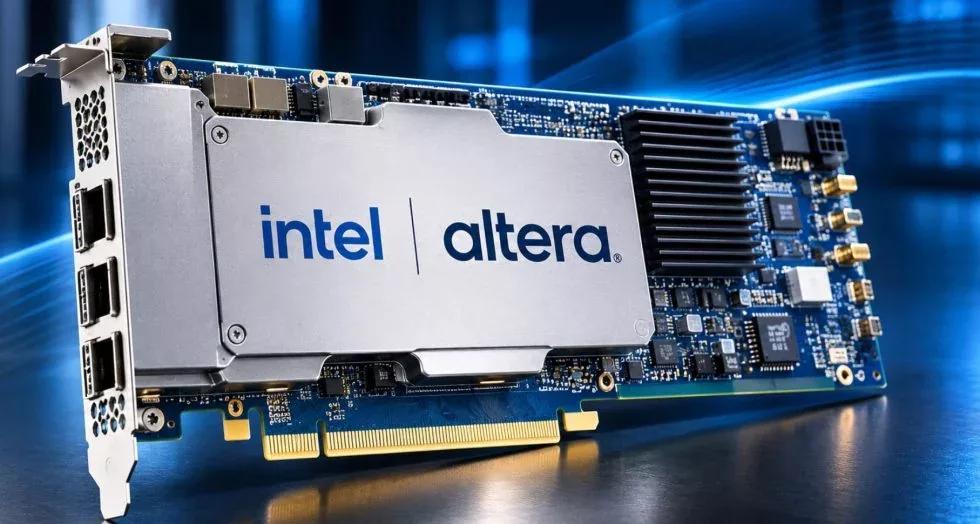
A powerful AI computing unit is of little use if the required sensor data arrives too late or in an incompatible format. This is a critical bottleneck in robotics, medical devices, and industrial control systems, where cameras and motion sensors must synchronize across diverse interfaces. To address this, Intel and Altera announced a collaboration on November 10, 2026, to develop a programmable real-time sensor bridge designed to bridge the gap between various sensors and Intel's processing platforms.
The proposed solution aims to integrate Altera's FPGAs (Field Programmable Gate Arrays) with Intel processors and their software environments. In this architecture, the FPGA is intended to handle sensor interfacing, data preprocessing, and time-critical control tasks, while the Intel platform provides the general computing power and software infrastructure for higher-level AI applications. While the technical direction is clear, the announcement focuses on the planned collaboration rather than a finished product; no specific hardware models, performance metrics, or release dates have been disclosed yet.
Addressing the Complexity of Modern Edge Systems
Modern edge systems often rely on multiple sensors simultaneously. For instance, an autonomous robot must process continuous video streams alongside small, high-frequency data packets from motion sensors and distance measurements. These components have vastly different requirements: cameras demand high bandwidth, while motion sensors require precise temporal synchronization and rapid response times. Traditionally, this complexity is managed by specialized interface controllers or microcontrollers, but as sensor counts increase, the hardware and software overhead grows significantly.
The modular sensor bridge aims to solve this by using the reconfigurable nature of FPGAs. Unlike a CPU that executes instructions sequentially, an FPGA allows data paths and logic functions to be mapped directly into the hardware. This makes them particularly suited for parallel data processing and meeting strict timing requirements. By offloading the initial signal processing and synchronization to the FPGA, the Intel processor is freed to focus on intensive mathematical computations and complex AI models.
The Division of Labor: FPGA vs. Processor
Intel and Altera have described their approach as a modular reference solution. The goal is to provide manufacturers with a technical foundation that can be adapted to various sensors and interfaces. The intended division of tasks is as follows:
While the concept is technically sound, it is not a guarantee of reduced total system latency. The time required for data transfer between the FPGA, system memory, and the processor remains a critical factor. The actual effectiveness of this solution will depend heavily on how the entire data processing chain—from sensor to actuator—is implemented.
Target Applications: From Robotics to Aerospace
A primary focus of this collaboration is robotics. In dynamic environments, robots must synchronize camera data with positional information and motor control, often with different update rates. FPGAs can provide the necessary logic for timestamping and stream synchronization to ensure this data is temporally aligned. Beyond robotics, the companies are targeting medical applications, where low latency and real-time performance are paramount, as well as aerospace and defense sectors, where SWaP (Size, Weight, and Power) constraints are the priority.
Despite the ambitious scope, several technical details remain unknown. It is currently unclear which specific FPGA families will be used, what sensor protocols will be supported, or what the data rates will be. Furthermore, for highly regulated sectors like medical or defense, the companies have yet to provide details regarding specific hardware certifications or safety approvals. For now, the project remains in the stage of developing technical reference designs rather than standardized, off-the-shelf hardware modules.
The collaboration extends into software support, aiming to streamline the development process for heterogeneous systems. Developers are expected to access the planned functions through the Intel Open Edge Platform SDK and an Altera SDK. For hardware manufacturers, this could potentially reduce the complexity of integrating new sensors, provided that the announced interfaces and development tools are sufficiently synchronized. Currently, developers often face the challenge of using disparate toolchains: specialized software is required for FPGA configuration, while separate compilers, libraries, and runtimes are needed for CPU-based applications. A more unified development environment could bridge these two domains, though it remains to be seen whether Intel and Altera will deliver truly integrated APIs, new libraries, or additional specialized tools.
At this stage, the announcement functions more as a strategic development direction rather than a fully specified product platform. Details regarding support for existing FPGA designs or current Intel software projects are currently missing. For an architecture explicitly targeting real-time processing and efficient data transfer, performance metrics such as latency measurements will be critical for any meaningful evaluation.
Crucially, Intel and Altera have not yet released concrete data regarding response times, maximum data rates, or power consumption. Information concerning the number of simultaneously supported sensors, the specific FPGA models to be used, or the exact hardware configurations is also absent. While the inherent advantages of programmable logic for deterministic signal processing are well-established, these theoretical benefits do not yet translate into specific performance improvements for this proposed sensor bridge. Furthermore, no binding market launch date was provided as of November 10, 2026. It remains unclear which specific products will emerge from this partnership and when the first reference systems will become available.
Editorial Perspective
The approach is fundamentally logical. In robotics and industrial Edge systems, a significant portion of technical difficulty lies in the reliable acquisition and synchronization of sensor data; a powerful AI unit alone cannot solve these synchronization challenges. Combining Intel processors with Altera's programmable hardware could provide a robust foundation for modular systems, particularly by allowing time-critical signal processing to be decoupled from heavy AI computations.
However, the announcement remains thin on technical substance. Without specific data on the FPGA models, interface bandwidth, latency, and power consumption, the practical utility of this architecture cannot be reliably assessed. Whether this evolves into a convincing industrial platform depends entirely on the eventual reference designs and their measured performance metrics.
The collaboration between Intel and its FPGA subsidiary, Altera, focuses on addressing the growing complexity of sensor data in modern autonomous systems. As Edge AI applications move from simple pattern recognition to complex real-time decision-making, the bottleneck often shifts from raw compute power to the efficiency of data ingestion and preprocessing. This is where the proposed FPGA-based sensor bridge aims to intervene, acting as a high-speed intermediary between diverse sensor arrays and primary processing units.
Bridging the gap between sensors and compute
In robotics and autonomous driving, sensors such as LiDAR, high-resolution cameras, and ultrasonic transducers generate massive streams of asynchronous data. Standard CPUs and even many GPUs are not natively optimized to handle the raw, unstructured, and time-sensitive nature of this input without significant latency or overhead. The Altera-driven solution leverages the inherent flexibility of Field-Programmable Gate Arrays (FPGAs) to implement custom hardware logic specifically for sensor interfacing.
By implementing a dedicated sensor bridge, the system can perform several critical tasks at the hardware level before the data even reaches the main application processor: • Temporal synchronization of multiple sensor inputs to ensure a coherent view of the environment. • Real-time data filtering and noise reduction to decrease the workload on downstream AI accelerators. • Protocol conversion, allowing various proprietary or legacy sensor interfaces to communicate seamlessly with modern high-speed interconnects like PCIe.
Optimizing the Edge AI pipeline
The primary technical advantage of this approach lies in the reduction of 'data movement' latency. In many Edge AI deployments, a significant portion of the power budget and processing time is wasted simply moving data from the sensor interface to the memory where the AI model resides. The FPGA bridge can perform 'in-flight' processing, executing lightweight neural network layers or classical computer vision algorithms directly on the incoming data stream.
This capability is particularly vital for robotics, where the delay between sensing an obstacle and executing a motor command must be minimized to ensure safety. By offloading the initial stages of the perception pipeline to the Altera FPGA, the main compute unit—whether it is an Intel Core processor or a specialized AI accelerator—can focus entirely on high-level logic and path planning rather than low-level data management.
Strategic implications for Intel's ecosystem
This development highlights a strategic shift toward a more holistic approach to Edge computing. Rather than just providing the most powerful NPU (Neural Processing Unit) or CPU, Intel is looking to control the entire data path. By integrating Altera's FPGA technology into the Edge AI ecosystem, Intel aims to provide a more cohesive solution for industrial automation and autonomous mobile robots (AMRs), where the integration of specialized hardware is often the deciding factor in system viability.