

Indies and original IP blew up in 2026
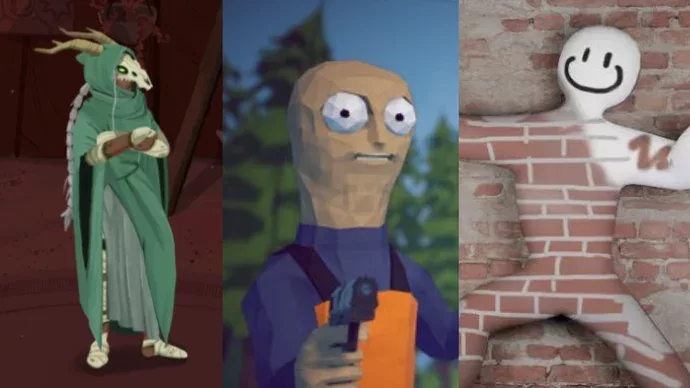
The gaming market in 2026 saw a significant shift toward original content. Research from Sensor Tower shows that indie studios and original IP developers occupied a much larger share of the year's biggest hits compared to 2025.
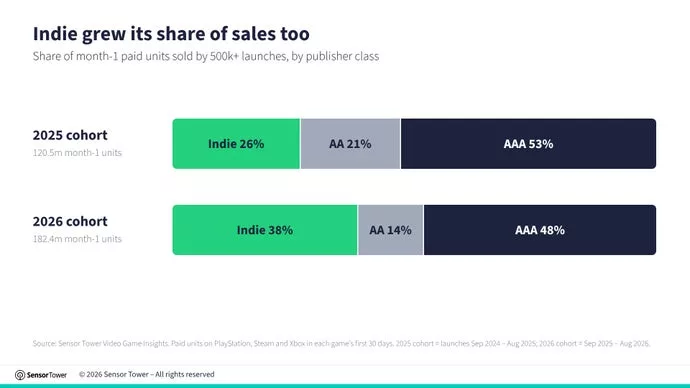
The analytics firm tracked games that sold over 500,000 units in their first month across two 12-month periods: September 2024 to August 2025 (the 2025 cohort) and September 2025 to August 2026 (the 2026 cohort). Total sales in this category grew by 51%, rising from 120.5 million to 182.4 million units. During this time, the number of successful titles increased from 55 to 76.
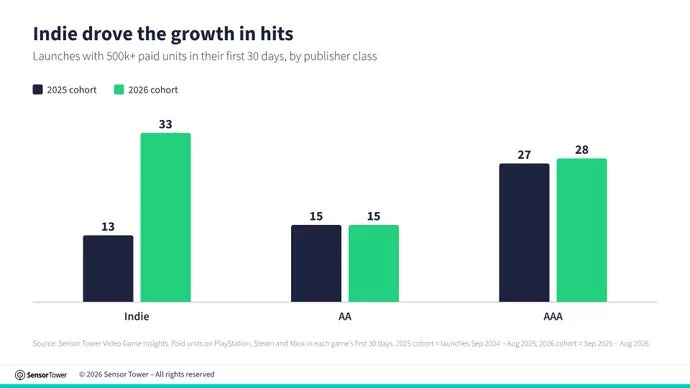
The standout trend is the explosion of the indie segment. In 2025, indies accounted for only 13 titles (24%) among the top sellers, but in 2026, that number jumped to 33 (43%). Furthermore, the share of month-one paid units attributed to indies grew from 26% to 38%. Notably, this indie surge hasn't come at the expense of the AAA segment; the number of AAA hits remained steady (growing slightly from 27 to 28), suggesting that indie successes are acting as an additive driver for market growth rather than a replacement.
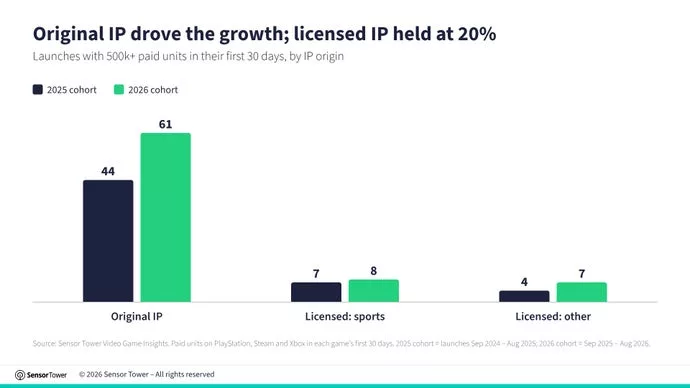
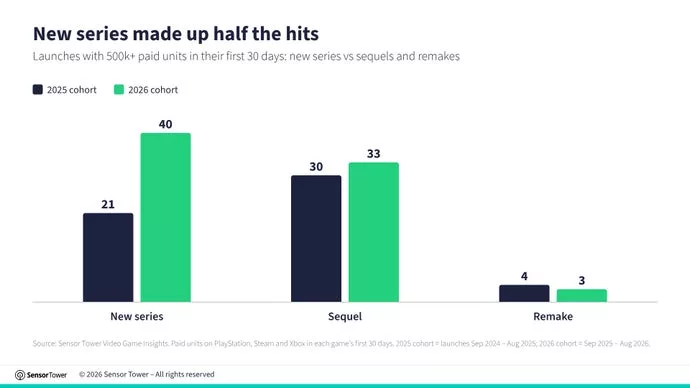
New series are also seeing a breakthrough. Over half of the successful releases in 2026 (53%) were the first entries in new franchises, up from 38% in 2025. The number of games based on original IP (owned by the developer/publisher rather than licensed) also climbed from 44 to 61 titles. Of the 35 completely new IPs that achieved high sales, 27 were produced by indie studios.
Some of the most significant indie hits in the 2026 cohort include:
- Meccha Chameleon (estimated 13.9 million units);
- How to Fish (7.9 million units);
- Slay the Spire 2 (5.9 million units);
- Hollow Knight: Silksong (5.2 million units);
- Escape from Duckov (4 million units).
Karl Kontus, SVP and GM of Video Game Insights at Sensor Tower, noted that indie success has become much broader. While low-budget co-op games previously drove much of the volume, the 2026 cohort saw significant contributions from long-awaited sequels and single-player titles. Meanwhile, AAA publishers continue to rely on established franchises like Battlefield 6, Resident Evil Requiem, and EA Sports FC, maintaining a stable presence while innovation increasingly stems from the AA and indie sectors.
Флешка
