
Synaptics Astra SR200: New AI Microcontrollers with Integrated DRAM
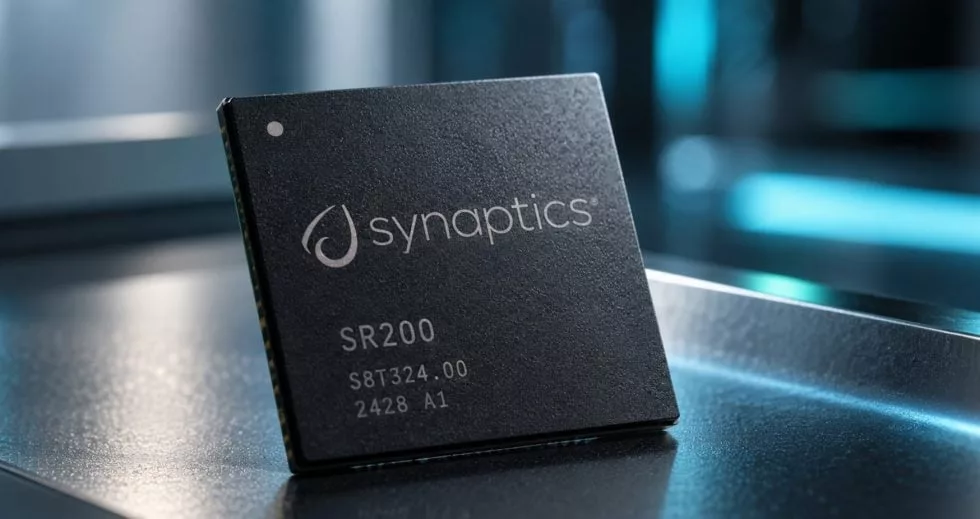
The "Synaptics" Astra SR200 series has been officially introduced. Categorized by the manufacturer as xMCUs, these microcontrollers are designed to handle AI tasks directly on-device (Edge AI), aiming to reduce cloud dependency and power consumption.
Architecture and AI Performance
The lineup consists of three models: SR210, SR230, and SR250, delivering between 200 and 400 GOPS of AI computing power. The architecture combines an ARM Cortex-M85 core (up to 800 MHz) for high-performance tasks with a Cortex-M52 core (up to 200 MHz) for energy-efficient background operations. Both cores support Helium extensions for vector and signal processing.
AI acceleration is handled by the Torq-Engine, a Neural Processing Unit (NPU) based on the Google Coral architecture developed in collaboration with Google Research. The engine supports INT8, INT16, and BF16 data formats, enabling the execution of various neural networks, including Transformer models.
Integrated Memory and SiP Design
A standout feature of the SR200 series is its System-in-Package (SiP) architecture. Rather than relying on external memory chips, Synaptics has integrated up to 8 MB of SRAM and custom DRAM—providing several hundred megabytes of capacity—directly into the chip package. This approach reduces PCB footprint and simplifies hardware design.
According to Synaptics, this integrated memory architecture can consume approximately one-third of the energy required by conventional external DRAM solutions under specific workloads. It is important to note that this claim is based on the manufacturer's internal comparisons and has not yet been verified by independent measurements.
Connectivity and Multimedia
The three models are pin-compatible, allowing manufacturers to offer different performance tiers within the same hardware platform. The flagship SR250 is designed for demanding multimodal applications, capable of simultaneous video processing (supporting H.264 and JPEG), audio processing (via a Cadence-Tensilica HiFi-5 DSP), and driving displays up to 1920×1080 @ 60 Hz.
The platform supports MIPI-CSI-2 for cameras, MIPI-DSI for displays, and various industrial interfaces including CAN-FD, Gigabit-Ethernet, and USB 2.0. For software development, Synaptics is providing support for Zephyr RTOS and an open compiler for the Torq-NPU to ease the deployment of custom AI models.
Гика
