

South Korea Chip Exports Surge 169.6% to $281.2B
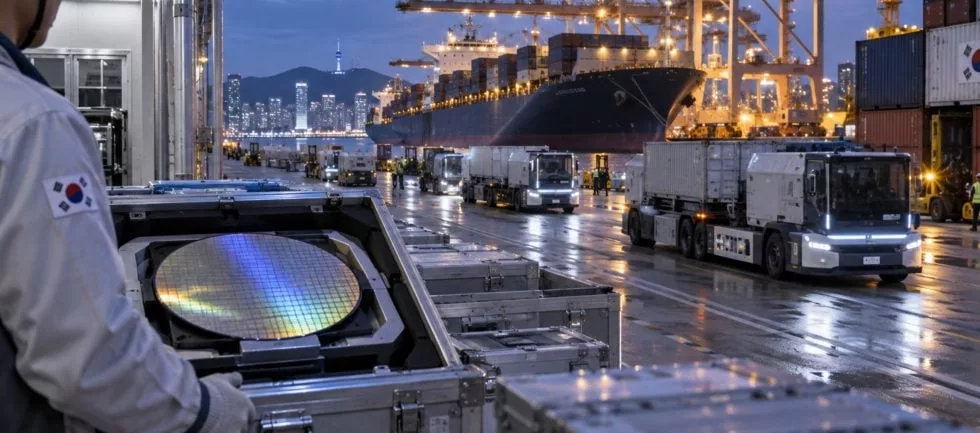
South Korea’s cumulative exports reached $709.4 billion by September 5, 2026, surpassing the full-year 2025 record of $709.3 billion more than four months before the year ends. The primary driver is the semiconductor sector, where chip exports from January to August totaled $281.2 billion, representing a 169.6 percent year-over-year increase. Semiconductors now account for 40.6 percent of the country’s total exports, a structural shift fueled by demand for AI infrastructure components such as HBM and server DRAM.
According to data from the South Korean Ministry of Trade, Industry and Energy and the Korea Customs Service, the nation’s export performance in the first eight months of 2026 has already exceeded the previous annual benchmark. The cumulative export value of $709.4 billion marks a significant milestone, achieved 117 days before the end of the calendar year. This growth is not evenly distributed across all industrial sectors; instead, it is heavily concentrated in the semiconductor industry.
From January to August, South Korea exported semiconductors worth $281.2 billion. This figure is approximately 60 percent higher than the total semiconductor exports for the entire year of 2025, which stood at $175.3 billion. The year-over-year growth rate for this period is 169.6 percent. The share of semiconductors in total exports has risen to 40.6 percent, indicating a deepening reliance on this single industry for the country’s trade balance.
Drivers of Growth
The surge in semiconductor exports is primarily attributed to the expansion of large-scale AI data centers. These facilities require substantial quantities of High Bandwidth Memory (HBM) and server DRAM. SK hynix has established a strong position in the HBM market, while Samsung Electronics is aggressively expanding its production capacity. The demand for these high-value memory products has outpaced growth in other sectors.
HBM is particularly attractive to memory manufacturers because its prices and margins are significantly higher than those of standard PC DRAM. However, the production process for HBM requires more wafer area per bit and additional packaging steps. This shift in production capacity toward HBM can influence the supply of other DRAM products. The AI boom extends beyond GPU manufacturers like NVIDIA and AMD; every additional AI server drives demand for memory, packaging capacity, substrates, and production equipment.
Economic Implications
The concentration of exports in semiconductors presents both opportunities and risks. In the short term, high export volumes improve the trade balance and corporate profits, enabling further investment. However, the economy becomes more sensitive to fluctuations in the chip cycle. Memory prices have historically been volatile, and there is no guarantee that the current AI-driven demand will sustain its present growth rate indefinitely.
Other export sectors are also growing, albeit at a slower pace. Computer peripherals, petroleum products, communication equipment, and ships have all seen increases. Nevertheless, the contribution of the semiconductor industry surpasses all other product groups. Approximately 74 percent of the additional export value from January to August is attributed to semiconductors, while total exports grew by 52.8 percent during the same period.
The Korea Customs Service suggests that if the current pace continues, South Korea could reach $1 trillion in exports by early December 2026. This would place the country in a small group of economies that have ever achieved goods exports of this magnitude. The current trend is driven by a global investment wave in AI infrastructure and a significant rise in memory prices. South Korea is not only exporting more chips but also higher-value and more expensive products.
Limitations and Context
The data reflects cumulative figures up to September 5, 2026. The projection of reaching $1 trillion in exports is a possibility based on current trends, not a guaranteed outcome. The volatility of memory prices and the potential for a slowdown in AI infrastructure spending remain key risks. The analysis is based on official trade statistics and reports from Reuters, Yonhap News Agency, and the Seoul Economic Daily.
Цифра
