

ASUS ProArt GR1X: Compact RTX Spark PC for Local AI
ASUS unveils the ProArt GR1X, a compact desktop based on NVIDIA's RTX Spark platform. Featuring up to 128 GB of unified LPDDR5X memory and 1 Petaflop of FP4 AI performance, it is designed for local AI workloads and professional creative tasks.
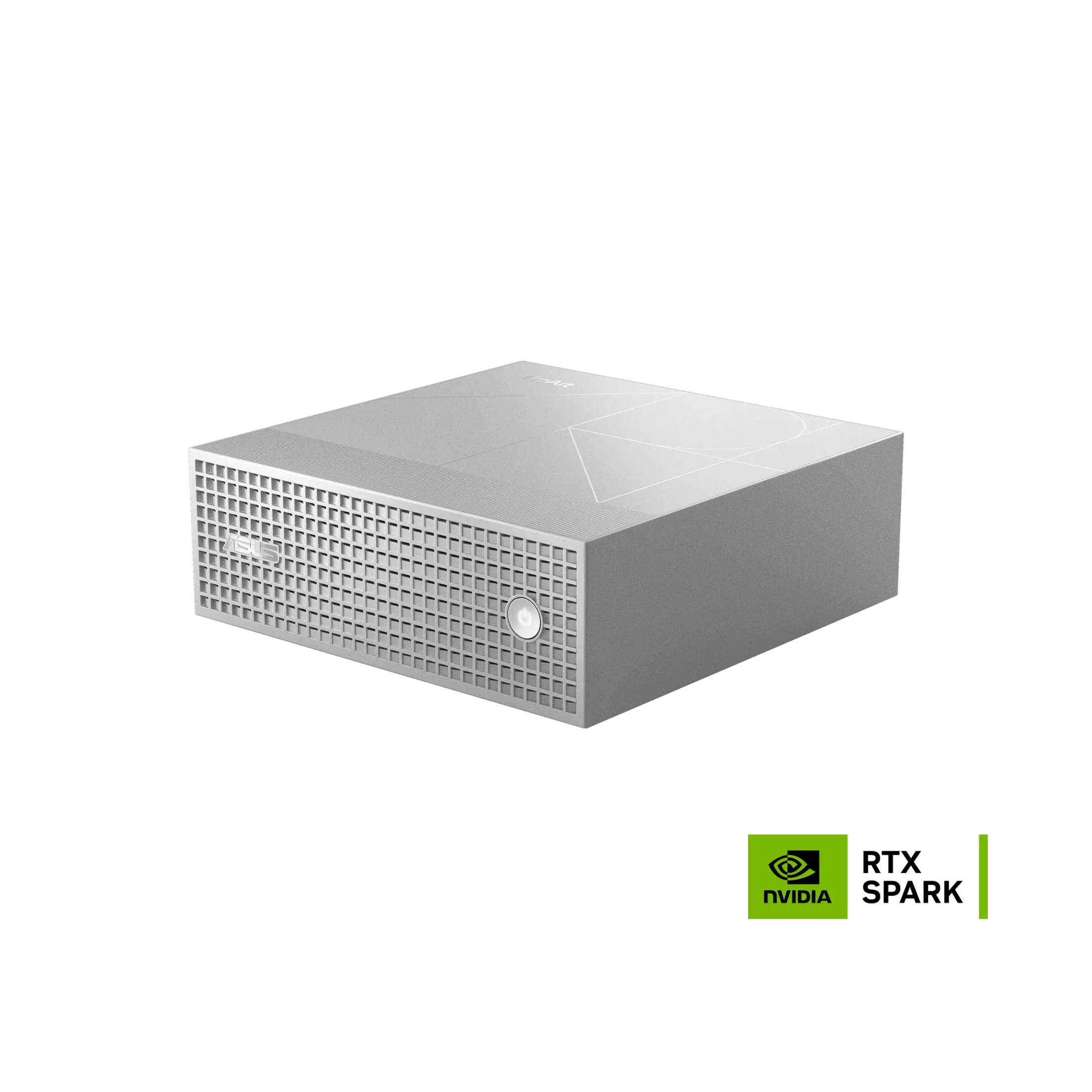
ASUS has introduced the ProArt GR1X, a compact desktop system built on NVIDIA's new RTX Spark platform. Announced at IFA 2026, the device combines the Grace-Blackwell architecture with up to 128 GB of shared LPDDR5X memory to target local AI workloads and professional creative applications.
Measuring just 150 × 150 × 51 mm, the GR1X is only slightly larger than a standard mini-PC. Despite its small footprint, ASUS claims the system can deliver up to 1 petaflop of FP4 AI performance while sustaining a power draw of up to 140 W. The technical core is the NVIDIA RTX Spark superchip, which integrates ARM-based Grace CPU cores with a Blackwell GPU. Because both the CPU and the GPU access the same memory pool, the system reduces the data transfer overhead typically associated with the PCI Express interface in traditional desktop configurations.
Shared memory and AI performance
ASUS offers the GR1X with up to 128 GB of LPDDR5X memory. This capacity is particularly relevant for local AI applications, such as language models and image generators, that do not fit entirely within the memory of a standard discrete graphics card. By running these models directly on the integrated Blackwell GPU, the system avoids the need to constantly move data between system and graphics memory. ASUS also cites large 3D scenes as a use case, stating that projects of up to 90 GB can be edited and rendered natively.
The advertised 1 petaflop figure refers specifically to calculations in the compact FP4 format. FP4 reduces memory requirements and increases potential compute throughput, but it is not universally suitable for all applications. Consequently, this metric cannot be directly compared to traditional FP32 performance or the gaming performance of a GeForce graphics card. It indicates the throughput the system can achieve with highly optimized and quantized AI models. Through the Blackwell architecture, the GR1X gains access to NVIDIA's existing AI ecosystem, including CUDA, TensorRT, and optimized frameworks. This software support could be a significant advantage over alternative ARM or x86 mini-PCs.
Thermal design and connectivity
Managing high performance in a chassis only 51 mm tall presents a significant thermal challenge. ASUS uses two fans, each with 109 rotor blades, to facilitate a sustained power draw of up to 140 W. The cooling system is designed to prevent the CPU or GPU from significantly downclocking during long calculations. This makes the GR1X suitable for continuous workloads, including long-duration 3D rendering, video editing, local inference, and persistently active AI agents. However, the noise level under full load cannot yet be assessed based on manufacturer specifications alone.
For transferring large models, videos, and 3D data, ASUS equips the mini-PC with a 10-Gigabit Ethernet port and Wi-Fi 7. This allows the GR1X to function as a compact compute node in a local studio or enterprise network. The fast network connection is particularly relevant when multiple workstations access central project data or load models from a NAS. The system could also operate as part of a local cluster in conjunction with distributed AI tools such as NVIDIA PAIR. ASUS additionally cites a MIL-STD-810H certification, which documents the system's resistance to various environmental conditions. This does not, however, automatically mean the GR1X is approved for every conceivable industrial load.
ASUS positions the ProArt GR1X as an "Agent Computer," intended for AI agents to work persistently in the background and handle tasks largely autonomously. Local execution keeps sensitive files, source code, and project data on the user's own system. This approach eliminates transmission latencies and recurring fees for rented cloud accelerators. While a compact mini-PC cannot replace a large data center, its strength lies in the combination of high memory capacity, NVIDIA software support, and minimal space requirements.
The ProArt GR1X is one of the most interesting RTX Spark systems announced to date. ASUS has not simply used the platform for a standard mini-PC but has consistently oriented the device toward local AI and creative workloads. The up to 128 GB of shared memory, 10-Gigabit Ethernet, and cooling designed for 140 W align with this goal. Ultimately, the price, memory bandwidth, noise level, and actual performance with large models will be decisive. It will also need to be seen how well classic Windows applications function on the ARM platform. ASUS has not yet announced a specific retail price or a final release date.
Гика
