

First AMD Ryzen AI Max+ PRO 495 gaming reviews show Radeon 8065S gains over 8060S
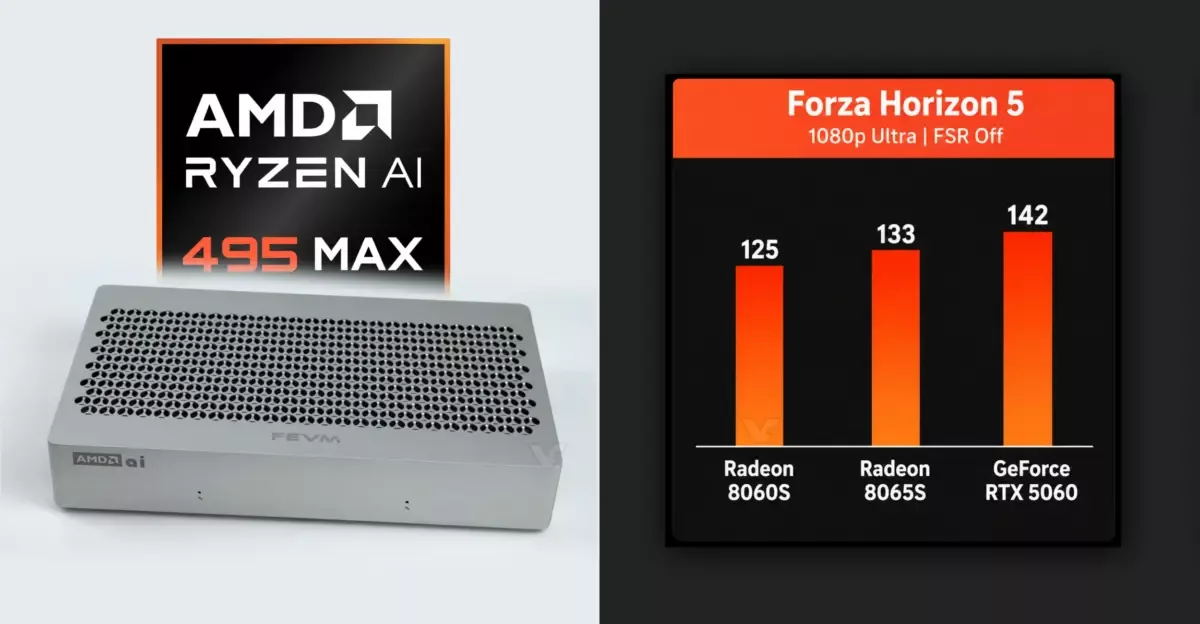
The new Gorgon Halo processors from AMD have arrived, featuring support for up to 192GB of unified memory—with as much as 160GB allocatable to the integrated GPU. While this massive memory capacity is clearly aimed at AI workloads, we are focusing on what matters most to gamers: actual gaming performance.
Technical Upgrades: Higher Clocks and Bandwidth
The Ryzen AI Max+ PRO 495 is a refresh of the Strix Halo architecture, featuring 16 Zen 5 cores and 40 RDNA 3.5 Compute Units. Compared to the older Radeon 8060S, the 8065S sees a boost in clock speeds, reaching 3.0 GHz versus 2.9 GHz. Additionally, memory support has been upgraded to LPDDR5X-8533, providing a total bandwidth of 273 GB/s.
Early testing by reviewers like ETA Prime shows that these hardware changes translate into real-world gains. In a test using the GMKtec EVO-X5 Pro with a 120W power limit, the 8065S achieved an 11.3% improvement in graphics scores and a 9.3% increase in single-core performance in Geekbench 7 compared to the previous EVO-X2. In 3DMark Time Spy, the 8065S scored 11,743 points, an 11.8% jump over the EVO-X2 at the same power setting.
Gaming Performance: FPS Gains in Action
In actual gaming scenarios, the Radeon 8065S shows a clear advantage over the Radeon 8060S. Testing on the FEVM FAEX2 mini PC (running at a 160W limit) yielded the following results at 1080p:
- Forza Horizon 5 (Ultra, FSR off): 133 FPS on the 8065S vs. 125 FPS on the 8060S.
- Cyberpunk 2077 (High): 104 FPS on the 8065S vs. 90 FPS on the 8060S.
- Shadow of the Tomb Raider: 151 FPS vs. 107 FPS.
- Black Myth: Wukong (Highest preset): 79 FPS vs. 72 FPS.
When testing at 1440p Ultra on the GMKtec EVO-X5 Pro (120W), Cyberpunk 2077 averaged approximately 69 FPS when using FSR 4.1 upscaling. Red Dead Redemption 2 reached about 87 FPS on mixed Ultra/High settings without FSR. For demanding titles like Crimson Desert at 1440p Ultra, FSR Multi Frame Generation is required to maintain an average performance in the mid-90s FPS range.
It is important to note that performance varies depending on the system's cooling and power limits. Furthermore, some of these gains might be attributed to more mature drivers, as older hardware is not always tested against the latest software versions. While the Radeon 8065S is a solid step up, the $7,000 price point for such high-memory systems remains a niche consideration for the average gamer.
Гика
