
RTX PRO 6000: 16-Pin-Stecker Melts Despite TempGuard Protection
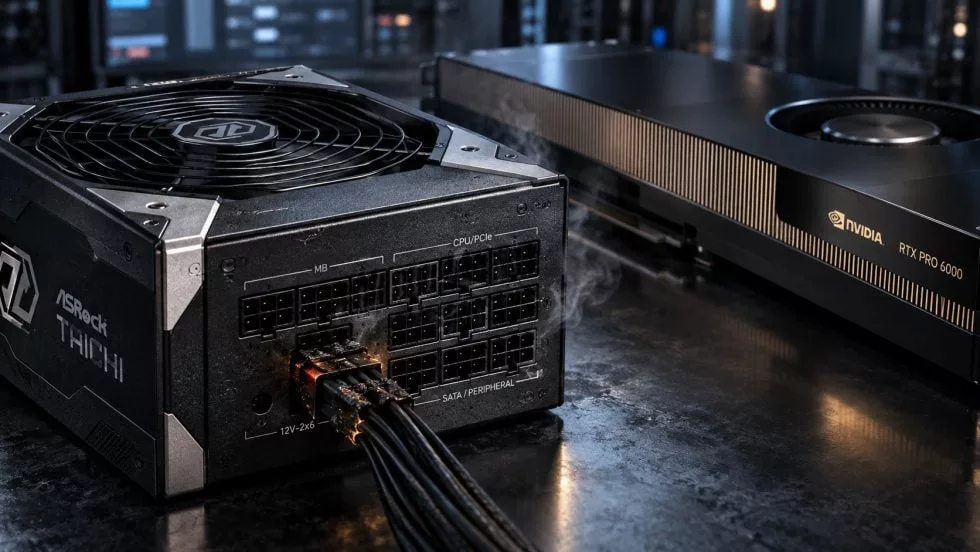
Another incident involving damaged 16-pin power connectors has surfaced, but this time it involves a high-end professional workstation card rather than a consumer GeForce RTX 5090. An NVIDIA RTX PRO 6000 Blackwell Workstation Edition was paired with an ASRock Taichi TC-1650T power supply when the 12V-2×6 connector on the PSU side overheated significantly, causing the plastic to melt and fuse with the socket.
The TempGuard Limitation
What makes this case particularly interesting is the hardware involved. The ASRock Taichi TC-1650T features the TempGuard technology, which utilizes an NTC sensor located on the VGA-side connector to monitor temperatures and prevent damage. ASRock also uses distinctive green connector elements to help users identify incomplete connections. Despite the user reporting that the connectors were fully seated on both sides, massive thermal damage occurred at the power supply end.
The NVIDIA RTX PRO 6000 is a high-performance professional GPU designed for rendering, AI, and data analysis. It features 96 GB of "GDDR7" ECC memory, a bandwidth of 1,792 GB/s, and a maximum power draw of up to 600W. This high power requirement places immense continuous stress on the electrical connections.
Technical Implications of Single-Ended Sensing
The incident highlights a potential technical gap in thermal monitoring. Since the TempGuard sensor is located on the cable end near the GPU, it may not detect localized hotspots occurring at the opposite end—the PSU socket. If high contact resistance causes a temperature spike at the power supply side, the heat might not reach the sensor in time to trigger a shutdown before physical damage occurs. This raises questions about the efficacy of single-ended temperature monitoring for high-current 12V-2×6 cables.
Currently, this remains a single documented incident and does not constitute proof of a fundamental design flaw in the Taichi TC-1650T. ASRock has not yet released an official technical investigation. Previously, VideoCardz reported a similar instance involving an RTX PRO 6000 where overheating traces were found on the GPU side of the cable, though the card was later cleared by PNY. This latest event underscores the complexity of managing power delivery for next-generation high-wattage hardware.
Гика
