

RTX 5090: 16-Pin-Anschluss schmilzt bei DLSS-5-Test mit mehr als 600 Watt
A user reported a melted 16-pin power connector on an MSI GeForce RTX 5090 Gaming Trio OC during a DLSS-5-Test in NBA 2K27, with GPU-Z showing over 610 Watts. NVIDIA and MSI have not yet officially investigated the specific case.
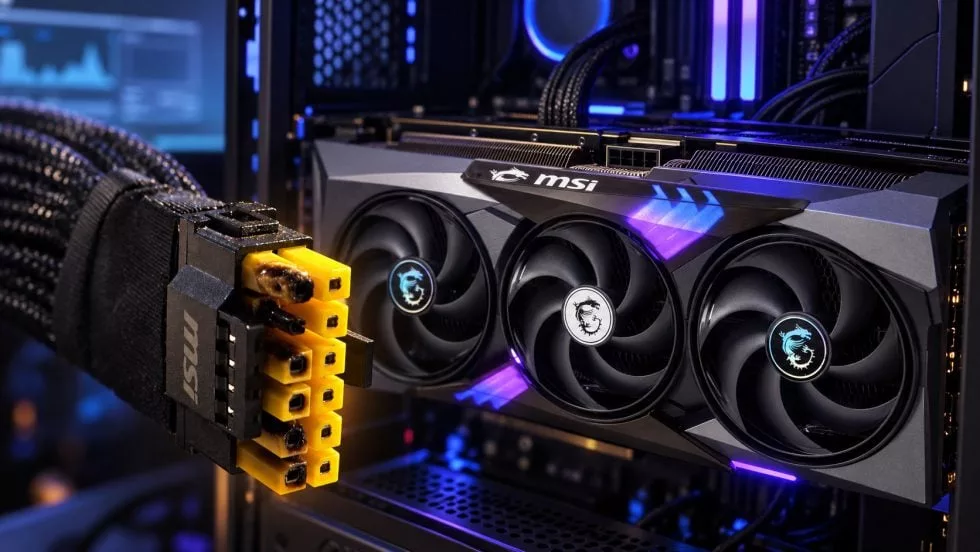
A user named Erek reported a melted 16-pin power connector on an MSI GeForce RTX 5090 Gaming Trio OC during a DLSS-5-Test. The GPU reportedly drew over 600 Watts in the test, which is higher than its usual gaming load of around 450 Watts. While a direct causal link between DLSS 5 and the damage has not been proven, the incident highlights potential risks associated with high power consumption and neural rendering technology.
Incident Details
The owner documented the issue in the HardOCP forum after noticing a burnt smell and inspecting the card. The 16-pin connector was found melted, with at least five contacts on the cable visibly discolored or damaged. The plastic housing connecting the cable to the GPU appeared deformed. Prior to the incident, GPU-Z displayed sustained power readings of more than 610 Watts during the test.
Power Consumption and Neural Rendering
NVIDIA's new DLSS 5 technology introduces a computationally intensive neural rendering stage that significantly increases power draw in some scenarios. Tom's Hardware previously tested an MSI RTX 5090 Lightning Z with DLSS 5 enabled. In the game Control, power consumption rose from 691 Watts to approximately 800 Watts. In Hogwarts Legacy, measurements showed 480 Watts without neural rendering and 720 Watts with it enabled, representing a 50% increase. Another RTX 5090 Founders Edition tested in the same game showed an increase from roughly 417 Watts to about 547 Watts, a rise of approximately 31 percent.
Root Cause Remains Unclear
The 16-pin connector on an RTX 5090 is nominally rated for up to 600 Watts, with an additional 75 Watts available via the PCIe slot. A total power reading of 610 Watts does not necessarily mean more than 600 Watts flowed exclusively through the cable. Similar damage has been observed on other RTX 5090 cards, often attributed to improperly seated connectors, uneven load distribution across wires, or bent cables increasing transition resistance at specific contacts. In this case, a cable with a yellow-marked connector tip was used to indicate full insertion, but independent verification of the connection's state before the test is not possible from available images.
Recommendations and Status
This incident should be treated as a documented single case rather than proof of a general DLSS 5 defect. Owners of high-performance GPUs are advised to ensure connectors are fully seated, avoid bending cables immediately behind the connector, and watch for unusual smells, discoloration, or instability. NVIDIA and MSI have not yet publicly conducted a technical analysis of this specific case. A full investigation involving the GPU, cable, and power supply would be required to determine if high sustained load, a contact issue, or a combination of factors caused the damage.
Source Information
Owner Report: HardOCP forum discussion detailing the incident, images of the damaged connector, and event sequence.
Tom's Hardware: Provided data on RTX 5090 power consumption with DLSS 5 and descriptions of potential causes.
NVIDIA: Official technical specifications for the GeForce RTX 5090 and its regular power consumption.
PCI-SIG: Technical background on PCIe power supply and connector specifications.
Гика
