
ROG Azoth Extreme Edition 20: What a $600 Keyboard Delivers
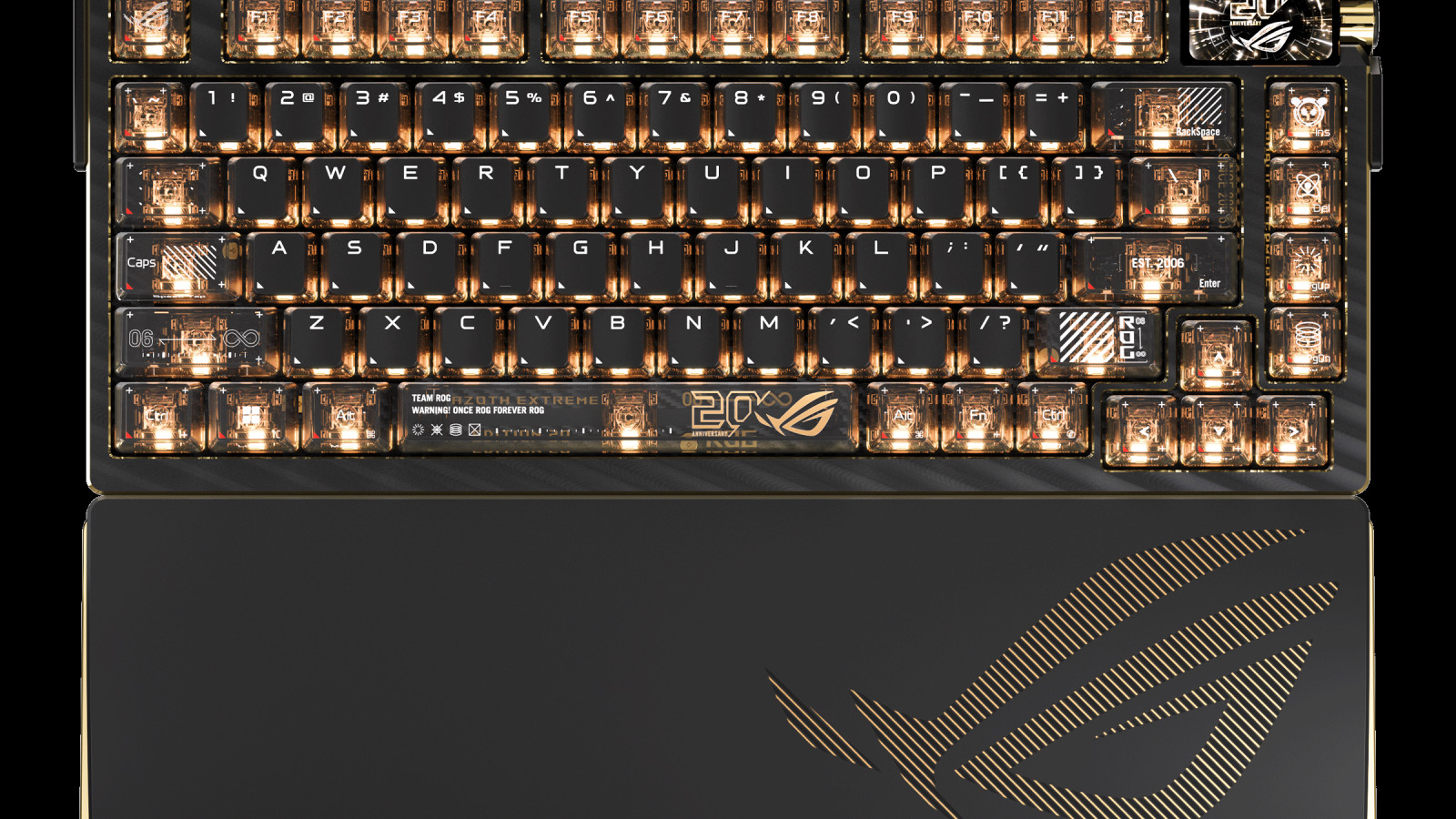
The ROG Azoth Extreme Edition 20 is ASUS' $600 anniversary 75% keyboard. It combines a carbon-fiber positioning plate, hot-swappable ROG NX mechanical switches, a color OLED, three connection modes, and polling up to 8,000 Hz. This is not an attempt to maximize performance per dollar; it is a collectible flagship where construction and finish matter more than rational pricing.
Carbon and Chassis Mass
The carbon plate holds the switches and shapes key feel. Several damping layers sit below it to suppress hollow metallic resonance. At roughly 1.5 kilograms, the keyboard is unlikely to move across a desk.
The compact layout keeps the function row and arrow keys while removing the number pad. That is a practical balance for games and writing, although full-size users will need to move some commands onto shortcuts.
Switches and Stabilizers
Hot-swap sockets allow compatible mechanical switches to be replaced without soldering. The included ROG NX set provides a finished profile, but the deeper value is the option to change force and sound later without replacing the chassis.
Translucent black keycaps support the anniversary appearance. The unusual finish stands apart from ordinary PBT sets, though a rare design is harder to reproduce if an individual cap is damaged.
Wired, Bluetooth, and 2.4 GHz
USB, Bluetooth, and 2.4 GHz wireless are available. Wired or the dedicated radio link is the logical choice for competitive play; Bluetooth suits multiple devices. A mode control lets one keyboard move between work and play.
ASUS claims up to 1,600 hours of battery life in its most economical scenario. Actual endurance depends on OLED use, lighting, polling, and connection mode, so the maximum does not describe every feature running together.
Who Needs 8,000 Hz
An 8,000 Hz rate reports to the PC more frequently than 1,000 Hz. In theory that reduces the interval between reports, but the gain is measured in fractions of a millisecond and depends on the rest of the input, game, and display chain.
For most users, switch quality, wireless stability, and layout comfort are easier to notice. High polling makes sense inside an already optimized system, not as a standalone reason to buy.
OLED, Collectibility, and Price
The color OLED reports status and serves as a settings interface beside a multifunction control. A gold-plated anniversary nameplate and limited finish make the collectible intent explicit.
At $600, the buyer pays for unusual construction, materials, and presentation rather than a proportional improvement in game results. As a technical showcase the Edition 20 is persuasive; as a universal recommendation it is far too expensive. Sources: ASUS Republic of Gamers; ASUS Pressroom; PC Gamer; Tom's Hardware.
Аналитика MBG
