
Resizable BAR on Z87 and H87: reBART brings modern GPU memory addressing to Haswell platforms
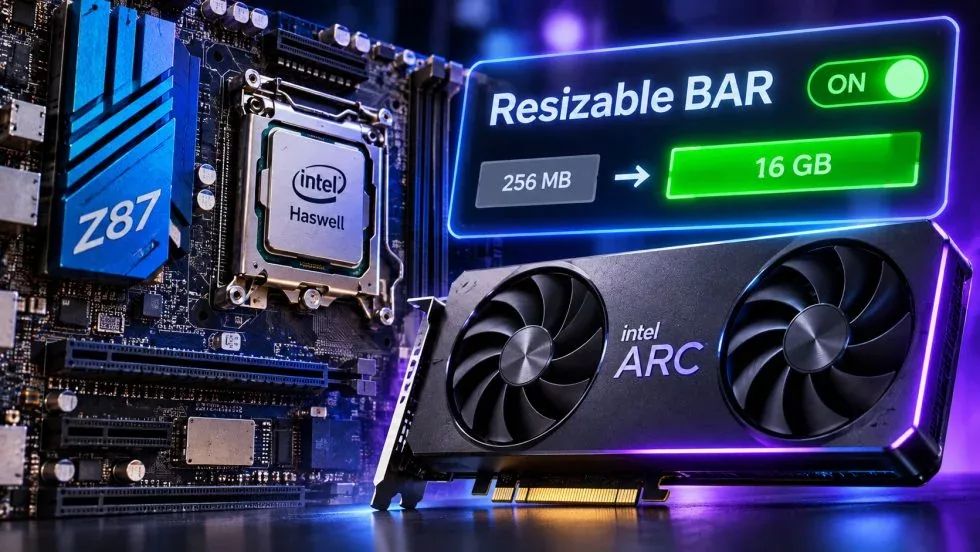
A new open-source project named reBART is bringing Resizable BAR support to Intel 8-series motherboards, a feature that was never originally intended for these chipsets. By bypassing specific firmware limitations that prevent proper memory addressing above the 4 GB boundary, reBART allows users to utilize modern GPUs—including Intel Arc B580 and A750—on aging Haswell-based platforms with full Resizable BAR functionality enabled.
Resizable BAR (ReBAR) is a technology that allows the CPU to directly address significantly larger portions of video memory (VRAM). In traditional PCIe configurations, the CPU typically operates through a small window, often limited to 256 MB, which only makes a fraction of the VRAM visible at once. With ReBAR, depending on the hardware, a large portion or even the entire VRAM can be integrated into the CPU's address space, potentially improving performance in many modern titles.
The 4 GB Addressing Gap in Intel 8-Series
The issue with Intel's 8-series chipsets (such as Z87, H87, Q87, B85, Q85, and H81) is more fundamental than simply a missing BIOS toggle. According to the developer of reBART, the platform firmware fails to provide a suitable MMIO (Memory-Mapped I/O) region above the 4 GB mark, and the Host Bridge does not report the necessary 64-bit decoding. Interestingly, this required firmware code was present in both the preceding 7-series and the subsequent 9-series, but was omitted in the 8-series implementation.
Because of this architectural oversight, simply unlocking a hidden 'Above 4G Decoding' option in the BIOS is insufficient for Z87 or H87 boards. The necessary address space must be actively established during the boot process. Consequently, reBART operates at a much deeper level than many other ReBAR modifications, intervening directly in the UEFI boot sequence.
How reBART Works and Installation Risks
The reBART UEFI driver waits for the firmware to complete the initial GPU initialization. Once complete, the driver re-programs the Base Address Register (BAR), opens the Prefetchable Window of the upstream PCIe bridge above the 4 GB boundary, and moves the GOP (Graphics Output Protocol) framebuffer to the new address. This allows the operating system to boot with the expanded BAR configuration already in place.
This process is significantly more complex than a standard BIOS update. Users must extract and patch the motherboard's DSDT (Differentiated System Description Table), insert the reBART driver as an FFS (Firmware File System) module into the UEFI, and then flash the modified BIOS. Additionally, the system requires a 64-bit operating system, UEFI/GPT boot mode, and CSM (Compatibility Support Module) must be disabled.
While the project aims to support discrete graphics cards from NVIDIA, AMD, and Intel, it carries substantial risks. A poorly patched or incompatible UEFI can render a motherboard unbootable, potentially requiring an external flash programmer for recovery. Reports have already surfaced of users experiencing failed boots after attempting similar modifications on older boards.
Real-World Application: Intel Arc on Haswell
The practical utility of this project is most evident with Intel Arc GPUs, which rely heavily on Resizable BAR for optimal performance. Testing on a Gigabyte GA-Z87M-D3H equipped with a Core i7-4771 under Ubuntu demonstrated successful operation: an Intel Arc A750 reported an 8 GB BAR, while an Arc B580 reported a 16 GB address window. While this confirms that the feature is technically active, actual performance gains in gaming or specific applications remain to be measured on this specific platform.
Гика
