
PC GPU Shipments Rise 10.4% in Q2 Despite High Prices
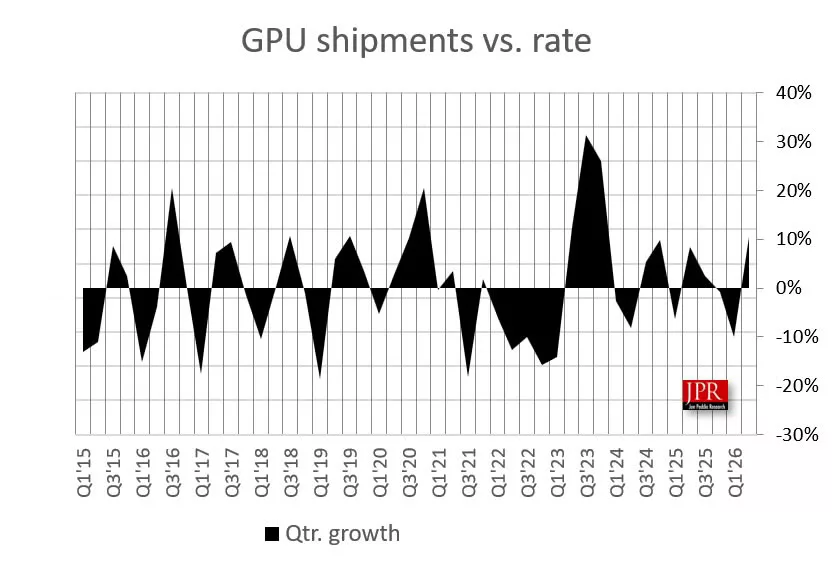
Despite record-high pricing, PC GPU shipments increased by 10.4% quarter-over-quarter in Q2, according to data from Jon Peddie Research. The total volume reached 75.5 million units, marking a slight 1.1% year-over-year increase compared to Q2 2025. This growth was primarily driven by a 16.8% surge in laptop GPU shipments, which offset a 4% decline in desktop discrete GPU shipments. While Intel remains the market leader with a 56% share, its position is gradually eroding, whereas NVIDIA and AMD have seen modest gains in market share.
The recent report from Jon Peddie Research (JPR) highlights a counterintuitive trend in the PC graphics market: despite what the industry describes as record-high prices, the total number of PC GPUs shipped has actually risen. This data challenges the common assumption that high costs inevitably suppress demand. Instead, the figures suggest that the market is undergoing a structural shift in how and where GPUs are deployed. The overall increase of 10.4% compared to the previous quarter indicates robust underlying demand, but a closer look reveals that this growth is not uniform across all product categories.
Market Dynamics: The Laptop Driver
The primary engine behind the Q2 shipment increase was the laptop segment. JPR data shows that laptop GPU shipments surged by 16.8% quarter-over-quarter. This significant jump was sufficient to drive the total market volume up to 75.5 million units. In contrast, the desktop discrete GPU segment, which traditionally represents a high-value portion of the market, experienced a 4% decline over the same period. This divergence underscores a broader industry trend where the majority of PC shipments are now occurring in the mobile form factor rather than in traditional desktop towers.
When comparing year-over-year performance, the total PC GPU market showed a modest 1.1% increase relative to Q2 2025. This suggests that while the quarter-over-quarter momentum is strong, the long-term growth rate has stabilized. The reliance on laptop shipments for volume growth is a critical factor for manufacturers, as it shifts the focus from high-margin discrete desktop cards to integrated graphics and mobile discrete GPUs.
Vendor Landscape: Intel, NVIDIA, and AMD
In terms of market share, Intel continues to dominate the PC GPU market, accounting for 56% of total shipments. This leadership is largely attributed to the ubiquity of integrated graphics in Intel’s client CPUs. Most modern Intel processors include some form of integrated graphics, which means that a vast number of laptops and desktops ship with an Intel GPU, even if the user does not perceive it as a dedicated graphics card. This structural advantage allows Intel to maintain a massive volume share despite not being a primary player in the high-end discrete desktop GPU market.
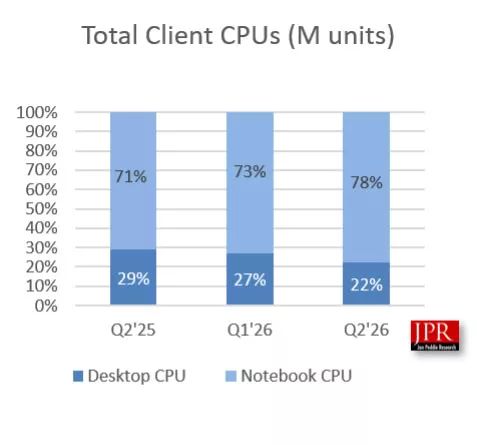
However, Intel’s position is not static. The report indicates that Intel’s market share decreased by 1% quarter-over-quarter and dropped by approximately 5% year-over-year. This erosion suggests that competitors are gaining ground in the integrated and mobile GPU segments. Meanwhile, NVIDIA saw a slight increase in its market share, rising by 0.46% quarter-over-quarter. AMD also experienced a modest gain, with its market share increasing by 0.6% in the same period. These small but consistent gains for NVIDIA and AMD indicate a gradual shift in the competitive balance, particularly in the mobile and integrated graphics sectors where Intel has traditionally held a strong lead.
CPU Shipments and Form Factor Shifts
The JPR report also provides insights into CPU shipments, which are closely linked to GPU trends. In the client segment, AMD CPU shipments increased by 12.74%, while Intel CPU shipments rose by 8.99%. Both companies are seeing growth, but AMD is expanding its share at a faster rate. This trend in the CPU market mirrors the dynamics seen in the GPU sector, where AMD is making inroads into a market previously dominated by Intel.
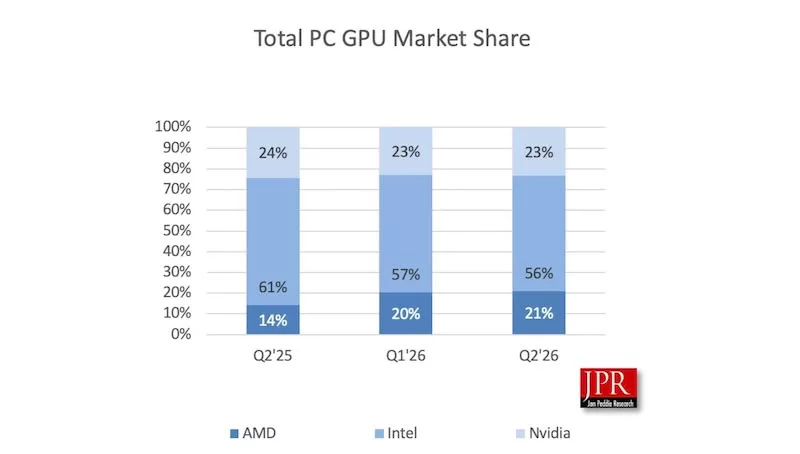
A recurring theme in recent quarters is the declining proportion of desktop CPUs in total shipments. Currently, desktops account for only about 22% of total CPU shipments, while laptops represent a record-high 78% of the client CPU market. This shift has profound implications for the GPU market, as it means that the majority of GPUs shipped are now integrated into mobile platforms. This structural change favors manufacturers who have strong integrated graphics offerings and mobile discrete GPU solutions, rather than those focused solely on high-end desktop cards.
Implications for the Industry
The data from Jon Peddie Research paints a picture of a PC market that is increasingly mobile-centric. The growth in GPU shipments, despite high prices, is driven by the volume of laptop units rather than the value of desktop units. This shift has several implications for GPU manufacturers. First, it highlights the importance of integrated graphics and mobile discrete GPUs in driving overall market volume. Second, it suggests that the high-end desktop market, while still significant in terms of revenue, is a smaller portion of the total unit count. Third, it indicates that competition in the mobile and integrated segments is intensifying, with AMD and NVIDIA gaining share at the expense of Intel.
For Intel, the challenge is to defend its dominant position in the integrated graphics market while also competing effectively in the mobile discrete GPU space. For NVIDIA and AMD, the opportunity lies in leveraging their strengths in mobile and integrated graphics to capture a larger share of the total market. The data suggests that the future of the PC GPU market will be shaped by the ability of manufacturers to adapt to the mobile-centric nature of the industry.
Limitations and Context
It is important to note that these figures are based on shipment data, which may not fully reflect actual sales or consumer adoption. Shipment data can be influenced by inventory levels, channel stocking, and other factors that do not directly correlate with end-user demand. Additionally, the definition of a "PC GPU" in this context includes both integrated and discrete graphics, which can make direct comparisons with previous years or with other market reports challenging. The data also does not provide a detailed breakdown of specific product models or price points, which limits the ability to analyze the impact of pricing on demand in more detail.
Despite these limitations, the JPR report provides valuable insights into the current state of the PC GPU market. The key takeaway is that the market is growing, but the nature of that growth is shifting. The dominance of the laptop segment and the gradual erosion of Intel's market share are trends that are likely to continue in the coming quarters. Manufacturers who can adapt to these changes and offer competitive solutions in the mobile and integrated graphics segments are likely to be best positioned for success in the evolving PC GPU market.
Цифра
