

Modders bring VR-style foveated rendering to DLSS 5, boosting RTX 4090 performance by over 60% on ultrawide monitors
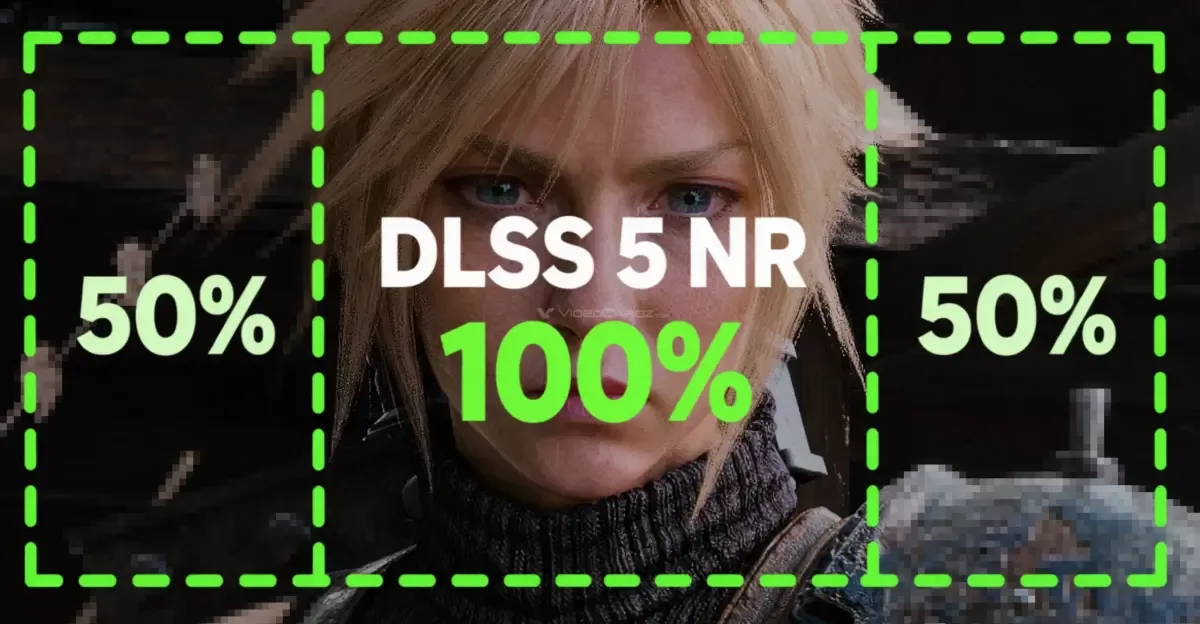
Foveated rendering, a technique widely known in the VR space, is making its way to conventional displays. Through community modifications, DLSS 5 neural rendering can now concentrate processing resources in the center of the frame, offering massive performance gains for ultrawide monitor users.
How FoveatedDLSS5 Works
Foveated rendering works by concentrating rendering resources where the user is looking, while reducing detail in peripheral areas. While VR implementations typically rely on eye tracking, the FoveatedDLSS5 mod by developer maximedgoulet uses a fixed focus in the center of the monitor.
The mod is an open-source addition to the RenoDX DLSS 5 add-on for ReShade. Instead of processing the entire frame at a uniform resolution, it compresses the image into a smaller processing grid before passing it to the AI model. This means the neural network processes fewer pixels, while the output is reconstructed at the original display resolution. At a resolution of 7680 × 2160—common for 57-inch super-ultrawide monitors—the number of pixels requiring neural network processing is reduced to approximately 71% of the original count.
RTX 4090 Performance Gains
In benchmarks conducted in The Witcher 3 using a GeForce RTX 4090 at 7680 × 2160, the results were substantial. With two neural rendering passes, performance reportedly jumped from roughly 49 FPS to over 80 FPS, representing a gain of about 63%. The developer noted that the reduction in quality toward the edges of the screen was difficult to perceive during gameplay.
This is not the first attempt to apply foveated processing to DLSS. Another project, CheekyFoveatedDLSS, already supports DLSS Super Resolution and experimental DLSS 5 neural rendering. Originally designed for VR (UEVR), it includes optional eye tracking, allowing the high-quality rendering zone to follow the user's gaze, which can further optimize performance.
Гика
