
Lexar Muse: 3.8mm Slim SSD with Magnetic Connection
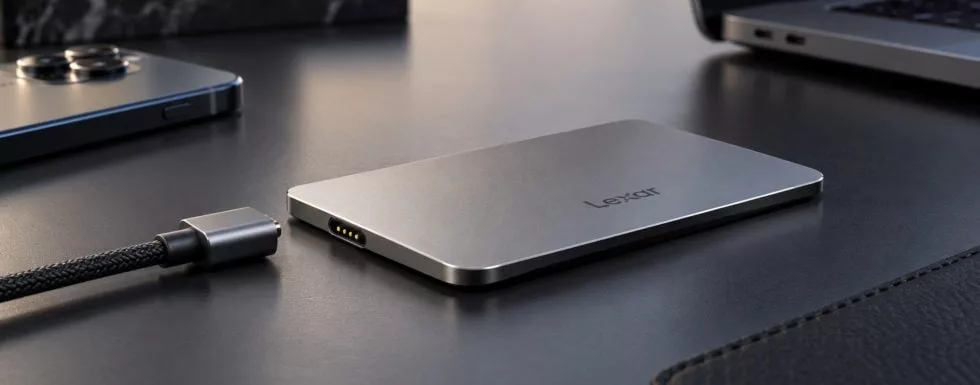
Lexar has unveiled the Muse Ultra-Slim Portable SSD, a drive that measures just 3.8 mm at its thickest point and tapers to approximately 1 mm at the edges. Presented at IFA on September 4, 2026, the device replaces the standard USB-C port on the drive itself with a magnetic Pogo-Pin connection, a design choice that enables its extreme thinness but ties users to Lexar’s proprietary accessories.
The physical construction is the primary technical focus of the Muse. Lexar utilizes a specially developed ultra-flat PCB, densely stacked NAND, and a unibody metal enclosure to achieve the 3.8 mm profile. The company claims this makes it the thinnest portable SSD currently on the market, a designation that naturally relies on Lexar’s own measurement standards. While the thickness is a notable engineering feat, the practical implications are more nuanced than a simple record-breaking metric.
Instead of a standard USB-C receptacle, the SSD uses spring-loaded Pogo-Pins for data transfer. The included SnapLink Magnetic Cable docks onto these contacts, with alignment provided by N52 Neodymium magnets. These magnets are also integrated into a magnetic sleeve that can attach to compatible MagSafe iPhones, allowing the SSD to sit directly on the back of the smartphone during video recording. The connection to the host device remains standard USB-C on the cable end, preserving compatibility with iPhones, iPads, Macs, and other USB-C devices. The proprietary interface is limited to the SSD side of the connection.
Performance specifications place the Muse in the category of fast USB 10 Gbit/s drives. Lexar lists read speeds of up to 1,050 MB/s and write speeds of up to 1,000 MB/s. These figures are sufficient for large photo archives, backups, and video files, though the drive is not positioned as a speed leader. The engineering effort is directed more toward the form factor and mobile usability than toward peak throughput.
For video creators, the Muse supports direct external recording to Apple ProRes. Lexar states that the drive can handle up to 4K resolution at 120 fps, but explicitly notes that actual resolution and frame rates depend on the specific iPhone model and settings. The requirement is an iPhone with a USB-C port, meaning at least an iPhone 15 generation device. This use case benefits significantly from the magnetic design, as the drive sits flat against the phone rather than dangling with a cable, reducing the risk of disconnection during handheld recording.
The trade-off for this design is the reliance on the proprietary SnapLink cable. If the cable is lost or damaged, users cannot simply plug in a standard USB-C cable to the SSD. Lexar has not yet disclosed the price of replacement cables or the extent of their separate availability. The drive is initially planned in 512 GB and 1 TB capacities; a 2 TB version has not been announced, despite the fact that long ProRes recordings can consume storage quickly. Regional pricing is also currently unavailable.
The Muse is scheduled for release in the fourth quarter of 2026. Lexar also plans to support automatic photo and video backups from smartphones via its own app. This positions the Muse less as a traditional PC backup drive and more as a mobile accessory for content creation. The success of the device will depend not only on its thinness but also on its price, the availability of replacement parts, and the reliability of the magnetic connection in daily use.
Гика
