

AMD Threadripper Halo Station: 96 Cores, 576 GB HBM3E
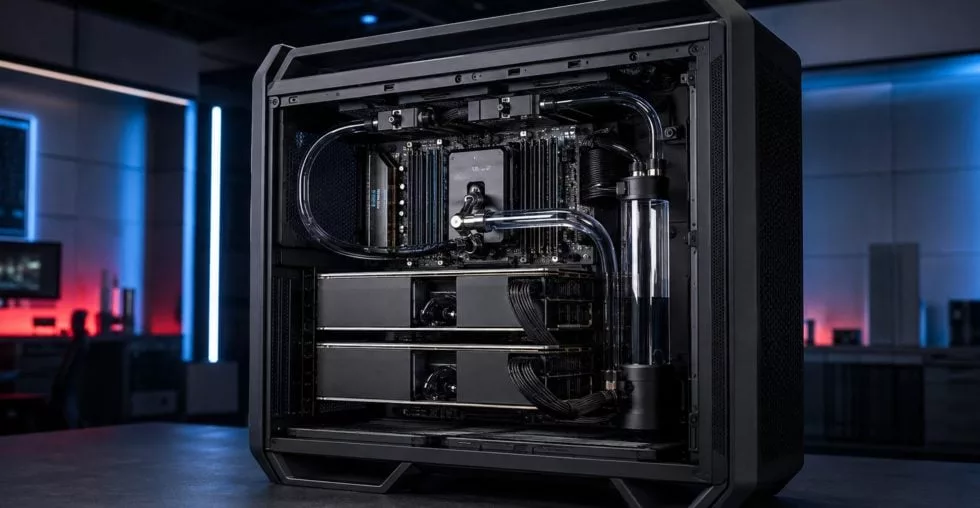
AMD unveiled the Threadripper Halo Station at IFA 2026, a fully liquid-cooled AI workstation pairing a 96-core Ryzen Threadripper PRO with two Instinct MI350P accelerators and up to 2 TB of DDR5 memory. The company plans a future configuration with four MI350P cards, bringing total HBM3E capacity to 576 GB for local inference of models exceeding one trillion parameters. No price, release date, or confirmed OEM partners were announced.
AMD presented the Halo Station on September 4, 2026, positioning it as a platform for running large AI models locally. The company described it as the "most powerful workstation in the world," a claim that remains a manufacturer statement without published comparative system benchmarks. The configuration itself is notable for combining a high-core-count CPU with multiple data-center-class accelerators in a tower chassis.
The host processor is a 96-core Ryzen Threadripper PRO, which corresponds to the Ryzen Threadripper PRO 9995WX. This chip features 96 Zen 5 cores, 192 threads, eight DDR5 memory channels, 128 usable PCIe 5.0 lanes, and a maximum boost clock of 5.4 GHz at a 350 W TDP. The system supports up to 2 TB of DDR5 system memory.
For AI acceleration, the displayed unit contains two Instinct MI350P PCIe cards. Each accelerator is based on the CDNA 4 architecture, includes 128 compute units, and carries 144 GB of HBM3E with up to 4 TB/s of memory bandwidth. Together, the two cards provide 288 GB of high-speed accelerator memory. AMD indicated that a future configuration will support up to four MI350P cards, increasing total HBM3E capacity to 576 GB. Each MI350P has a maximum total board power of 600 W, meaning two cards can draw up to 1,200 W, and four could reach 2,400 W before accounting for the CPU, memory, and other components.
The power requirements explain the shift to full liquid cooling. A four-GPU setup would theoretically consume several kilowatts, a level that exceeds the thermal and power delivery capabilities of traditional air-cooled workstation designs. AMD clarified that the platform is intended for local inference and optimization of large models, not necessarily for training them. A dense model with one trillion parameters requires approximately 2 TB of memory for weights at 16-bit precision, about 1 TB at 8-bit, and roughly 500 GB at 4-bit, excluding additional working data. The 576 GB of HBM3E in the planned four-GPU configuration allows heavily quantized models to remain largely in fast accelerator memory, while the 2 TB of DDR5 provides capacity for offloading and larger workloads.
Strategically, the Halo Station competes with NVIDIA's DGX workstation concept, both aiming to bring data-center-class AI compute to developer workstations. AMD's approach combines its Threadripper CPU platform, Instinct accelerators, and the ROCm software stack. The platform offers flexibility through a large number of PCIe lanes and conventional system memory, but it does not automatically guarantee faster performance than specialized NVIDIA systems for real AI workloads. Independent benchmarks are currently unavailable. It is also unclear whether the four-GPU configuration will use the same chassis or require larger OEM systems.
AMD has not announced a price, specific release date, or confirmed OEM partners for the Threadripper Halo Station. The availability and real-world performance of the system remain to be determined.
Гика
