
Kioxia LD4: E1.L-SSD with QLC-NAND targeting up to 122.88 TB in 1U-Server
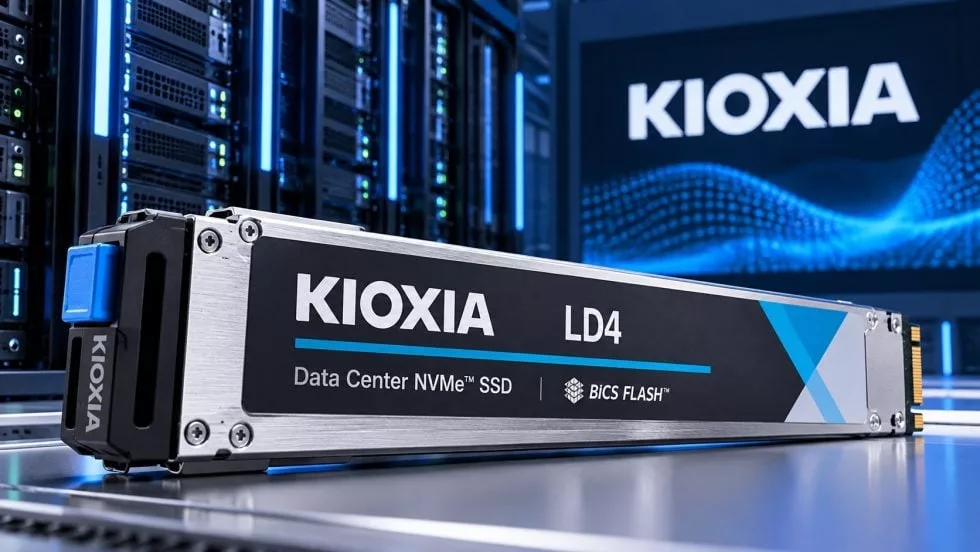
Kioxia is pushing the boundaries of storage density in data centers with its new LD4 series. These are the company's first E1.L form factor SSDs based on eighth-generation BiCS FLASH with QLC-NAND technology. The drives are specifically designed for hyperscalers and read-intensive applications where maximizing flash capacity within minimal rack space is the primary goal.
Currently, Kioxia is sampling models with capacities of 15.36 TB and 30.72 TB. However, the underlying architecture has already been validated for capacities reaching up to 122.88 TB. It is important to clarify that a 122.88 TB LD4 is not yet a mass-produced product; rather, it demonstrates that the E1.L design and NAND architecture are engineered to support such high-density classes.
E1.L vs. Traditional 2.5-inch Drives
The E1.L belongs to the EDSFF family and was built specifically for data center environments. This elongated "Ruler" form factor (9.5 mm thickness) allows for significantly more NAND and larger cooling surfaces within a 1U-Server compared to standard U.2 or 2.5-inch drives. For scale-out systems, this is a game-changer: when deploying dozens of drives per server, the leap from 30.72 TB to a potential 122.88 TB per SSD can result in several petabytes of additional storage per rack unit.
By utilizing QLC-NAND (four bits per cell), Kioxia achieves much higher density than TLC. While QLC traditionally faces challenges regarding write endurance and write performance, these trade-offs are less critical for the intended read-intensive workloads, such as AI datasets, object storage, and content repositories. This positioning allows flash to compete directly with Nearline-HDDs in storage layers where capacity and read density are paramount.
Interface and Specifications
Regarding the interface, while Kioxia labels the LD4 as PCIe-5.0 compliant, the maximum interface speed is specified at 16 GT/s over four lanes. This effectively matches the bandwidth typically associated with PCIe 4.0. For hyperscale storage systems, this is often an acceptable compromise, as capacity, power consumption, thermal density, and reliability are more critical than the peak sequential bandwidth of a single drive.
The LD4 series complies with the NVMe-2.0e specification and supports the OCP Datacenter NVMe SSD Specification 2.6. This ensures standardized telemetry and management functions across massive drive fleets. The use of a single-port design further emphasizes its focus on scale-out architectures rather than traditional dual-port enterprise storage.
Kioxia is expected to showcase the LD4 series at the OCP Global Summit in San Jose, scheduled for October 12–15, 2026.
Гика
