Intel Unveils Diamond Rapids Details and D270 GPU at SC26
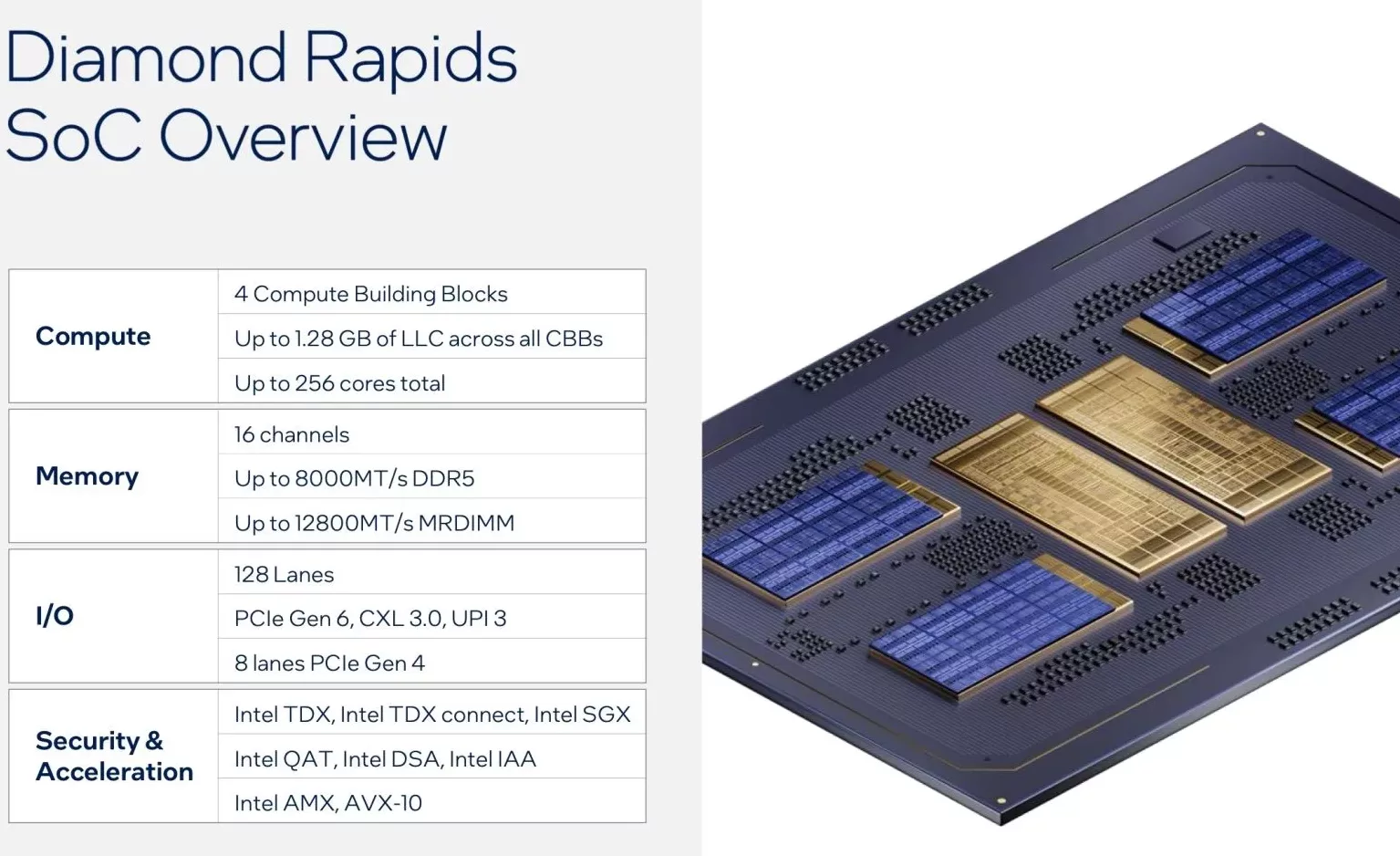
During Supercomputing 2026 (SC26), Intel provided a deeper look into its roadmap for high-performance computing, unveiling new technical details for the upcoming Xeon Diamond Rapids generation and the D270 GPU. While the server processors focus on massive core density and expanded cache hierarchies to tackle scientific simulations, the D270 is positioned as a specialized accelerator designed primarily for AI inference, though it retains significant capabilities for traditional HPC workloads through robust FP64 support.
Intel's Diamond Rapids architecture represents a major evolutionary step for the Xeon lineup. Building on the preliminary details shared at Hot Chips earlier this year, this new generation is designed to scale up to 256 performance cores. The architecture aims to significantly boost both computational density and memory bandwidth compared to current Xeon offerings. A key highlight is the implementation of a unified memory fabric capable of reaching up to 1.6 TB/s of bandwidth, bringing Intel's throughput capabilities in line with AMD's EPYC-9006 series. To further accelerate scientific modeling and complex simulations, Intel is integrating a massive Last-Level Cache (LLC) with capacities reaching up to 1.28 GB, ensuring large datasets remain closer to the processing cores.
The instruction set architecture (ISA) is also seeing significant updates. Intel confirmed support for AVX10.2 and enhanced implementation of Advanced Matrix Extensions (AMX) to handle AI workloads more efficiently. Furthermore, the introduction of Advanced Performance Extensions (APX) will provide additional registers and expanded instructions to streamline specific computational operations. By combining wide vector units with integrated matrix acceleration, Intel intends to address both classical HPC applications and modern AI-driven workloads, though specific power consumption figures and absolute TFLOPS performance metrics remain undisclosed in this announcement.
Intel D270 GPU: High Capacity via LPDDR5X
The D270 GPU, previously known under the codename Crescent Island, is a specialized accelerator built on the Xe3P architecture. It features 32 Xe cores and 256 Xe Matrix Extensions (XMX), supporting a wide array of data formats including FP4, MXFP4, and FP64. Notably, full FP64 throughput is achieved via the vector units, with Intel reporting 64 FP64 Fused-Multiply-Add (FMA) operations per Xe core. While clock speeds and theoretical TFLOPS were not specified, the architecture's versatility is evident in its data format support.
A standout feature of the D270 is its memory configuration. Intel's base implementation utilizes 160 GB of LPDDR5X memory with a 1.5 TB/s bandwidth. To differentiate from high-end accelerators that rely on HBM (High Bandwidth Memory), Intel is leveraging LPDDR5X to provide massive capacity while maintaining compatibility with conventional server integration. Additionally, partners will be able to offer custom configurations with up to 480 GB of memory. The air-cooled PCIe card is rated at a 350 W power draw.
HPC Benchmarks and AI Inference Strategy
Although optimized for AI inference, the D270's FP64 support makes it a viable option for specific HPC tasks. Intel presented application-specific benchmarks from the financial sector, involving Binomial and Black-Scholes models as well as Monte Carlo simulations. In these tests, the D270 reportedly achieved a throughput 1.92x to 5.9x higher than the NVIDIA RTX PRO 6000 Blackwell Server Edition. It is important to note that these are application-specific measurements using optimized implementations (SYCL/MKL for Intel and CUDA for NVIDIA) rather than a direct comparison of theoretical peak FP64 performance.
In seismic analysis benchmarks involving a 3D grid with one billion points, the D270 reached a throughput of 45.91 billion grid points per second, outperforming the Intel Arc Pro B70 (22.52 billion points per second) by a factor of 2.04. For AI workloads, the 256 XMX units and support for low-precision formats like FP4 and MXFP4 are intended to maximize throughput. The massive memory capacity (up to 480 GB) is designed to keep large LLM models and datasets directly on the accelerator, reducing the need for frequent data transfers. While specific tokens-per-second metrics for LLMs were not provided, Intel is demonstrating a 'Disaggregated Inference' concept alongside SambaNova, where GPUs handle the compute-intensive prefill phase while SambaNova's RDUs manage the decode phase, orchestrated by Xeon-6 processors.