
Gigabyte AI TOP 100 B850: Ryzen 9 9950X vs RTX 5090 or Dual Radeon AI PRO R9700
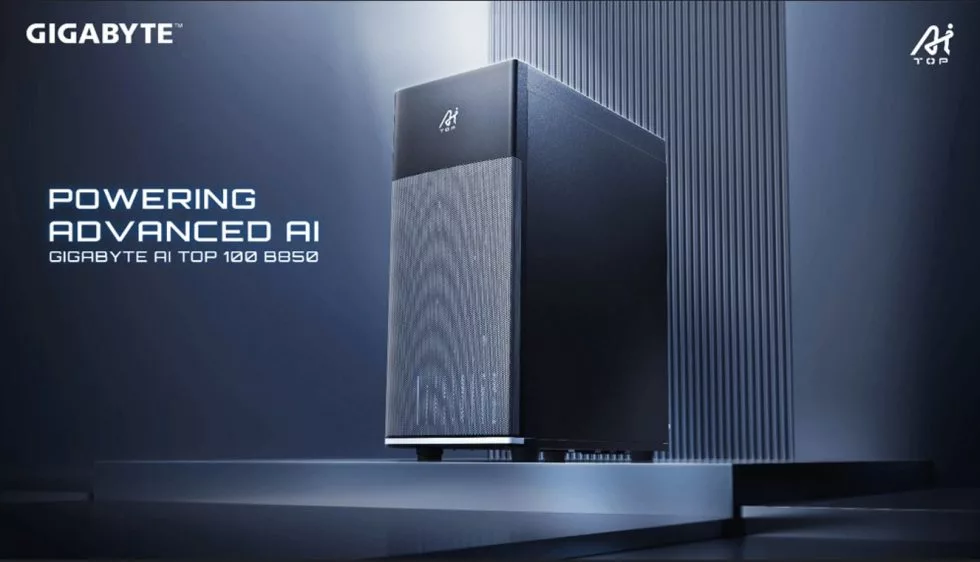
While many manufacturers use "AI PC" as a marketing buzzword, GIGABYTE is delivering actual hardware capable of heavy-duty local AI workloads. Following its debut at Computex 2026, the company has released the full specifications for the AI TOP 100 B850, a desktop workstation designed specifically for running large language models (LLMs).
Two Strategies: Speed vs. VRAM Capacity
The system offers two distinct GPU configurations to cater to different AI needs. Users can choose a single NVIDIA GeForce RTX 5090 with 32 GB of GDDR7 memory, or a dual-setup featuring two AMD Radeon AI PRO R9700 cards, each providing 32 GB of GDDR6. This provides a choice between the established CUDA ecosystem and massive total video memory.
The RTX 5090 variant is optimized for high inference speeds, leveraging NVIDIA's widespread software support. In contrast, the dual Radeon AI PRO R9700 configuration provides a combined 64 GB of VRAM. It is important to note that this is not a single unified 64 GB memory pool; software must support multi-GPU scaling to distribute model weights across both accelerators effectively.
Hardware Architecture and Scalability
At the core of the system is the 16-core AMD Ryzen 9 9950X (Zen 5 architecture) with AVX-512 support. The platform is built on the AMD B850 chipset and features two PCIe 5.0 x16 slots, which is essential for providing the necessary bandwidth for the dual-GPU Radeon configuration. The system includes 128 GB of DDR5 RAM and a 2 TB PCIe 4.0 SSD.
To handle the significant power requirements, GIGABYTE has equipped the machine with a 1,600W 80 PLUS Platinum power supply following the ATX 3.1 specification. Weighing approximately 25 kg, the system is more of a professional workstation than a standard desktop PC.
Performance Benchmarks
According to GIGABYTE, the system delivers impressive performance for local AI tasks. The RTX 5090 configuration can achieve up to 65 tokens per second when running the Qwen3 32B model (in FP4 precision). The dual Radeon AI PRO R9700 setup is marketed for its ability to handle much larger models, claiming support for models with up to 235 billion parameters (based on Qwen3-235B-A22B in FP4) and fine-tuning models up to 110 billion parameters.
These performance figures are based on internal testing and are highly dependent on quantization methods, software versions, and specific settings. While the 235B parameter claim is technically plausible through 4-bit quantization, it is not a universal metric for all LLMs. Additionally, the system supports Memory Offloading, allowing parts of a model to reside in system RAM, though this results in significantly lower processing speeds compared to native VRAM usage.
Гика
