
GeForce RTX 3060 12 GB price jumps to nearly $480 in US after relaunch
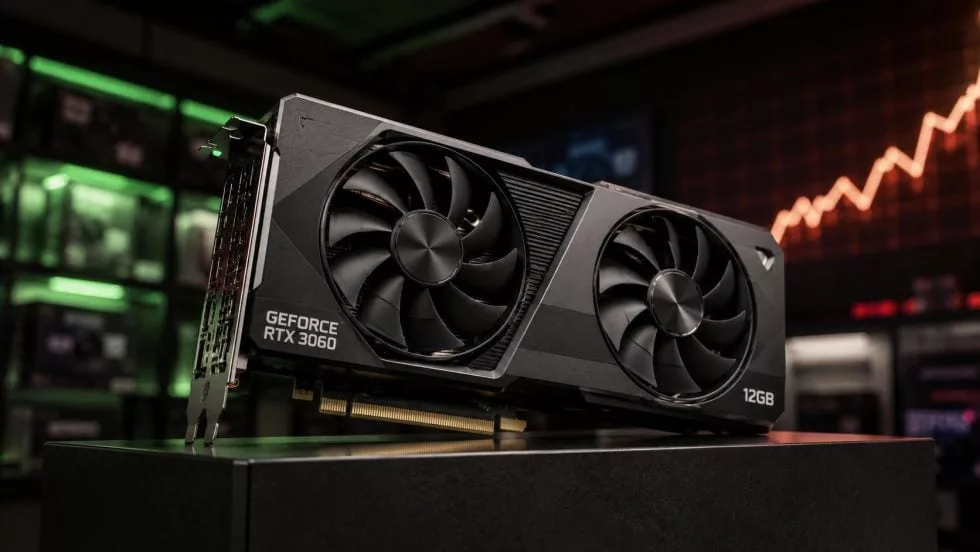
The re-released GeForce RTX 3060 with 12 GB of GDDR6 memory has returned to the US market at a significantly higher price point, now costing nearly $480 for an MSI Ventus 2X model. This represents a sharp increase from its original launch price and current pricing on newer architectures, raising questions about its value proposition for gamers and creators alike.
According to retailer data from Newegg, the specific MSI GeForce RTX 3060 Ventus 2X 12G OC model has risen in price by approximately 45 percent since its return. The card is now listed at $479.99, a stark contrast to the $329.99 price point observed just weeks prior in July 2026. This surge moves the graphics card well above the recommended starting price of $329 set by Nvidia when it was originally introduced in January 2021.
The pricing trend is not isolated to this single model. Other re-released RTX 3060 variants from Asus and Gigabyte are also being listed for over $400, indicating a broader market shift rather than an anomaly specific to one manufacturer. However, the official MSRP has not been officially updated by Nvidia, meaning these higher prices reflect current retailer pricing strategies influenced by limited stock availability and supply chain dynamics.
Technically, the re-released card remains unchanged from its original specifications. It utilizes the Ampere architecture with 3,584 CUDA cores, a boost clock of 1.78 GHz, and 12 GB of GDDR6 memory connected via a 192-bit interface. While the generous 12 GB memory capacity is a notable feature compared to many modern entry-level cards that offer only 8 GB, it does not automatically translate into superior raw performance.
In terms of gaming performance and value, the current price makes the RTX 3060 less competitive against newer generations. The GeForce RTX 5050, for instance, is available for around $299.99 in US listings, offering a significantly lower entry cost alongside a more modern architecture that delivers better frame rates in current titles. Similarly, the RTX 5060 from the Blackwell generation supports advanced features like Multi Frame Generation and offers superior computational power.
The extra memory on the RTX 3060 is beneficial for specific workloads such as video editing, 3D rendering, or local AI tasks where exceeding 8 GB of VRAM could cause performance bottlenecks. However, for pure gaming, the older Ampere architecture lacks hardware-accelerated Frame Generation and other modern optimizations found in newer GPUs. Consequently, paying nearly $480 for a re-released card places it in a price bracket where buyers typically expect significantly faster performance.
Manufacturers like Palit have also introduced new RTX 3060 models, such as the Infinity 2 OC, which maintain the same core specifications and memory configuration. Despite these technical similarities, the market reality is that consumers are increasingly prioritizing newer architectures over legacy hardware with larger memory pools when the price gap widens so drastically.
Ultimately, the decision to purchase a re-released RTX 3060 depends heavily on individual needs. For users requiring specific high-memory applications where the Ampere architecture is sufficient, the card might still hold value. However, for gamers seeking the best price-to-performance ratio or those wanting access to modern features like DLSS 3 and Frame Generation, the current market prices make newer alternatives a more compelling choice.
Гика
