

FM27 Review: A Refined Masterpiece After the Unity Transition

The transition to the Unity engine was a double-edged sword for Sports Interactive. While it promised a new era of visual fidelity, the fallout from the canceled FM25 and the subsequent backlash against FM26's radical UI overhaul left the community skeptical. FM26 was a necessary, albeit painful, experiment in redesigning a decades-old interface. Now, with FM27, the studio has moved past the 'first-year model' defects. Much like a car manufacturer releasing a refined facelift after an initial redesign, Sports Interactive has listened to a year of player frustration and delivered a product that finally feels like the series we know—only significantly better.
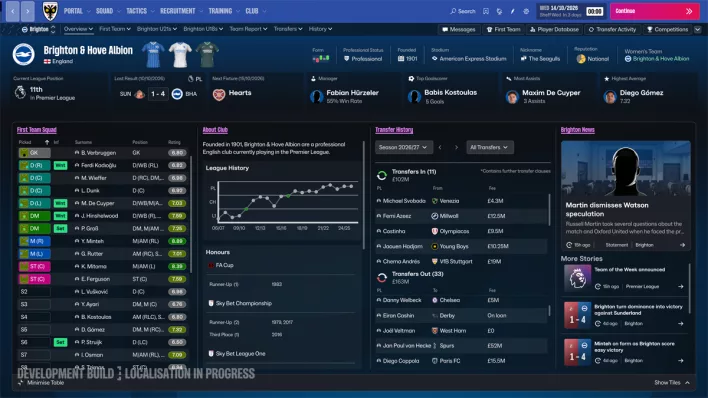
The core of the Football Manager experience has always been the synthesis of vast amounts of data to build a winning club. In FM26, that process was hampered by a tile-centric UI that forced players to hunt through menus, causing immense fatigue. FM27 fixes this by returning to an intuitive, top-down navigation system. Core categories—Portal, Squad, Tactics, Recruitment, Training, and Club—are now arranged side-by-side at the top of the screen, with sub-menus allowing seamless toggling between the First Team and Youth Teams. The tiles haven't disappeared, but their purpose has changed: they are now dedicated to information summaries rather than acting as confusing navigation links.
The quality-of-life improvements are substantial. The inbox has been redesigned so that scout reports unpack directly within the message body, and when multiple clubs bid for a single player, you can compare terms at a glance. Other much-needed additions include bookmark reordering, key remapping, and customizable 'Continue' button frequency for news and inbox items. It is a relief to see the 'navigational stress' that plagued the previous title effectively eliminated.
Efficiency, Familiarity, and Predictability
In a pre-launch interview at GGX in Seoul, Associate Game Director Rémy Boicherot explained the philosophy behind this redesign. The goal was to balance the benefits of the new engine with 'efficiency, familiarity, and predictability.' Boicherot noted that while some players enjoyed the experimental tile layout of FM26, the priority was ensuring that players wouldn't have to 'relearn how to use chopsticks' every time they opened the game. The focus remains on the gameplay, not the interface, ensuring the flow of management remains uninterrupted.
This return to familiarity doesn't mean a lack of progress. The benefits of the Unity engine are fully realized here: loading speeds are crisp, and UI elements scale perfectly to any monitor resolution. Furthermore, the Data Hub has seen the return of essential features that were missing at launch in FM26, such as real-time in-match heatmaps, pitch coverage areas, and player pass networks. It feels like the engine is finally working for the player, rather than the player working to accommodate the engine.
A Living Matchday Experience
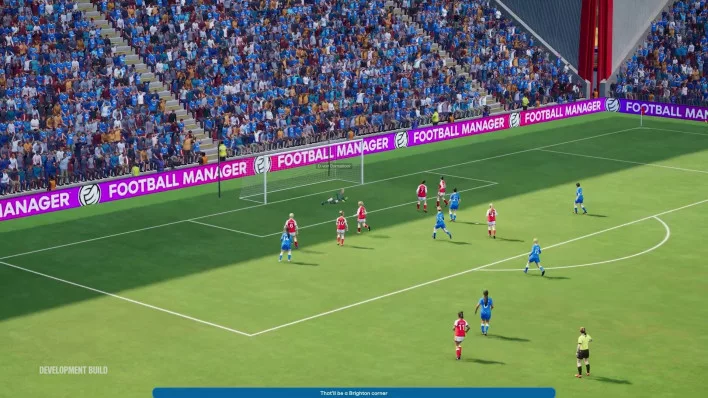
Visually, FM27 moves away from the 'static background' feel of its predecessor. The stadium atmosphere has been significantly polished, with real-time weather and time progression affecting the scenery. You can watch the sun dip and floodlights flicker on during an afternoon kickoff, or see snow accumulate on the pitch during a winter match. The architectural variety of stadiums and the dynamic camera angles during player walkouts add a layer of professional polish that was previously lacking.
The most striking improvement, however, is the crowd. According to Boicherot and Senior PR & Product Executive Andrew Sinclair, the art team prioritized spectator representation. Fans now wear clothing that reflects the season and weather, and the distinction between home and away sections is clear. Most impressively, the crowd reacts to the match's emotional weight; if a team is suffering a heavy defeat, you can actually see disappointed fans packing up and leaving the stands before the final whistle. It transforms the match from a mere simulation into a living, breathing event.
Tactical Depth: Beyond Familiarity
The most significant mechanical shift is the introduction of 'Tactical Effectiveness,' which replaces the old 'Tactical Familiarity' system. This is a much more holistic metric, calculating how well players understand instructions, their ability to execute specific roles, their adaptability to your philosophy, and their pre-match intelligence regarding opponents. This depth is supported by a new 'Tactical Complexity' layer: as you give more detailed instructions, you must use dedicated first-team training sessions to refine specific movements, such as high pressing or playing out from the back. Even scout reports have been upgraded, allowing you to see exactly how a target player fits into your specific tactical setup before you make a move.
The End of the 'Overpowered Tactic' Era
For years, veteran players have relied on a predictable loop: max out Tactical Familiarity and then run a single, proven 'overpowered tactic' for several seasons without significant adjustment. FM27 aims to break this cycle through a fundamental overhaul of how instructions translate to pitch performance. According to Director Boicherot, the previous familiarity system failed to capture the nuance of a manager's vision. In the past, implementing a high-intensity style like counter-pressing was as simple as a single click; in reality, it requires a synchronized effort from the entire squad to close gaps and offer cover.
The new Tactical Effectiveness system introduces a much-needed layer of complexity. Success is no longer just about the tactic itself, but about managing the intersection of training schedules, team cohesion, player attribute nuances, and Tactical Complexity. If a manager attempts to implement a high-intensity system before the squad has the necessary cohesion, they must now actively manage weekly training sessions to compensate. If the squad lacks the tactical intelligence to execute a complex instruction, the manager faces a difficult choice: scale back the instructions or use the transfer window to find specific profiles. It is a demanding, high-stakes decision-making chain that makes the game feel significantly more challenging and, crucially, more like real-world management.
However, this depth comes with a learning curve. As a newly introduced mechanic, the system can be volatile. Minor tactical tweaks can cause effectiveness to wobble, leading to frustrating transition periods. While this provides a satisfying sense of hands-on control for those who enjoy micro-managing training and instructions, it may prove tiresome for players who prefer a more 'set and forget' approach. As this is an inaugural feature, the long-term viability of this system will depend heavily on how developers address early balance issues and flaws in upcoming patches.
The Modding Ecosystem: From Facepacks to Generative AI
While the base game provides a solid foundation with a familiar UI and improved optimization, the true evolution of FM27 is happening in the modding community. During a joint interview, Andrew Sinclair clarified Sports Interactive's stance: while licensing restrictions prevent official mod support, the studio has no intention of restricting voluntary, user-created mods. This open environment has allowed for a surge of innovation, particularly with the integration of generative AI.
The most striking advancements are seen in tools like 'RegenerateFM,' which uses AI to render high-quality portraits for generated youth players (regens). These aren't static images; the AI updates the portraits as players age, adding facial hair or more mature features, allowing managers to see a 17-year-old prospect evolve into a 30-year-old veteran through their profile photos. This level of immersion was previously unimaginable.
Furthermore, interactive AI mods are transforming the role-playing aspect of the game. Using the 'FMLE' real-time editor, the AI head analyst 'Eri' can read live save data to provide tailored analysis on contract renewals or transfer targets via a chat window. Even more ambitious is 'AI FM Chat,' which expands press conferences and team talks. By using external APIs, it allows for custom player input—managers can type or speak their own words, and players/journalists respond dynamically, generating unique news articles and fan commentary. These mods are filling the niche gaps left by the base game, turning FM27 into a highly customizable simulation platform.
The transition to FM27 represents more than just a standard incremental update; it is a fundamental restructuring of the series' core architecture. After years of iterative changes, the developers have finally committed to a complete overhaul that addresses long-standing criticisms regarding engine rigidity and data processing speed. This isn't merely a facelift for the UI; it is a rebuild of the underlying simulation logic that dictates how every match, transfer, and tactical nuance is calculated.
The Engine Rebuild: Simulation vs. Presentation
The most significant achievement in FM27 is the decoupling of the match engine from the tactical simulation layer. In previous iterations, the sheer weight of calculating real-time player movement often compromised the depth of the long-term simulation. By optimizing the way the game processes data in the background, the developers have allowed for a much more granular tactical experience. You can feel the difference in how player fatigue and tactical instructions interact during a match; the response to mid-game changes feels immediate and logically consistent with the player's attributes, rather than being a pre-determined outcome of the simulation's 'hidden' math.
However, this depth comes with a caveat. The increased complexity of the simulation means that the hardware requirements have shifted. While the game remains playable on mid-range setups, the 'full overhaul' isn't a free lunch. Players with older hardware may find the increased CPU load during the passage of time—specifically during the rapid progression of seasons—to be more taxing than in previous entries. It is a trade-off of raw speed for simulation fidelity.
Tactical Nuance and Player Agency
Tactically, FM27 moves away from the 'meta' dominance that plagued earlier versions. In the past, certain tactical setups were objectively superior due to how the engine interpreted player roles. In this new iteration, the engine respects the nuances of player instructions and individual player traits much more effectively. A player's specific instruction to 'tackle harder' or 'dribble more often' actually manifests in their movement patterns and decision-making on the pitch, rather than being a statistical modifier that only affects their success rate in a vacuum.
This increased agency creates a more unpredictable and, consequently, more rewarding experience. You can no longer rely on a single 'perfect' formation to carry you through a season. Success now requires a deeper understanding of how your specific squad's attributes interact with the tactical instructions you provide. It is a steeper learning curve, but for the hardcore enthusiast, it is the most satisfying version of the game to date.
The Verdict: Is the Switch Worth It?
The decision to move to FM27 is ultimately a question of whether you value the depth of the simulation over the familiarity of the old system. For those who felt the previous games were becoming too predictable or 'solved,' this is the definitive answer. The overhaul has successfully addressed the core issues that have been debated in the community for years. While the learning curve is steeper and the hardware demands are higher, the payoff is a game that finally feels like a true, living simulation of football management.
Ultimately, FM27 earns its 8.5 rating by delivering on the promise of a revolution rather than a mere revision. It is a bold, necessary step forward for the franchise.
Зануда
