The 16-Year Orbit: How Faraway Evolved from a Simple Prototype into an Audiovisual Journey

For some developers, a game is a product; for others, it is a persistent obsession. Steph Thirion’s Faraway is the latter. After a concept first glimpsed in the early days of smartphone gaming, the project has undergone a sixteen-year metamorphosis, evolving from a simple one-button prototype into a sophisticated audiovisual experience. This is the story of how a quest for simplicity led to a decade-long journey of technical reinvention and creative refinement.
The concept of Faraway first appeared sixteen years ago, during the initial surge of mobile gaming. It was a brief, enigmatic glimpse: a 30-second trailer featuring a comet hurtling through the unknown. At the time, the mechanics were a mystery—was it an arcade game, an endless runner, or a cosmic sandbox? All that was certain was the name and the creator: Steph Thirion, the designer behind the early mobile hit Eliss.
The Legacy of Eliss and the Search for Feeling
Thirion’s previous work, Eliss, was defined by its difficulty to describe. It was a game driven by tactile, almost non-verbal interaction—moving colorful shapes through touch controls in a way that felt right, even if it wasn't immediately rational. Reflecting on that period, Thirion recalls the 'Cambrian explosion' of the indie scene, where innovation felt constant and the potential for new ideas was boundless.
The genesis of Faraway was rooted in a moment of personal inspiration. While in the French countryside, looking up at the stars, Thirion found himself dreaming of a game that allowed players to fly through that very firmament in a 2D space. This vision took a concrete shape at GDC 2010, when he began prototyping a game designed to be controlled with a single button, utilizing physics-based movement around stars.
Sixteen Years of Refinement
The timeline of Faraway is not a straight line of continuous work, but rather a series of ambitious leaps interrupted by life. After the initial prototype in 2010, the project saw a seven-year hiatus before Annapurna Interactive stepped in to provide the support needed to realize its full potential. This partnership transformed the project from a low-resolution pixel art game into something far more ambitious.
The evolution of the game's aesthetic required a complete technical overhaul. Thirion aimed to move from 'procedural low-resolution' to 'procedural infinite resolution,' resulting in a smooth, almost vector-like visual style. This shift necessitated a total rewrite of the game in a new engine to ensure the high-fidelity visuals remained performant.
The Tetris Paradox: Complexity vs. Depth
At the heart of the long development cycle was a philosophical question: why do games grow in complexity and quantity rather than staying simple and going deep? Inspired by the timeless, compelling nature of Tetris, Thirion became obsessed with finding the balance between a minimal rule set and a deep, engaging experience. He wanted to create something that remained compelling whether played for two hours or a thousand, a pursuit that led him into a deep rabbit hole of experimentation.
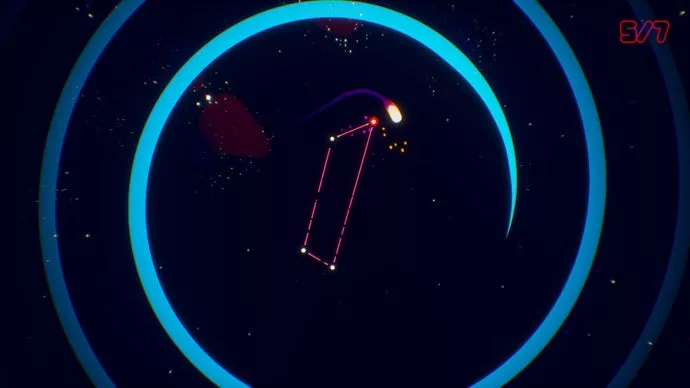
Faraway is a game centered entirely around a comet. You inhabit the role of this celestial traveler, though your control is indirect. The interaction is remarkably minimalist: there is only one button. By pressing it, you bind the comet to the gravity of a nearby star. Holding the button allows you to remain gravitationally bound, using the stars to adjust your course, trajectory, and speed. Releasing the button sends you drifting back into the depths of space toward the next star system.
From this singular mechanic, the game constructs a series of challenges that are simple to grasp yet difficult to describe. It is an experience that blends elements of precision movement, pattern recognition, and survival. While the atmosphere is serene and beautiful, there is an underlying sense of desperation in the attempt to navigate the void. The movement feels fluid; the arc of the comet bends and flexes as you manipulate its trajectory, creating a sense of bending elemental forces to your will. The orbital paths themselves, revealed when holding the button, possess a geometric, Spirograph-like elegance.
The philosophy of the void
The game's themes touch upon the vastness of space and the hostile nature of the universe—concepts like the Wow! Signal, the Great Attractor, or Tabby's Star. It is a meditation on the scale of existence. This sense of cosmic wonder is shared by the creator, Thirion, who notes that the game stems from a fascination with the universe's unanswered questions and its inherent beauty.
Thirion suggests that while the exact meaning of the game may be open to interpretation, it touches on fundamental existential questions: Why are we here? Why is life so short, or so long? It is a reflection on the luck of finding beauty in a universe that is often indifferent or incomprehensible.