

Fake Ryzen 9 9900X3D: No Silicon Found Under the Heatspreader
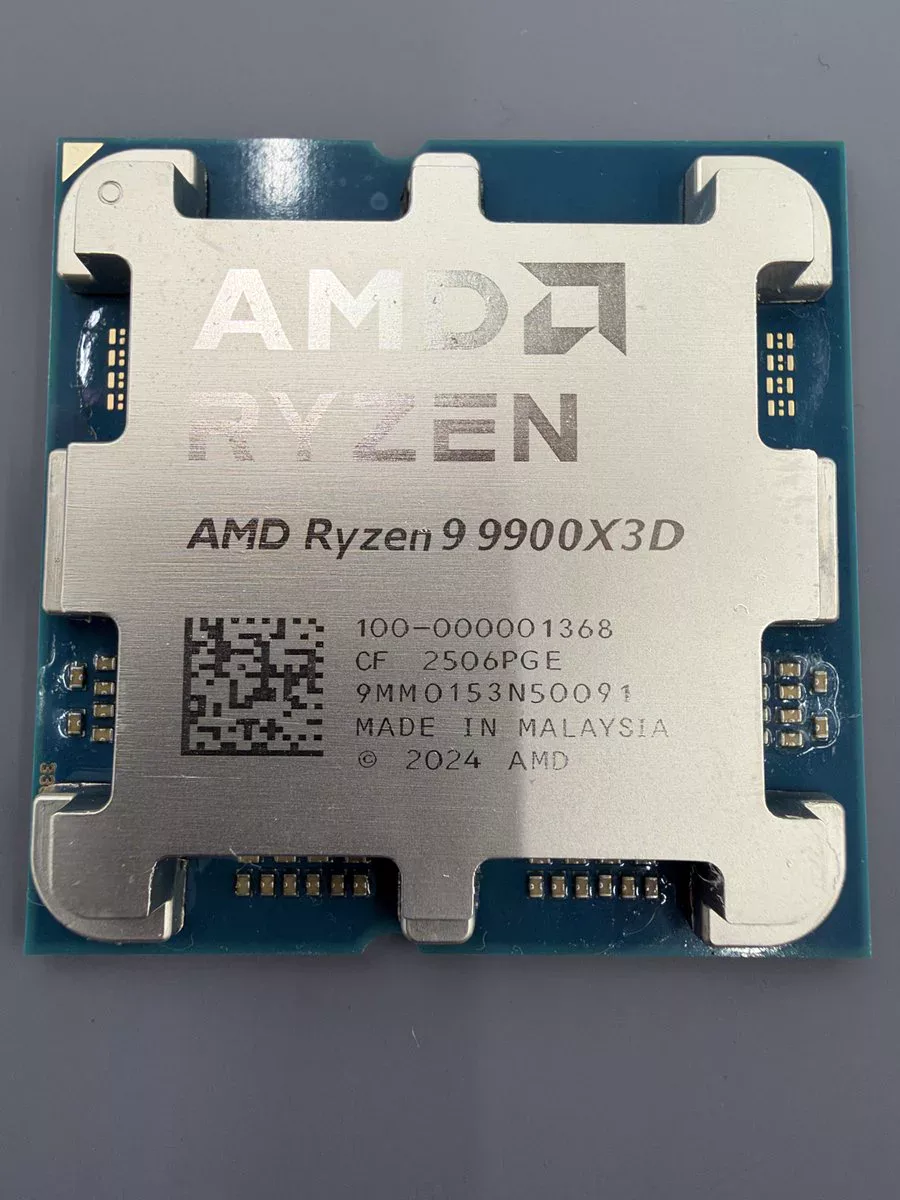
In a startling case of hardware fraud, a Japanese retailer has uncovered a counterfeit Ryzen 9 9900X3D that is essentially a hollow shell. Upon removing the integrated heatspreader (IHS), investigators found that the package contained no silicon at all—no compute dies and no I/O die—making it a completely non-functional piece of hardware designed solely to deceive buyers.
The Japanese PC retailer PC One’s recently shared findings after a customer brought in a suspected counterfeit Ryzen 9 9900X3D for examination. While the processor appeared legitimate at first glance, subtle discrepancies in the heatspreader's laser engraving—specifically regarding font style, line thickness, and the execution of the model name—raised suspicions. When compared side-by-side with an authentic unit, the differences became evident, though the retailer noted that such nuances might be difficult for an average consumer to spot without a genuine reference model.
A Completely Empty Substrate
The true extent of the deception was revealed only after the heatspreader was removed. While a legitimate Ryzen 9 9900X3D should feature two Zen 5 CCDs (Core Complex Dies) and a separate I/O die—providing a total of 12 cores and 24 threads, with one CCD featuring 64 MB of stacked 3D V-Cache—the counterfeit was entirely empty. The substrate beneath the metal cover contained no functional components, meaning there was no silicon to perform any computations.
It remains unclear how these fraudulent units are being manufactured. Experts suggest two possibilities: either the original dies were removed from a genuine substrate before the IHS was reattached, or a completely empty, non-functional package was used as the base for the scam. Currently, there are no recorded measurements regarding weight differences that could serve as a reliable verification method for consumers.
The Risks of High-Value Counterfeits
Counterfeit processors are a recurring issue, and high-end X3D models are particularly attractive targets for scammers due to their high market value. This specific case highlights that even a visual inspection of the packaging or the IHS might not be enough to guarantee authenticity. While opening a heatspreader can reveal the truth, it is not a recommended method for consumers, as it destroys the CPU and voids all warranties and legal guarantees.
To mitigate risks, experts advise being extremely cautious when purchasing from unknown private sellers or platforms lacking robust buyer protection. While sealed retail packaging offers a higher layer of security, it is not foolproof, as the integrity of the entire supply chain cannot always be verified.
Гика
