EpiPad: Radar-based armband turns skin into a touchpad
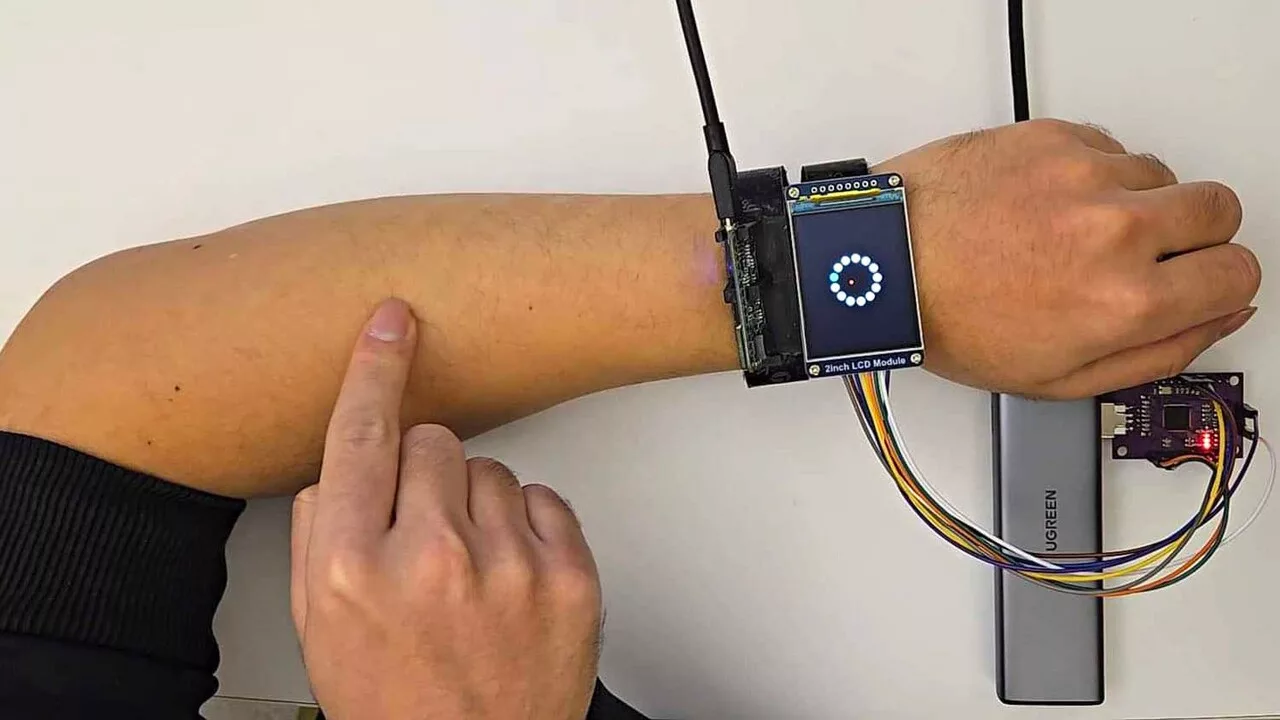
Interacting with small UI elements on a smartwatch can often be a frustrating task requiring extreme precision. To address this, researchers at North Carolina State University have developed a prototype called EpiPad—a radar-based armband designed to transform the user's forearm into a functional touchpad.
The EpiPad system utilizes millimeter-wave radar to detect minute deformations in the skin caused by finger pressure on the forearm. By analyzing changes in reflected radar signals through machine learning, the software can determine both the position and movement of the fingers. This technology enables the system to recognize individual fingertip taps, swipes, and multi-finger gestures, such as pinching to zoom on a map. Additionally, the system is capable of detecting pressure-dependent commands based on how hard the user presses against the skin.
The hardware implementation is remarkably compact, with the radar sensor array measuring approximately 5 × 4 mm. Crucially, the user's forearm requires no embedded sensors or technical modifications; the device relies entirely on external radar monitoring. In a study involving 20 participants, the system achieved a 92.8% accuracy rate for recognized gestures, following a brief period of individual calibration.
Calibration requirements and precision limits
Despite the high accuracy during testing, the system's performance is heavily dependent on a calibration phase. Participants had to perform a series of predefined movements to help the system adapt to their specific arm anatomy and input style. This process took an average of 3 minutes and 54 seconds. Without this individual adjustment, the recognition rate for new users dropped significantly to 56.7%.
Precision also remains a challenge for practical use. While the system correctly identified varying levels of finger pressure in 90.2% of cases, the average error in determining finger position was 10.2 mm. This margin of error could prove problematic when attempting to select very small interface elements on a screen.
The road to consumer integration
The current prototype is far from a finished consumer product. The setup consists of an armband with a protruding circuit board, and during real-time tests, sensor data was transmitted via a cable to a laptop for processing. Furthermore, physical barriers like loose clothing over the forearm can interfere with the radar's ability to detect skin movements.
Looking ahead, the researchers see potential applications in smartwatches and other wearables, including smart glasses that lack their own input surfaces. While the estimated material cost for the required electronic components is less than $10, this figure represents a manufacturing estimate rather than a projected retail price.