
CXMT Starts LPDDR6 Mass Production Ahead of Rivals
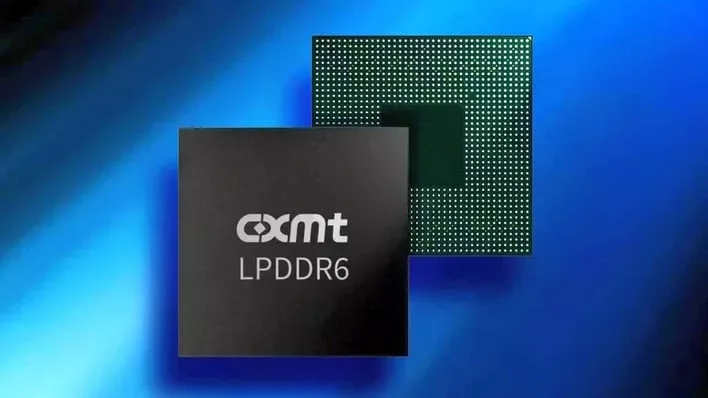
CXMT has announced the start of mass production for LPDDR6 memory, becoming the first manufacturer to do so ahead of major competitors like Samsung, SK hynix, and Micron. The announcement was made via the company's Weibo account, stating that Xiaomi's upcoming 18 Fold smartphone, launching in September, will be the first device to utilize this new memory standard.
The transition to LPDDR6 marks a significant milestone in mobile memory technology, following the introduction of LPDDR5 in 2020 with the "Qualcomm" Snapdragon 865. As demand for higher memory bandwidth continues to grow, CXMT's move positions the Chinese manufacturer as a key player in the next generation of mobile RAM. The company's announcement highlights a direct challenge to the established dominance of the traditional DRAM market leaders, who have yet to confirm similar mass production timelines for LPDDR6.
Technical Specifications and Bandwidth
Xiaomi has specified a memory transfer rate of 10,667 Mbps for the LPDDR6 interface in the 18 Fold. Combined with a 4× 24-bit bus width, resulting in a total of 96 bits, this configuration yields a peak theoretical memory bandwidth of approximately 113.8 GB/s. It is worth noting that while LPDDR6 transfers 288 bits per transaction, 32 bits are dedicated to metadata. Consequently, the actual peak bandwidth is calculated by multiplying the raw bandwidth figure by 8/9, which explains why the effective bandwidth is lower than the theoretical maximum of 128 GB/s.
This bandwidth level significantly exceeds that of desktop PCs running dual-channel DDR5 memory at 6400 MT/s. It also represents a substantial increase over most current smartphone SoCs, which typically utilize LPDDR5X memory on a 64-bit bus. Xiaomi claims that the XRING O3 SoC used in the 18 Fold offers 48% more memory bandwidth than the previous XRING O1. While this is speculative, it is possible that the XRING O3 utilizes LPDDR6 memory IP from Innosilicon, which began offering such solutions earlier this year.
Generational Progress and Desktop Outlook
It is important to note that the initial LPDDR6 speed of 10.67 Gbps is comparable to the fastest LPDDR5X speeds. However, the wider memory bus available in DDR6 and LPDDR6 standards allows for significant bandwidth improvements right from the start. The technology is expected to scale to 14.4 Gbps and beyond in future iterations. For desktop PC users, the transition to DDR6 memory is still pending, as the JEDEC specification for DDR6 has not yet been finalized. Furthermore, AMD has committed to supporting the Socket AM5 platform, which uses DDR5, through 2029. Similarly, Intel's upcoming Nova Lake platform, expected to launch at the end of this year or the beginning of next, is also slated to use DDR5. This suggests that desktop and server memory transitions to DDR6 will take several more years to materialize.
Гика
