
Biwin M560: What 11 GB/s Below 5.2 W Actually Means
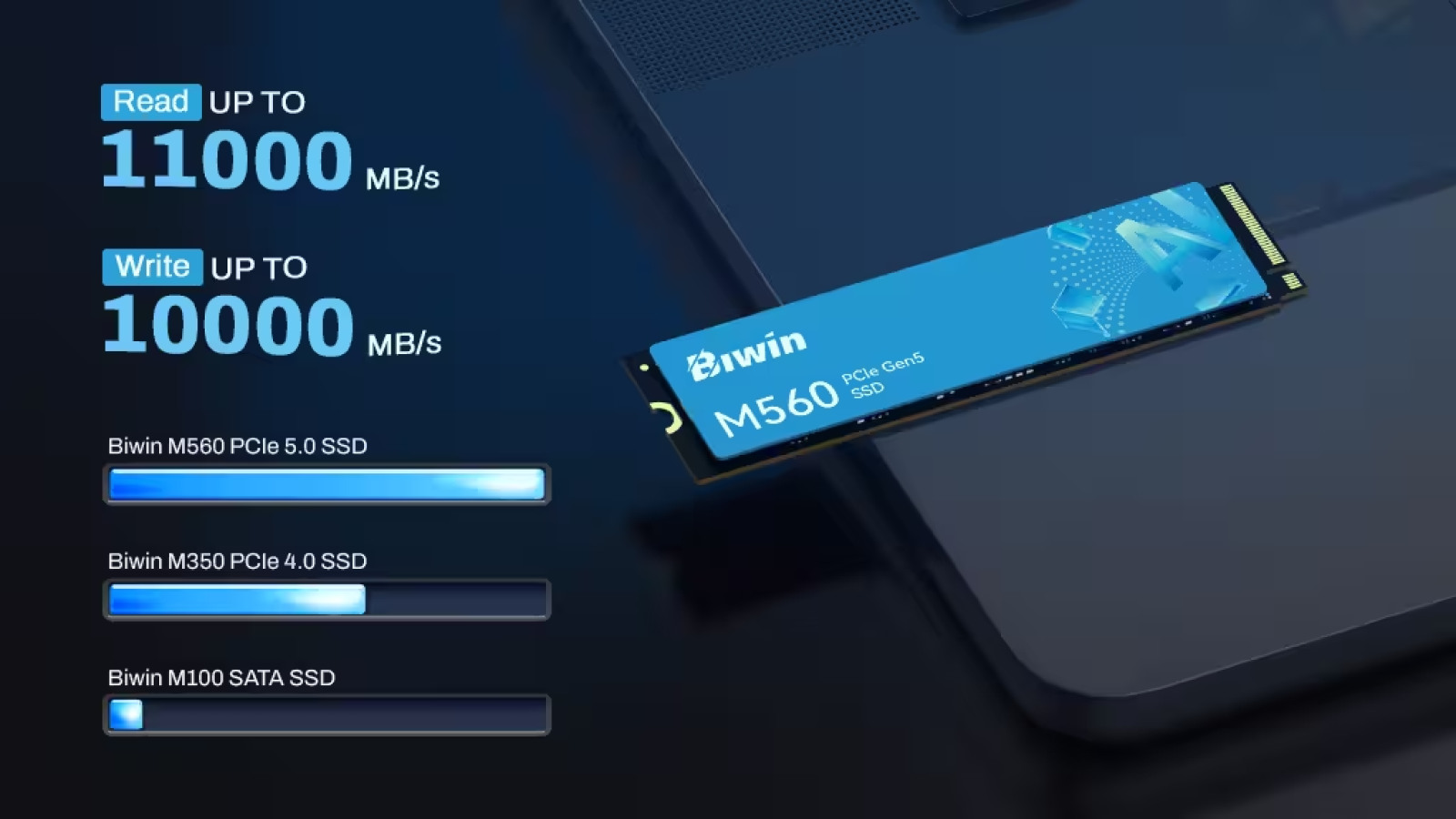
The Biwin M560 is a single-sided M.2 2280 SSD using PCIe 5.0 x4 and NVMe 2.0, aimed at balancing speed and heat rather than saturating the interface. Biwin rates it for up to 11,000 MB/s reads, 10,000 MB/s writes, and average power below 5.2 W. Initial 1 TB and 2 TB models are available.
Why SM2504XT Matters More Than the Gen5 Label
Silicon Motion manufactures the SM2504XT controller on a 6 nm process with three Arm Cortex-R8 cores and four NAND channels. It has no dedicated DRAM and instead uses Host Memory Buffer, borrowing a small portion of system memory for mapping data. That reduces board area, cost, and power.
The tradeoff appears less in a short sequential benchmark than during sustained writing, high drive utilization, and mixed queues. A peak 11 GB/s therefore cannot describe the complete behavior. Games also depend on random reads, performance after the dynamic SLC cache is exhausted, and latency during background work.
The Difference Between 1 TB and 2 TB
Both capacities are rated for reads up to 11,000 MB/s. The 1 TB model writes up to 9,700 MB/s and reaches 1.4 million read IOPS and 1.6 million write IOPS. The 2 TB version reaches 10,000 MB/s and up to 1.7 million IOPS in either direction. These are manufacturer figures, not one independent comparative test.
Endurance is 750 TBW at 1 TB and 1,500 TBW at 2 TB. The limited warranty lasts five years or until the relevant TBW is reached. Biwin also lists LDPC error correction, wear leveling, and a 1.5 million-hour mean time between failures.
Five Watts Does Not Mean No Cooling
Average power below 5.2 W is materially lower than double-digit peaks associated with some early Gen5 drives. A single-sided board measuring 80 by 22 by 2.45 mm suits laptops and compact PCs where a large SSD heatsink is impossible. It weighs less than ten grams and does not include a factory heatsink.
About five watts across an M.2 board still creates meaningful heat density. Temperature depends on the slot, motherboard heat spreader, airflow, workload, and specific NAND. Laptop buyers should check both physical clearance and whether the SSD bay includes an effective thermal pad or cover.
What a Player Will Notice
Moving from a fast PCIe 4.0 SSD to the M560 will not shorten every load by the interface ratio. Decompression, CPU work, and engine design can remain the bottleneck. Gen5 helps more with large sequential copies, installing and unpacking large packages, media work, and simultaneous heavy storage tasks.
Its value in a gaming system depends on price against proven Gen4 and Gen5 alternatives with independent tests. Initial European listings near €180 for 1 TB and €280 for 2 TB are marketplace prices rather than an official regional MSRP and may move quickly.
The Measurements Still Missing
The headline is technically plausible: PCIe 5.0, a modern controller, and TLC can deliver high speed at moderate average power. But “11 GB/s at five watts” combines different conditions. Biwin specifies average consumption below 5.2 W, while Silicon Motion discusses the controller and reference configurations below five watts.
A full recommendation needs independent temperature, sustained-write, dynamic SLC-cache, filled-drive, and latency measurements. The M560 is most interesting as evidence that mainstream Gen5 SSDs can become cooler, not yet as a proven absolute leader. Sources: Biwin; Silicon Motion; Igor’sLAB; ComputerBase.
Аналитика MBG
