
Big Walk: How Co-op Without Failure Turns Communication Into a Mechanic
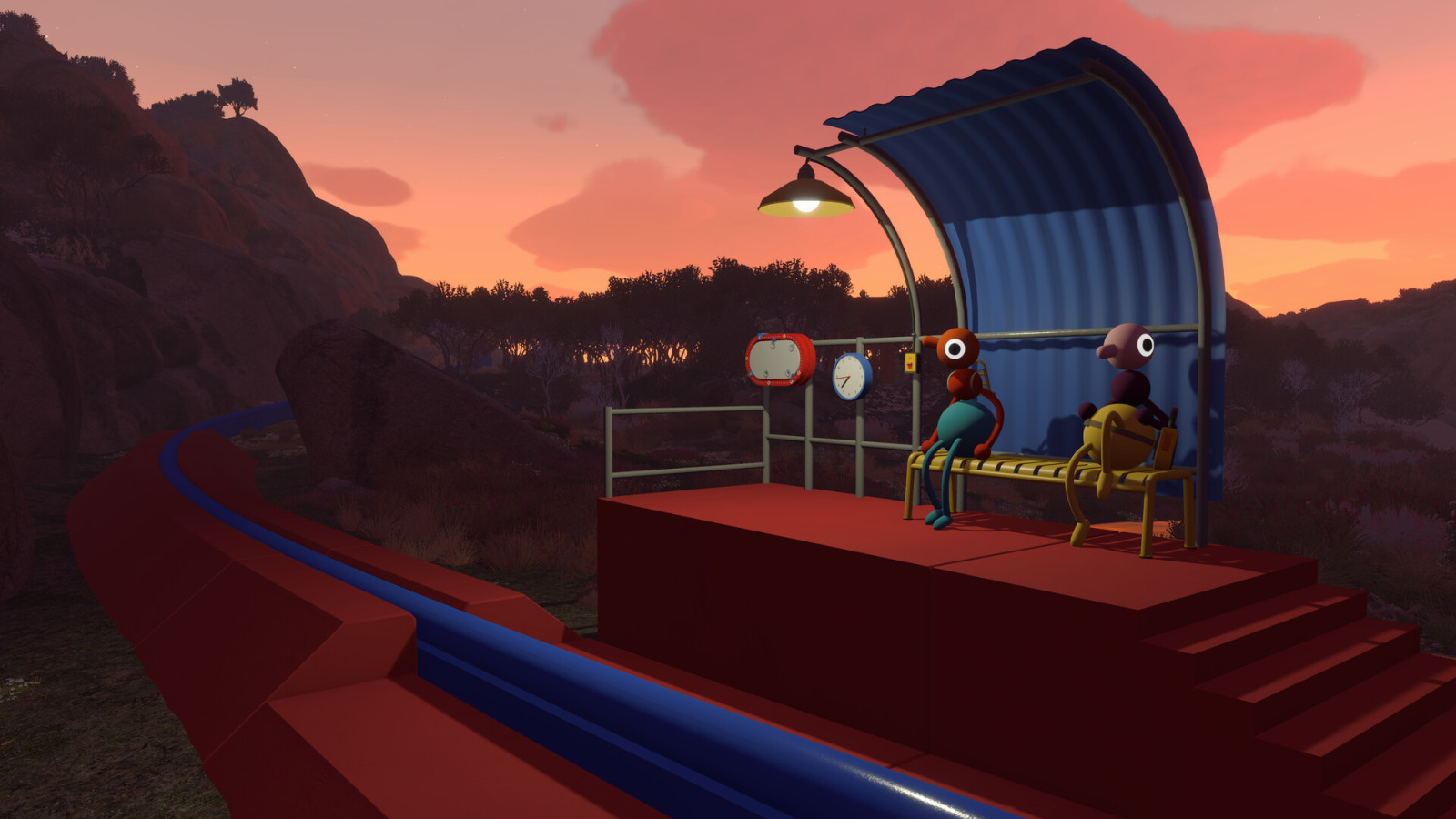
Big Walk launched on August 4, 2026, for PC, macOS, PlayStation 5, and Nintendo Switch 2. House House calls it a cooperative adventure about teamwork and talking. That description is precise: the island, puzzles, and tools primarily exist to keep a group explaining, pointing, and checking what it has seen.
Distance Changes the Voice
The built-in proximity voice system does not transmit speech uniformly from every location. Voices fade over distance, echo through corridors, become muffled by walls, and crackle through walkie-talkies. A player’s position consequently becomes part of the information. Once someone disappears around a corner, the team not only loses sight of them but also starts losing the clarity of their instructions.
This separates Big Walk from co-op games in which voice chat merely sits above play. Communication is part of the spatial design. Walkie-talkies restore contact over distance, megaphones extend reach, and gestures provide an alternative when speech is unavailable. An external voice channel removes some friction and, with it, part of the puzzle.
Tools Matter More Than Classes
Players do not select combat roles or optimize a damage composition. They find binoculars, laser pointers, walkie-talkies, flares, whiteboards, and other objects. A tool’s value depends on the situation: binoculars reveal a distant marker, a pointer connects an explanation to a place, and a whiteboard turns a spoken guess into a shared sign.
This structure supports groups ranging from two to twelve. In a small party, each person must retain more of the puzzle’s context. In a large one, information divides naturally: some explore, some relay symbols, and others test a route. Chaos emerges from meaning getting lost between people rather than from an arbitrary punishment.
Why No Death Does Not Remove Tension
Big Walk is not organized around runs, quotas, death, or a formal failure state. That does not make actions costless. A lost object, a badly described drawing, or a separated party creates a local problem that must be solved together. The game moves the cost of error from a defeat screen into the group’s time, attention, and trust.
The pace also allows pauses. Players can watch a sunset, investigate a side path, or simply stay together. The quiet can create lulls for groups expecting a constant sequence of events. It also gives a puzzle room to arise from observation instead of a countdown.
A Campaign Instead of an Endless Loop
House House describes Big Walk as a handcrafted cooperative adventure with an ending. Its island is meant for sustained exploration rather than automatic rearrangements of the same tasks. PC Gamer reported that much of the island remained after roughly six hours, while explicitly presenting those impressions as something other than a finished review.
An ending changes the meaning of a shared session. A group does not repeat one efficient pattern for another score; it builds a common history, remembers discovered places, shortens its vocabulary, and returns to unfinished routes. Cross-platform play reinforces this design because a party is less dependent on one ecosystem.
How Party Size Changes the Game
The official range of two to twelve players is more than a server-capacity setting. In a pair, any separation immediately creates an information gap, although decisions are quick. With three or four people, one participant can remain near a mechanism while the others search for missing elements. At twelve, organizing the conversation becomes more important than supplying enough hands.
Crossplay helps assemble a party but does not solve the social problem automatically. It is useful to agree on who retains discovered information, how directions are named, and when everyone returns to a shared point. Big Walk appoints no formal leader, so roles arise from the situation: the person with binoculars sees, the person with a radio connects, and the player beside a symbol verifies the instruction.
What Big Walk Offers a Community
The central bet is that conversation can be design material instead of a support function. The game suits groups that want a shared expedition and puzzles without a constant threat of losing progress. Freedom still requires self-organization: without curiosity and a willingness to listen, the island may feel too quiet.
Big Walk does not invalidate short, chaotic co-op games. It demonstrates another branch of the genre, where a funny story grows from a specific shared mistake instead of a mandatory punishment system. A complete campaign, flexible party size, and physical voice behavior make communication its defining mechanic. Sources: House House; Panic; Steam; PlayStation Blog; PC Gamer.
Редакция MBG
