
NASA and HPE are launching an AI supercomputer to the Moon
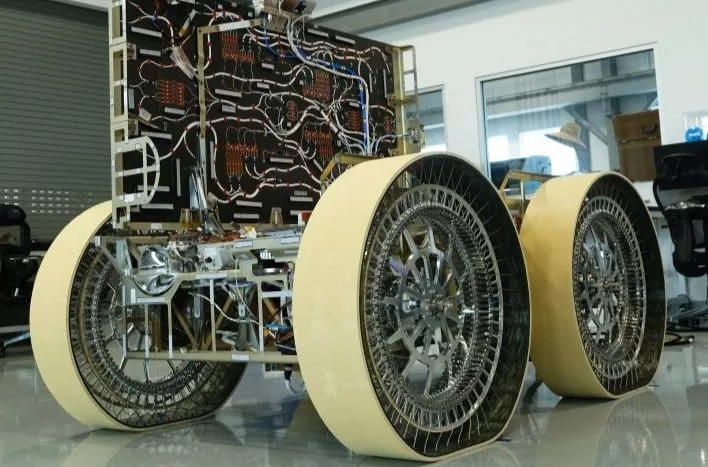
HPE is preparing to launch the first supercomputer to the lunar surface. The computing module will travel to the Moon's South Pole aboard Astrolab’s FLIP (FLEX Lunar Innovation Platform) rover. Part of NASA’s Commercial Lunar Payload Services mission, the deployment aims to establish the necessary infrastructure for deep-space exploration and the emerging lunar economy.
Hardware for extreme environments
The system, known as HPE Spaceborne Computer-4, is a compact edge computing module designed for extraterrestrial environments. It is a self-contained, fanless unit capable of processing complex datasets locally at the point of discovery. To withstand the extreme temperatures and radiation of the lunar surface, the hardware is equipped with low-power CPUs, bespoke GPUs, and flash memory from Kioxia.
During its mission at the lunar South Pole, the supercomputer will perform first-of-their-kind benchmarks, including high-performance LINPACK (HPL) tests to measure hardware performance under lunar conditions. The system is also tasked with processing LiDAR sensor data to assist FLIP in autonomous terrain analysis, mapping, and navigation. Furthermore, it will host vision inference software and run large language models (LLM) using retrieval-augmented generation (RAG) to evaluate how AI can streamline decision-making and document retrieval for future space missions.
Collaboration and cybersecurity
The mission involves significant collaboration between public and private sectors. In addition to the HPE hardware, NASA will deploy its FLUID (Federated Learning for Unbounded and Intelligent Decentralization) experiment, which coordinates three AI neural models trained on data from Earth, the ISS, and the Moon. Additionally, Deloitte will test its Silent Shield system, designed to provide cyber-analytics and anomaly detection to safeguard communications against digital threats in deep space.
Гика
