Kioxia GP2: PCIe-6.0-SSD Targeting 18M IOPS to Expand GPU Memory for AI
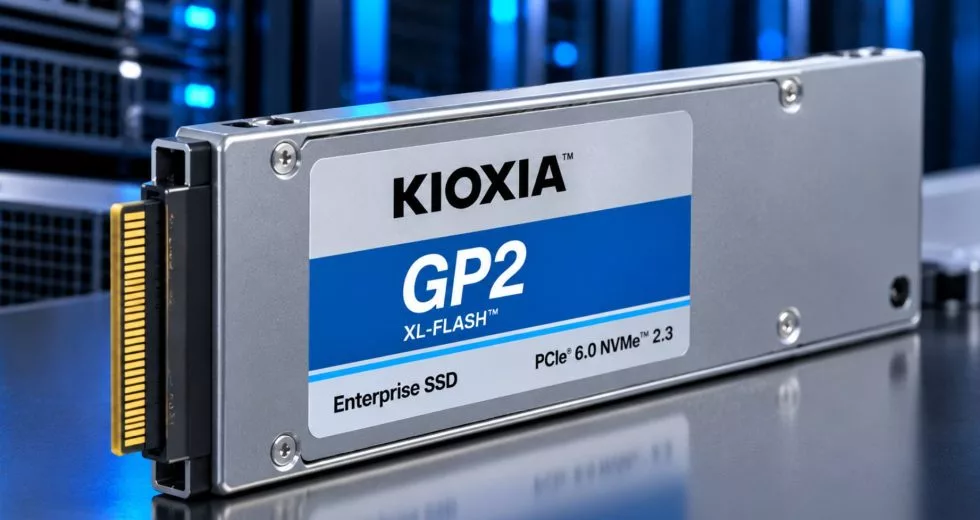
Following the unveiling of its third-generation XL-FLASH technology, Kioxia has moved from raw memory specs to a concrete product concept. The company announced the GP2 series, an enterprise SSD specifically engineered to facilitate direct data access for GPUs. This series aims to serve as a high-speed memory tier for AI systems, bridging the gap between expensive HBM/DRAM and traditional storage by handling massive datasets that are too large for local GPU memory.
The GP2 series builds upon the architecture of the GP1 series announced in August 2026, leveraging the latest iteration of Kioxia's XL-FLASH technology. This third-generation flash offers a significant leap in bit density—approximately 70% higher than its predecessor—while maintaining low read latency. This is achieved through the CMOS Directly Bonded to Array (CBA) manufacturing process, where memory cells and CMOS circuitry are manufactured separately and then bonded together to optimize performance and density.
Performance Metrics and the IOPS Context
Kioxia claims the GP2 series can achieve over 18 million random read IOPS, which is nearly double the performance of the GP1 series. However, it is critical to note the testing conditions: these figures are based on a 512-byte block size. In standard SSD benchmarks, random access is typically measured with a 4 KB block size. This distinction is vital because the actual throughput changes drastically depending on the block size used.
To illustrate the difference, 18 million IOPS at a 512-byte block size results in a calculated throughput of approximately 9.216 GB/s. If the same IOPS were applied to 4 KB blocks, the throughput would theoretically jump to 73.728 GB/s—a figure far beyond current interface capabilities. Conversely, achieving 9.216 GB/s with 4 KB blocks would require only 2.25 million IOPS. For AI applications like Graph Neural Networks (GNNs), where data structures are often accessed in small, irregular chunks, the high IOPS count at small block sizes is more critical than raw sequential speed, as it reduces the time a GPU spends waiting for data.
PCIe 6.0 and the New Memory Hierarchy
While most current high-performance drives rely on PCIe 5.0, Kioxia is jumping ahead with the GP2 series, utilizing the PCIe 6.0 x4 interface. This transition doubles the transfer rate per lane from 32 GT/s to 64 GT/s using PAM4 signaling, which allows for two bits per symbol. To maintain signal integrity at these speeds, PCIe 6.0 introduces Forward Error Correction (FEC) and Flit-based (Flow Control Unit) transmission, which adds some protocol overhead.
Kioxia expects sequential read rates to reach up to 28 GB/s, which would utilize a significant portion of the theoretical PCIe 6.0 x4 bandwidth. The series also supports the NVMe 2.3 specification. When paired with appropriate software and drivers, this setup can enable direct data transfers between the SSD and the GPU, potentially bypassing the host CPU and reducing memory copying overhead. It is important to clarify that this does not physically expand the GPU's VRAM; rather, it provides an additional, high-speed storage layer that requires specific software management to function as an extended memory tier.
Reliability and Availability
The GP2 series is designed for heavy enterprise workloads, boasting an endurance rating of up to 50 DWPD (Drive Writes Per Day). Kioxia is currently evaluating the E1.S (9.5 mm) and E3.S form factors from the EDSFF family to ensure compatibility with modern data center architectures. While evaluation samples are expected in the second half of 2027, specific details regarding capacities, sequential write speeds, and mass production availability have not yet been disclosed.
The GP2 series introduces a significant shift in how flash storage is utilized, moving away from traditional SSD use cases toward high-density data access required by AI. Kioxia is positioning this series as a potential layer to supplement expensive HBM and DRAM, providing a massive pool of high-speed storage for data that doesn't necessarily require the extreme latency of main memory but needs to be closer to the processor than standard NVMe drives.
Thermal Management and Development Status
To handle the high access density and the rapid speeds of the PCIe interface, Kioxia has announced support for direct liquid cooling. This is a critical consideration, as the SSD controller and interface electronics can generate substantial heat during intensive workloads, alongside the NAND flash chips themselves. While specific power consumption figures and the exact design of the liquid cooling solution have not yet been disclosed, the GP2 series remains a development product.
The timeline for availability varies by region. According to Kioxia Europe, selected customers are expected to receive evaluation samples in the second half of 2027. Kioxia's Japanese headquarters, however, cites a broader window for availability through the end of 2027. It is important to note that these samples may differ from final mass-produced versions, and official pricing, specific capacities, and general market availability remain unconfirmed.
Performance Metrics and Long-term Goals
The headline-grabbing figure of 18 million IOPS should be viewed with technical context: these measurements are based on a small 512-byte block size. While the manufacturer also points toward 28 GB/s sequential performance and high write endurance, these are currently theoretical values that require real-world testing in actual AI applications to verify their practical impact.
Looking further ahead, Kioxia has already set an ambitious development goal for future generations of the GP series: reaching up to 100 million random read operations per second. This target is explicitly for future products and is not a guaranteed specification for the current GP2 series.