ASUS ROG XG Station 3: Thunderbolt 5 eGPU Dock with BTF Support Debuts for €399
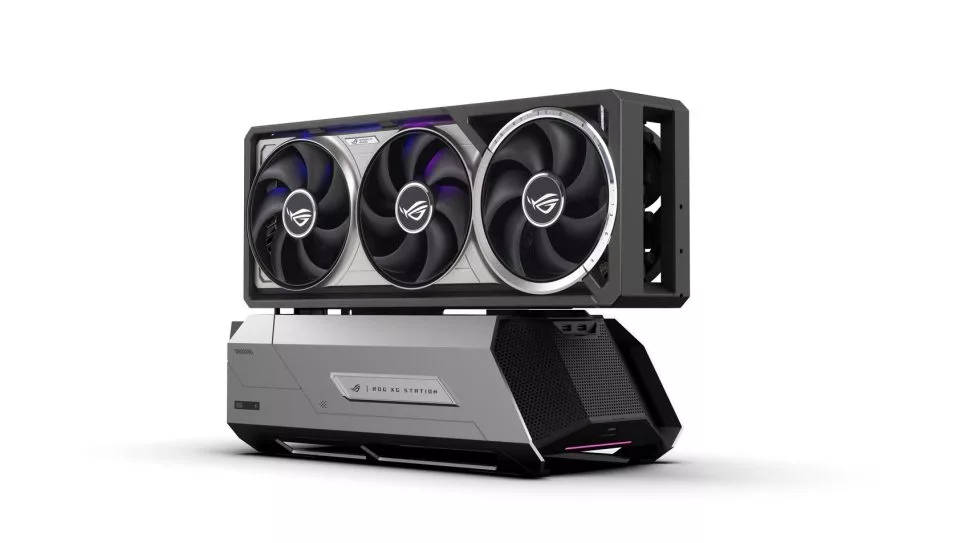
External GPU (eGPU) docks are a recurring solution for users who want the portability of a laptop without sacrificing desktop-class graphics power. ASUS Republic of Gamers has officially announced the availability of the ROG XG Station 3 in Germany, Austria, and Switzerland. This new docking station distinguishes itself with Thunderbolt 5 connectivity, an open-frame design, and support for ASUS's BTF (Back-to-the-Future) graphics cards. However, the €399 MSRP is just the starting point, as the unit requires a separate power supply and a graphics card to function.
Unlike many traditional eGPU enclosures that use a closed chassis, the ROG XG Station 3 features an open-frame construction. This design allows the installed graphics card to be fully visible and draw ambient air directly, potentially offering thermal advantages for high-TDP cards by avoiding the heat buildup common in enclosed boxes. The trade-off is a lack of acoustic shielding and increased exposure to dust, as the card's fans will be operating in an open environment.
BTF Support and Power Requirements
A standout feature is the integration of the Graphics Card High-Power Connector (GC-HPWR). This allows compatible graphics cards from the ASUS BTF-2.5 portfolio—such as the TUF Gaming GeForce RTX 5080 BTF OC Edition or the ROG Astral GeForce RTX 5090 BTF Edition—to be powered directly through the dock. These specific models eliminate the need for visible power cables on the card itself. Standard desktop graphics cards remain fully compatible via their traditional power connectors. To power the setup, users must provide their own SFX or SFX-L format power supply. ASUS recommends a minimum of 750W with an 80 PLUS Gold certification or higher, though a more powerful unit may be necessary depending on the GPU and the power draw required by the host laptop.
The Thunderbolt 5 Advantage
The most significant technical leap in the ROG XG Station 3 is the transition to Thunderbolt 5. While Thunderbolt 4 is capped at a 40 Gbps total bandwidth, Thunderbolt 5 doubles this to 80 Gbps in both directions. Furthermore, the 'Bandwidth Boost' mode can increase the unidirectional rate to up to 120 Gbps, while the return path remains at 40 Gbps. This asymmetric mode is specifically designed to handle high-bandwidth display requirements.
For eGPU users, the critical metric is the available PCIe bandwidth. Thunderbolt 5 provides up to 64 Gbps for PCIe data, which roughly equates to a PCIe 4.0 x4 connection. This is a substantial improvement over the 32 Gbps limit of Thunderbolt 4. However, it is important to note that these are theoretical maximums. Real-world throughput is typically lower due to protocol overhead and system configuration. Even with Thunderbolt 5, the connection remains a potential bottleneck for high-end desktop GPUs; the actual performance impact will depend on the specific application, rendering resolution, VRAM usage, and the frequency of data exchange between the CPU and GPU.
Connectivity and Compatibility
Beyond the GPU connection, the ROG XG Station 3 acts as a versatile docking station. The primary Thunderbolt 5 port can provide up to 140W of USB Power Delivery to compatible laptops, though high-performance gaming laptops or workstations may still require their original power bricks. A downstream Thunderbolt 5 port supports up to three 4K displays and provides up to 36W of power. Additionally, two front-facing USB-C ports offer 10 Gbps speeds for peripherals.
Compatibility requires careful checking. While ASUS mentions support for both Thunderbolt 4 and Thunderbolt 5 laptops in their FAQ, the official specification page emphasizes that the host system must explicitly support eGPU functionality. Simply having a fast USB-C port is not enough. Furthermore, while macOS is listed as compatible, users should be aware that Apple Silicon Macs do not support external desktop GPUs in the traditional eGPU manner. Users should verify their specific hardware compatibility before purchasing.
The Cost of Flexibility
At an MSRP of €399, the ROG XG Station 3 is positioned significantly higher than basic PCIe adapters. When you factor in the cost of a required SFX/SFX-L power supply and the graphics card itself, the total investment can quickly approach the price of a dedicated desktop system. The economic value of this solution depends heavily on what hardware you already own. For those who already have a high-end GPU and want to maintain a single, mobile laptop setup, the flexibility is a major plus. For those building a setup from scratch, the price-to-performance ratio may be less attractive compared to a traditional desktop.
The ASUS ROG XG Station 3 (model ROG-XG-STATION3-TB5) has officially arrived, bringing Thunderbolt 5 connectivity to the external GPU market. While the transition to the Thunderbolt 5 standard significantly improves technical prerequisites for data transfer, it is important to note that it does not entirely eliminate the inherent performance overhead compared to a direct PCIe connection. This device is primarily aimed at users who frequently switch between a mobile workstation and a stationary setup, offering a potential solution for seamless transitions.
Pricing and Market Positioning
The XG Station 3 is positioned at a starting price of €399 in the DACH region. However, potential buyers should consider the total cost of ownership: this price covers only the docking station itself. Both the power supply and the graphics card must be purchased separately. Given these additional costs, enthusiasts looking for a dedicated desktop gaming experience should carefully weigh whether a standalone PC might offer better value for the money compared to an eGPU setup.
Technical Context and Competition
The inclusion of BTF support is a notable addition for users looking to integrate modern hardware standards. In the current market, the XG Station 3 faces competition from various solutions, including the Aoostar EG02 (which offers Thunderbolt 5 and Oculink options) and the Razer Core X V2. While the Thunderbolt 5 standard provides a significant bandwidth boost, the practical utility of the device remains highly dependent on the specific use case and the overhead introduced by the external interface.