

Kioxia GP1: PCIe 6.0 SSD to Expand HBM in AI Systems
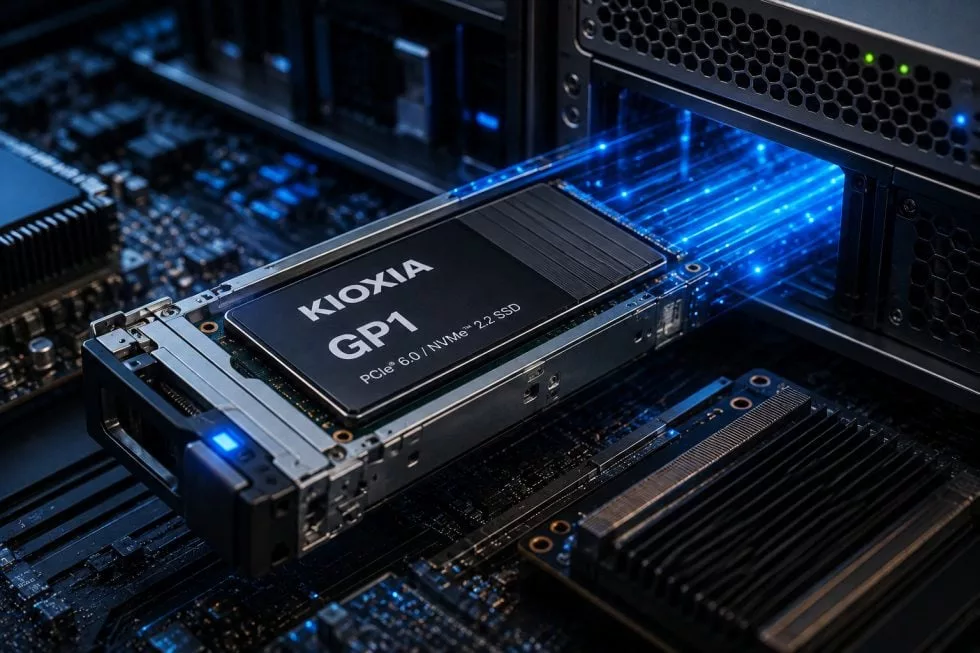
Kioxia has introduced a new line of solid-state drives, the GP1 series, which operates on the PCIe 6.0 interface and uses NVMe 2.2. The manufacturer claims these drives can handle up to ten million random read operations per second (IOPS) with 512-byte blocks. This solution is not intended for installation in regular PCs or use as a system drive; it is designed specifically for servers and AI accelerators where GPUs lack sufficient memory volume.
An Intermediate Level Between HBM and SSD
The main idea behind the new technology is to create an additional level of memory. Video cards with HBM (High Bandwidth Memory) have enormous bandwidth, but their volume is limited. Regular SSDs are cheaper and more capacious but slower. The GP1 series is intended to bridge this gap, acting as a buffer between ultra-fast HBM memory and standard storage devices.
Kioxia describes this as flash-based memory extension. This allows large datasets to be kept in close proximity to computational GPU blocks without overloading their HBM. The manufacturer links this approach to the NVIDIA Storage-Next architecture, which also assumes the use of SSDs for storing data accessed directly by the GPU.
Technical Details and Limitations
In the specified specifications, it is important to note the measurement conditions. The stated 10 million IOPS are achieved during random reads of 512-byte blocks. For comparison, regular consumer SSDs are often tested with 4-KB blocks. Converting speed to data volume gives approximately 5.12 GB/s. This is sufficient for working with small data, but the manufacturer has not disclosed random write, sequential read, or latency figures.
The drives will be released in E1.S and E3.S form factors, which are standard for servers. E1.S versions have a height of 9.5 mm or 15 mm, while E3.S has the standard 25 mm height. Kioxia states that models with high density can be connected to liquid cooling via Cold Plate, although specific power values (TDP) have not yet been published.
Durability and Power Consumption
One of the key characteristics of GP1 is durability. The manufacturer indicates a figure of 50 DWPD (Drive Writes Per Day). This means the drive can be fully rewritten 50 times per day throughout the warranty period. For comparison, regular enterprise drives withstand from 1 to 3 DWPD. High endurance makes GP1 an ideal candidate for storing temporary data (KV-Cache) that is constantly updated when working with large contexts in neural networks.
What Else Is Known
At this moment, Kioxia offers only evaluation samples, with deliveries starting by the end of 2026. Exact prices and available memory volumes are currently unknown. The manufacturer also mentions a future CM9 series that will operate on the PCIe 5.0 interface and use TLC-NAND with up to 25.6 TB capacity for tasks where volume is prioritized over access speed.
Гика
