

CXMT aims to bring DDR5-RDIMMs with 4F² cell architecture by 2026
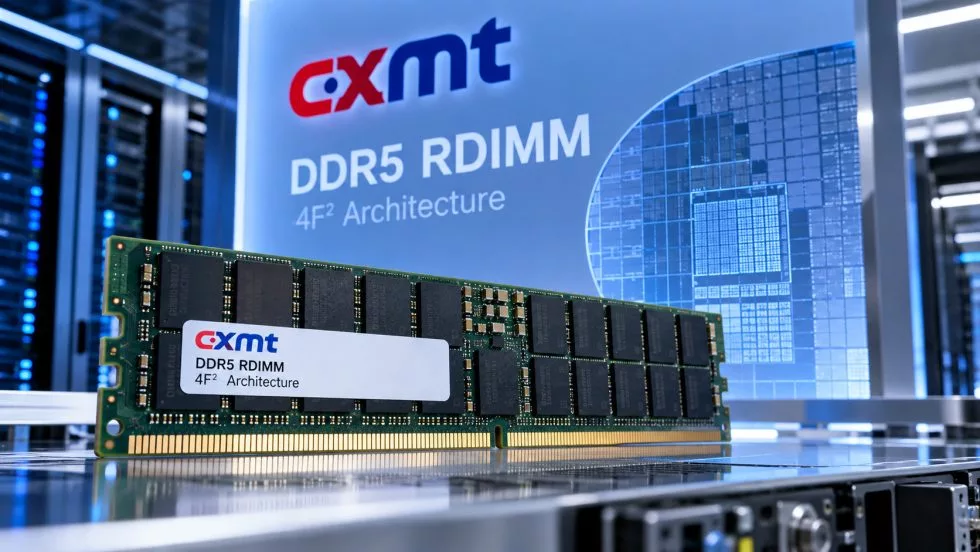
Chinese DRAM manufacturer CXMT (ChangXin Memory Technologies) intends to unveil server-grade DDR5-RDIMM based on a 4F² memory cell architecture before the end of 2026. The company confirmed this timeline during a chiplet conference in Shanghai. If CXMT successfully transitions this technology to mass production, it would be a significant technological milestone, as Samsung is currently associated with a similar 4F² structure only for 2028.
The Importance of 4F² Architecture
The core innovation lies not in the DDR5 interface itself, but in the underlying memory cell structure. Traditional planar DRAM cells are reaching their physical limits as structures shrink. The 4F² architecture is designed to significantly reduce the area per cell, allowing for higher density on a single wafer.
Moving from the standard 6F² to 4F² can theoretically increase density by 30% to 50%, depending on implementation. For manufacturers, this translates to lower cost per gigabit, higher capacities, and improved area efficiency. However, scaling down the cell size introduces immense technical challenges regarding transistor control, capacitor structures, leakage currents, and manufacturing tolerances.
G5 Platform and Hybrid Bonding
Reports suggest that CXMT may combine the 4F² architecture with Hybrid Bonding. This technique involves connecting stacked semiconductor layers directly via fine copper contacts, bypassing traditional microbumps—a method already utilized in advanced HBM and 3D-stacking concepts.
This development follows CXMT's September announcement regarding the mass production of its fifth DRAM technology platform, G5. The G5 platform utilizes SAQP (Self-Aligned Quadruple Patterning), features a 11.95 nm active-area half-pitch, and incorporates High-k Metal Gate (HKMG) and new Low-k structures. The platform is already being used for 24-Gb LPDDR5X production, and it is expected to serve as the foundation for the upcoming server products.
Market Context and Competition
While the timeline is ambitious, the claim that CXMT will "beat Samsung" should be viewed with caution. An announced roadmap is not a guarantee of validated mass production. For server-grade RDIMMs, density is only one factor; yield, long-term reliability, ECC performance, power consumption, and high-volume availability are paramount. In these areas, Samsung, SK Hynix, and Micron maintain significant experience advantages.
Nevertheless, CXMT's rapid progress is undeniable. The company already offers DDR5 up to 8,000 MT/s and is aggressively expanding capacity through long-term contracts with major Chinese cloud providers. By becoming competitive in standard DDR5 and server RDIMMs, CXMT is positioned to exert significant pressure on market pricing and margins, moving beyond being just a low-cost provider to a high-tech innovator.
Гика
