

AMD Unveils Helion Racks With 32,768 Zen 6 EPYC Cores For Agentic AI
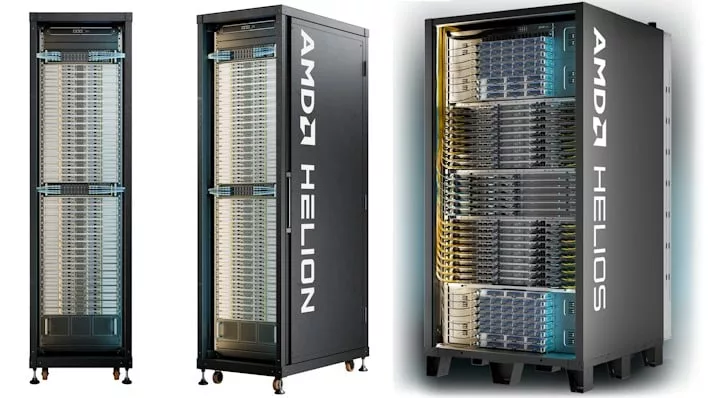
AMD has announced its new Helion rack platform, specifically engineered to handle the demands of agentic AI. Moving away from the GPU-heavy focus of previous architectures, Helion prioritizes the high CPU throughput required for autonomous AI agents.
Shifting Focus: From Training to Agents
While the massive Helios architecture was designed for training frontier models like ChatGPT—utilizing double-wide racks packed with GPUs—Helion addresses the emerging needs of agentic AI. These workloads involve complex reasoning and non-AI components that demand significant CPU horsepower. Industry consensus suggests that agentic tasks require a much higher CPU-to-GPU ratio, often approaching 1:1, compared to traditional generative AI tasks.
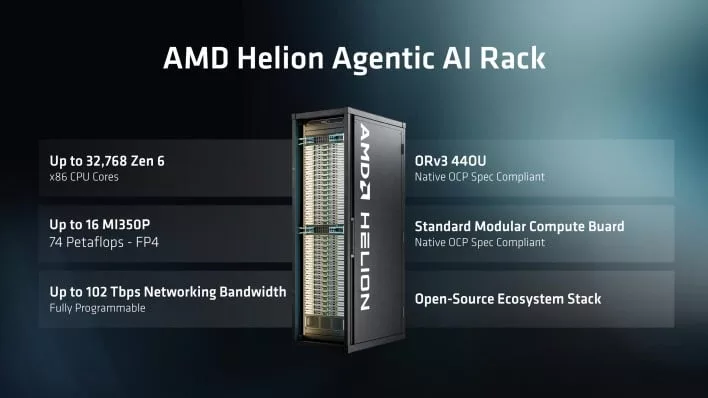
To accommodate this, Helion utilizes the standard OpenRack v3 form factor rather than the ultra-wide Open Rack Wide (ORW) format. This makes the system more compact and compatible with standard data center deployments, aligning with the Open Compute Project standards used by NVIDIA in its MGX-based systems.
Enterprise and Hyperscale Configurations
AMD is offering Helion in two distinct tiers to suit different market needs:
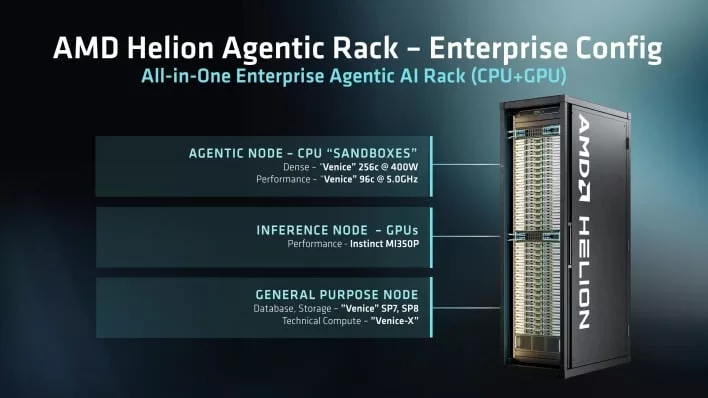
- Enterprise: A configuration pairing EPYC Venice CPUs with AMD Instinct MI350P accelerators, supporting up to 102 Tbps of networking bandwidth.
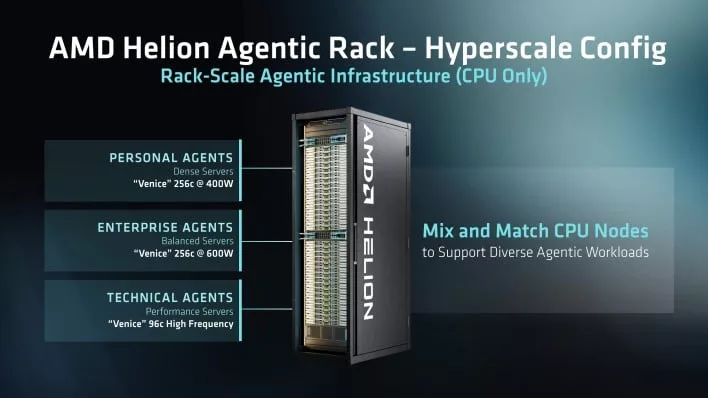
- Hyperscale: Designed for massive scale-out, this version can house up to 128 EPYC CPUs, delivering a staggering 32,768 Zen 6c cores. For latency-sensitive technical tasks, AMD also offers a configuration with 96 high-frequency Venice HF chips.
The platform's strength lies in its modularity. Built on open standards, Helion allows customers to mix and match CPU and GPU blades to create custom-tailored compute environments.
Open Standards and Availability
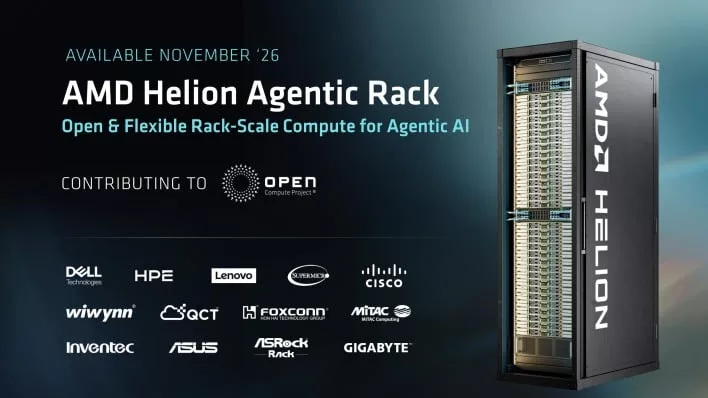
In a move to foster industry standardization, AMD plans to contribute the physical rack specifications of Helion back to the OCP. Similar to the approaches taken by Meta and NVIDIA, this contribution focuses on the physical form factor and mounting hardware, while the underlying silicon and interconnects remain proprietary. Helion-based systems are expected to be available through ecosystem partners starting next month.
Гика
