Xiaomi Pad 9 Pro review: High-end specs with a battery focus

Xiaomi's new premium tablet aims to be a high-performance alternative to the iPad Air, offering top-tier hardware in a mid-range price bracket. While the Pad 9 Pro brings significant upgrades in screen size and battery capacity over the Pad 8 Pro, a closer look at the technical specifications reveals a more nuanced story of high-end performance paired with strategic cost-cutting.
The Xiaomi Pad 9 Pro positions itself as a powerful Android tablet with stylus support, targeting users who want premium features without the full flagship price tag. It features a large 12.5-inch LCD and an impressive battery, making it a strong contender in the mid-range segment. However, the transition from the Pad 8 Pro to the Pad 9 Pro isn't a straightforward leap in every category.
Performance and Display: A Mixed Bag
On the performance front, the Pad 9 Pro utilizes a high-end Snapdragon chip, but it is not the absolute latest flagship SoC found in some competitors. As a result, in certain scenarios, the successor to the Pad 8 Pro may actually perform slightly slower than its predecessor. The display is a standout feature for those sensitive to PWM (Pulse Width Modulation) flickering, as it uses a bright LCD that avoids this issue. However, when compared to mid-range OLED panels from brands like Honor, it falls behind in terms of peak brightness and contrast ratios.
Build and Connectivity
The device is housed in a premium aluminum unibody that feels high-quality, though the increase to a 12.5-inch screen makes the tablet noticeably heavier at 580 grams. While it supports fast USB 3.2 via USB-C, it lacks DisplayPort input for video, a feature reserved for the Pro Max model. Connectivity is modern with Wi-Fi 7 support, but users should note that this version lacks 5G and GNSS (GPS) capabilities.
- Pros: Premium aluminum unibody, long battery life, bright LCD without PWM, good performance, and an appealing feature set.
- Cons: Stagnating performance compared to previous flagship iterations, no 5G/GPS version, relatively heavy, and lower brightness/contrast than OLED alternatives.
Networking and Connectivity
The Xiaomi Pad 9 Pro is not designed for mobile users who rely on cellular data without a smartphone; as with previous iterations, Xiaomi has omitted a 5G version with satellite positioning capabilities. However, for home use, the tablet supports the fast Wi-Fi 7 standard. In our testing, we achieved impressive transfer rates peaking at 1,500 Mbit/s. While these speeds are high, the device does not fully saturate the limits of our Wi-Fi 7 router, with some mid-range smartphones actually performing faster in similar conditions.
Cameras: High Megapixels, No Stabilization
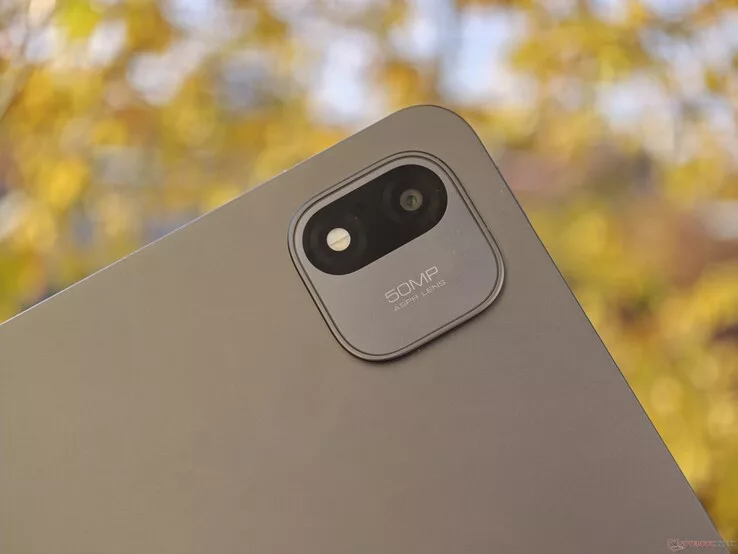
The camera hardware remains largely unchanged from previous generations. The front-facing 32 MP camera lacks pixel binning and uses fixed focus, though it remains perfectly adequate for video calls. To assist with audio, four microphones are integrated for active noise cancellation. On the rear, there is a 50 MP sensor with autofocus and an f/1.8 aperture, suitable for snapshots or digitizing documents. It includes a dedicated mode for automatic document cropping.
In daylight, the rear camera produces usable photos with fairly accurate color reproduction. However, the system lacks optical image stabilization (OIS).
Display: Larger LCD without PWM
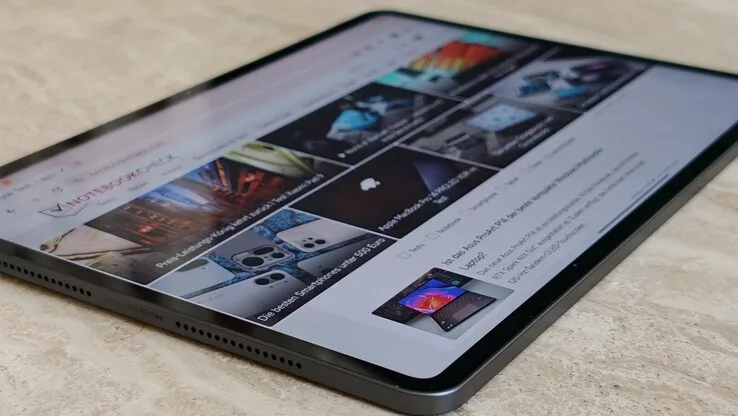
The Pad 9 Pro moves to a larger 12.5-inch LCD, up from the 11.2-inch panels of the last two generations. This increase in size results in a lower pixel density despite the 2,136p resolution, though the difference is unlikely to be noticeable during everyday use. Peak brightness reaches 1,000 nits according to the manufacturer; our measurements with APL18 and HDR content yielded similar results, averaging around 831.6 cd/m². While this is decent, it remains only average compared to competitors like the MagicPad 4.
A significant advantage for users sensitive to flicker is that Xiaomi does not use PWM (Pulse Width Modulation) to control brightness, opting for a flicker-free approach instead.
Accessories and Input
The tablet features a highly responsive touchscreen with a high refresh rate for smooth operation. Unlike the standard Pad 9, the Pro model includes a fingerprint sensor in the power button, which is easily accessible with the left hand and offers first-rate recognition speed. Biometric security is further supported by 2D facial recognition.
For productivity, Xiaomi offers the Focus Stylus Pro and a Focus Keyboard with a trackpad (priced at US$ 184). The retail package includes a 67W fast charger and a USB-A to USB-C cable.
Display: High Brightness, but Not OLED Deep
The Xiaomi Pad 9 Pro features a 12.5-inch LCD panel with a resolution of 3200x2136. In our testing, the screen demonstrated impressive peak brightness levels, reaching 993 cd/m² for APL18 and 982 cd/m² for HDR. While these figures are high, the black level sits at 0.55 cd/m², meaning it cannot match the deep blacks provided by OLED panels like those found in the Honor MagicPad 4 or Huawei MatePad Air (2026). Color accuracy is a strong suit for this price range, with a dE 2000 of 1.51 in the sRGB color space, though it slightly trails behind the Honor MagicPad 4, which achieved a dE of 0.9.
Response Times and Motion Clarity
When it comes to motion, the Pad 9 Pro's response times are adequate for general use but may fall short for competitive gamers. The measured Black-to-White response time is 22.6 ms (12 ms rise / 10.6 ms fall), and the 50% to 80% Grey response time is 27.6 ms. These results are slightly worse than the average of all tested devices (19.6 ms for Black-to-White and 30.6 ms for Grey-to-Grey), placing it in the middle of the pack regarding motion clarity.
Performance: The Snapdragon 8 Gen 5 Factor
Equipped with the Qualcomm Snapdragon 8 Gen 5, the Xiaomi Pad 9 Pro positions itself as a powerful mid-range option. However, it doesn't quite reach the performance heights of its predecessor, the Xiaomi Pad 8 Pro, which utilized the Snapdragon 8 Elite. In Geekbench 6.7 single-core tests, the Pad 9 Pro (2945 points) sits just behind the Pad 8 Pro (3088 points) and is comparable to the Honor MagicPad 4 (2863 points). In multi-core scenarios, the Pad 9 Pro (10055 points) shows a slight edge over the Honor MagicPad 4 (9492 points) but remains slightly behind the Pad 8 Pro (9543 points) in some configurations, though it generally performs better than the class average.
In productivity and AI-focused workloads, the results are more varied. In PCMark for Android (Work 3.x), the device scored 16756 points, which is significantly lower than the average Qualcomm Snapdragon 8 Gen 5 device (20298 points). Furthermore, the tablet appears to struggle somewhat in specific AI inference tests compared to its peers.
Benchmark Performance: Snapdragon 8 Gen 5 in Action
The Xiaomi Pad 9 Pro is powered by the Qualcomm Snapdragon 8 Gen 5 paired with the Adreno 829 GPU. In the BaseMark OS II test, the device achieved 12,288 points, which is a 14% decrease compared to the 14,323 points recorded by the previous Xiaomi Pad 8 Pro (equipped with the Snapdragon 8 Elite). However, when compared to the class average for tablets over the last two years (7,271 points), the Pad 9 Pro shows a significant performance lead of 45%.
System and memory performance shows a mixed bag. While the Pad 9 Pro leads in system-level tasks with 18,657 points (compared to 17,526 on the Pad 8 Pro), it falls slightly behind in memory-intensive operations, scoring 17,734 points—a 22% drop from the Pad 8 Pro's 22,893 points. In terms of raw graphics power, the Adreno 829 delivers 39,245 points in BaseMark, outperforming the Pad 8 Pro's 36,723 points by approximately 6%.
AI and Specialized Benchmarks
The device's AI capabilities, measured via UL Procyon AI Inference for Android (NNAPI), resulted in a score of 19,754 points. This is roughly in line with the class average (19,543 points) and slightly behind the Honor MagicPad 4 (20,683 points). In Geekbench AI tests, the results vary depending on the precision used: for Quantized NPU 1.7, the Pad 9 Pro scored 1,333 points, which is actually lower than the average for Snapdragon 8 Gen 5 devices (1,578 points).
3DMark and GFXBench: Gaming and Graphics
In 3DMark testing, the Xiaomi Pad 9 Pro shows a performance gap compared to the Snapdragon 8 Elite-based Pad 8 Pro. For instance, in Wild Life Extreme Unlimited, the Pad 9 Pro scored 5,635 points, while the predecessor achieved 6,432 points. However, the Adreno 829 remains highly capable for its price bracket, delivering 45 FPS in the demanding GFXBench 4K test—a slight improvement of about 2 FPS over the Pad 8 Pro.
- 3DMark Wild Life Extreme: 5,635 (Pad 9 Pro) vs 6,432 (Pad 8 Pro)
- 3DMark Solar Bay: 9,676 (Pad 9 Pro) vs 11,683 (Pad 8 Pro)
- 3DMark Steel Nomad Light: 2,087 (Pad 9 Pro) vs 2,596 (Pad 8 Pro)
- Antutu v12: 3,465,897 (Pad 9 Pro) vs 4,798,294 (Class Average)
Benchmark Performance: Pushing the Snapdragon 8 Gen 5
In synthetic benchmarks, the Xiaomi Pad 9 Pro demonstrates the capabilities of the Snapdragon 8 Gen 5 paired with UFS 4.1 flash storage. In GFXBench tests, the device shows strong performance, though it trails slightly behind the previous Xiaomi Pad 8 Pro in certain offscreen scenarios. For instance, in GFXBench 3.1 Manhattan ES 3.1 Offscreen, the Pad 9 Pro achieved 296 fps, compared to the Pad 8 Pro's 323 fps. However, in the demanding 4K Aztec Ruins High Tier Offscreen test, the Pad 9 Pro reached 45 fps, nearly matching the Pad 8 Pro's 43 fps.
Web-based and specialized benchmarks highlight the tablet's efficiency in modern tasks. In Jetstream 2, the Pad 9 Pro scored 326.483 points, placing it ahead of the Xiaomi Pad 8 Pro (267.483 points) but behind the Honor MagicPad 4 (338.038 points). In Octane V2, it recorded 84,673 points, showing a significant lead over the Pad 8 Pro's 76,383 points. When looking at web performance via WebXPRT 5, the Pad 9 Pro scored 74 points, which is slightly above the Snapdragon 8 Gen 5 average (67.3 points) but below the Honor MagicPad 4 (81 points).
Storage and Memory Throughput
The implementation of UFS 4.1 storage in the Xiaomi Pad 9 Pro provides high-speed data access. In AndroBench 3-5 tests, the device demonstrated a sequential read speed of 3985.4 MB/s and a sequential write speed of 3784.09 MB/s. This performance is notably higher than the Honor MagicPad 4, which recorded significantly lower sequential read (1978.75 MB/s) and write (1752.63 MB/s) speeds due to its UFS 4.0 configuration.
Thermal Profile and Throttling
Thermal testing reveals that while the Xiaomi Pad 9 Pro does not reach extreme temperatures under sustained load, it exhibits uneven heat distribution. The device warms up noticeably around the SoC area, with a maximum recorded temperature of 42.8 °C during heavy usage. This is a slight increase compared to the idle temperature of approximately 31.3 °C.
This thermal behavior leads to some performance degradation. 3DMark tests indicate that performance drops by approximately 15% during prolonged workloads. While this level of thermal throttling is not severe, it is more pronounced than the throttling observed on the Xiaomi Pad 8 Pro, suggesting that the higher performance of the new chipset requires more aggressive thermal management.
Thermal Performance and Stability
The Xiaomi Pad 9 Pro demonstrates impressive thermal management for a device of its class. Under maximal load, the upper side maintains an average temperature of 31.3 °C, which is slightly cooler than the 30 °C average seen in many other tablets. While the bottom of the device can reach a maximum of 42.8 °C—notably higher than the class average of 33.2 °C—the upper surface remains well-controlled, peaking at 36.5 °C. In idle conditions, the device is exceptionally cool, averaging 23.4 °C, significantly lower than the 30 °C class average.
3DMark Stress Test Results
In synthetic stress testing, the Pad 9 Pro shows varied stability depending on the workload. In the Wild Life Extreme Stress Test, it achieved a stability of 87.8%, which is lower than the Xiaomi Pad 8 Pro (93.4%) but remains competitive. However, it excels in the Steel Nomad Light Stress Test, maintaining 96.1% stability. When compared to its predecessor, the Pad 8 Pro, the Pad 9 Pro shows a slight drop in stability for the Wild Life Stress Test (87.4% vs 93.1%), despite the hardware upgrade.
Audio and Speaker Analysis
Xiaomi has reduced the speaker count from eight in the previous generation to six in the Pad 9 Pro. Despite this, the audio quality remains good to very good for everyday use. The speakers are relatively loud, reaching 85 dB. While the bass is slightly reduced—averaging 9.7% lower than the median—it remains perceptible. The mids are well-balanced, and the highs are slightly elevated compared to the median, resulting in an overall linear sound profile. Compared to other devices in its class, the Pad 9 Pro's audio performance is better than 80% of tested competitors.
Battery Life and Power Efficiency
Equipped with a massive 11,000 mAh battery, the Pad 9 Pro is a powerhouse in terms of endurance. It supports 67W fast charging, allowing for a full recharge in approximately 1.5 hours. In our real-world Wi-Fi web surfing test (at 150 cd/m² brightness), the tablet lasted an impressive 22 hours and 18 minutes—outlasting a comparable iPad Air by over 9 hours. The device is also highly efficient; its power consumption during idle (1.7 W) and load (8.6 W) is significantly lower than the average for tablets in its class.
Performance and Display: The Core Value Proposition
The Xiaomi Pad 9 Pro positions itself as a high-performance alternative in a market often dominated by Apple's ecosystem. At its heart lies the Qualcomm Snapdragon 8 Gen 5, paired with the Adreno 829 GPU. This hardware configuration, supported by 12 GB of RAM and 256 GB of UFS 4.1 storage, is designed to handle demanding tasks and modern gaming with ease. While the internal specs are impressive, the real-world utility of such power depends heavily on software optimization and the specific demands of the applications used.
The visual experience is centered around a 12.50-inch LCD panel. With a resolution of 3200x2136 and a pixel density of 308 PPI, it offers a sharp and detailed canvas for media consumption and productivity. While it lacks the native contrast benefits of an OLED panel found in competitors like the Honor MagicPad 4 or the Huawei MatePad Air (2026), the LCD implementation provides a reliable and consistent viewing experience for a wide range of users.
Market Context and Competition
When looking at the current landscape, the Xiaomi Pad 9 Pro faces stiff competition. It competes directly with the Honor MagicPad 4, which offers an OLED display and a slightly lighter build, and the Lenovo Yoga Tab Gen 2, which features a high-resolution IPS panel. However, Xiaomi's strategy focuses on the 'sweet spot' of price-to-performance. With a list price around 560€, it aims to provide a premium feel and high-end internals without the premium price tag associated with flagship tablets from Apple or Samsung.
The device's weight of 580 g makes it a substantial piece of hardware, leaning more towards a productivity tool than a handheld reading device. This weight, combined with its large screen real estate, suggests that the Pad 9 Pro is intended for users who prioritize screen size and raw processing power for multitasking or media, rather than those seeking the ultimate portability of a smaller tablet.