

Windows 11 Preps For Intel Nova Lake With A New CPU Performance Toggle
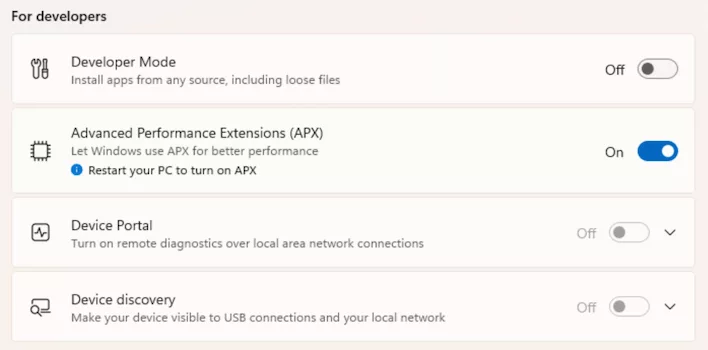
Windows 11 Experimental builds have revealed a new toggle within the Developer options that appears to enable Intel APX. This upcoming instruction set extension is expected to debut with the Intel Nova Lake processor family, which is rumored to be branded as the Core Ultra 4000 series.
What is Intel APX and why does it matter?
Intel APX (Advanced Performance Extensions) represents a significant expansion of the x86-64 instruction set. The most notable change is the doubling of general-purpose registers (GPRs) from 16 to 32. This allows compilers to keep more data in registers rather than constantly shuffling it to and from memory, potentially boosting performance in various workloads.
Currently, the toggle in Windows 11 does not perform any action because no existing processors support APX. However, the presence of this setting in the OS suggests that Microsoft is actively preparing for the arrival of Intel's next-generation hardware.
Why an explicit toggle instead of automatic support?
Typically, instruction set extensions like AVX are handled automatically; the OS identifies support via CPUID and enables the necessary features. However, APX introduces an additional architectural register state that the operating system must manage when switching threads, adding complexity to the kernel's task management.
There are several technical reasons why Microsoft might implement this as an opt-in feature:
- Developer Testing: It provides a way for developers to test software compatibility with the new register state before the feature is enabled by default.
- Compatibility Workarounds: An explicit switch could serve as a fallback if low-level software, such as kernel-level anti-cheat systems, encounters issues with the expanded instruction set.
With Intel Nova Lake leaks increasing and a potential announcement around CES 2027, Microsoft has a narrow window to finalize the implementation of APX support before these processors reach the market.
Гика
