Why AI Data Center Power Supplies Need More Independent Testing
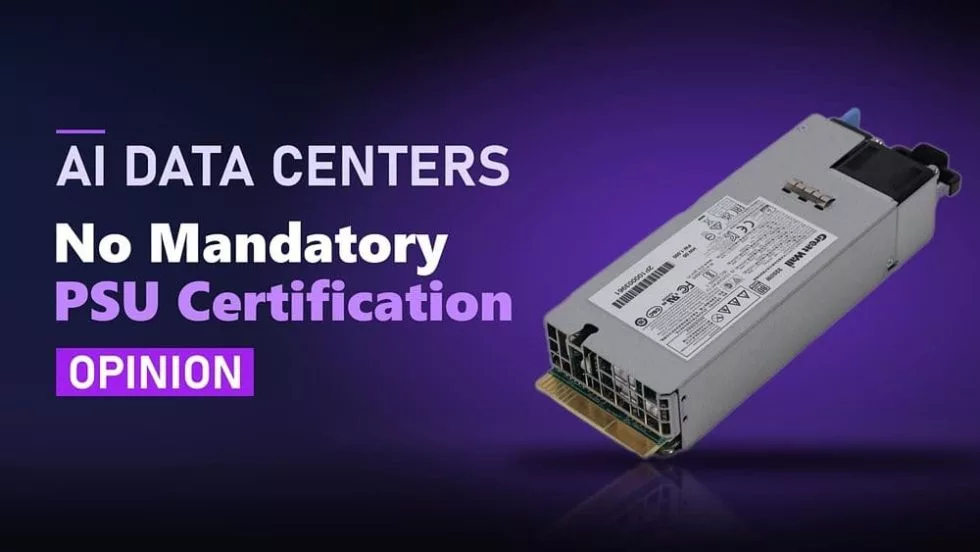
The energy appetite of data centers is growing at a staggering rate. While much of the focus remains on chips and cooling, a critical link in the power supply chain is being overlooked: the server power supply unit (PSU). According to Dr. Aris Mpitziopoulos of Cybenetics and hwbusters.com, many data center PSUs lack mandatory proof that their efficiency claims have been verified by an independent laboratory. As the global energy footprint of these facilities expands, the lack of standardized, transparent testing for server-level power conversion is becoming a significant regulatory and environmental concern.
The scale of the energy challenge is immense. The International Energy Agency (IEA) estimated global data center electricity consumption at approximately 415 TWh in 2024, accounting for about 1.5% of global consumption. Projections suggest this could rise to 945 TWh by 2030 and potentially reach 1,200 TWh by 2035. While these are scenarios rather than certainties—contingent on the growth of AI applications and hardware efficiency gains—the trend is clear. In the United States, the Lawrence Berkeley National Laboratory (LBNL) reported a consumption of 176 TWh in 2023, representing 4.4% of US electricity use, with projections for 2030 suggesting even higher percentages. These figures highlight why even marginal efficiency losses in power conversion become massive when scaled across entire data center infrastructures.
Multiple Conversion Stages and Hidden Losses
Power delivery in a data center is a multi-stage process. Electricity typically enters through the public grid, passes through a transformer, goes through an Uninterruptible Power Supply (UPS), and is distributed via Power Distribution Units (PDUs) to the servers. Once inside the server, the PSU performs the next conversion, and further voltage reduction on the motherboard supplies the processors and accelerators. At every stage, energy is lost as heat. The problem, as Mpitziopoulos points out, is the lack of a unified, mandatory verification process. Current standards are a patchwork of voluntary UPS programs, self-declared minimums for certain server PSUs, and a complete lack of requirements for DC or High-Voltage Direct Current (HVDC) power supplies, which are increasingly vital for new data center architectures.
Regulatory approaches vary significantly by region. In the EU, the Ecodesign Regulation 2019/424 sets efficiency minimums for servers and storage. For certain single-output PSUs, these include requirements at 10%, 20%, 50%, and 100% load (e.g., 90%, 94%, 96%, and 91% efficiency respectively). However, a major loophole exists: compliance is often declared via CE conformity without requiring mandatory verification by an independent lab before sale. Furthermore, high-performance systems like those with more than four CPU sockets or specialized HPC/Blade systems are often exempt. In the US, ENERGY STAR for computer servers is a voluntary program, though it does utilize third-party certification. Meanwhile, China's GB 43630-2023 standard, effective from January 2025, mandates efficiency limits but evaluates the server as a complete system rather than the PSU in isolation, leaving many high-end systems outside its scope.
The Three Blind Spots of Efficiency Measurement
There are three critical gaps in how efficiency is currently measured. First is the 'system boundary' problem inherent in Power Usage Effectiveness (PUE). Since the PSU is considered part of the IT equipment, its losses are included in the IT energy consumption. A low PUE indicates an efficient facility infrastructure, but it does not distinguish whether the power conversion within the servers themselves is efficient. A data center could boast an excellent PUE while using highly inefficient power supplies. Second is the issue of limited measurement points. Most standards, including EU and 80 PLUS, only test down to 10% load. In redundant configurations where multiple units share a load, individual units often operate well below this threshold, meaning their efficiency in real-world low-load scenarios remains unmeasured.
The third blind spot involves the transition to higher voltages. As the industry moves toward 48V or even 800V DC architectures to support AI-heavy racks, current testing protocols are struggling to keep up. While some manufacturers claim peak efficiencies exceeding 97.5% for new OCP-style power shelves, peak efficiency is a deceptive metric. It does not account for efficiency across varying load ranges, input voltages, or operating temperatures. Without continuous, comprehensive testing across the entire operating range, the true energy impact of these new high-voltage architectures remains largely unverified.
The transition to high-voltage DC architectures in AI data centers is creating a significant regulatory blind spot. While the industry focuses on chip performance and cooling, the efficiency of the power delivery chain—specifically server power supply units (PSUs)—remains largely unverified by independent standards. As power requirements scale to meet AI demands, even marginal inefficiencies in power conversion translate into massive energy losses and heat generation that current regulations fail to adequately address.
The Shift to High-Voltage DC
NVIDIA is reportedly working with Google, Microsoft, and other members of the Open Compute Project (OCP) on 800-Volt DC solutions for AI racks. The industry roadmap includes an 800V Powerrack for existing facilities in the second half of 2026, full-scale production of Kyber racks in 2027, and line-oriented busbars capable of delivering up to two megawatts per row. Additionally, an OCP specification for a 100-kW HVDC Power-Shelf was released in February 2026. These high-voltage DC (HVDC) and DC systems change how power is distributed, potentially shifting conversion stages closer to the racks or even inside the servers themselves. It is important to note that these timelines are industry plans and not guaranteed widespread implementation.
Current EU minimum requirements do not apply to these DC and HVDC systems. While manufacturers are already claiming peak efficiencies exceeding 97.5% for OCP-rack PSUs, a peak value does not represent average efficiency across actual load conditions, varying input voltages, or operating temperatures. Similarly, Uninterruptible Power Supply (UPS) systems are currently evaluated primarily through voluntary programs, despite the existence of the IEC 62040-3 standard for efficiency measurement.
The Scale of Potential Savings
The potential impact of improved efficiency is massive. Using a calculation by Dr. Mpitziopoulos (which is a hypothetical estimation, not a formal forecast), we can see the scale: if we take the IEA's 2030 baseline of 945 TWh and assume 60% is consumed by servers (567 TWh), increasing average PSU efficiency from 95% to 96% could save approximately 5.9 TWh annually. This calculation excludes additional savings from reduced cooling requirements. To put this in perspective, Cyprus's total electricity consumption in 2024 was roughly 5.4 TWh. At 95% efficiency, PSUs waste about 28 TWh annually as heat, which must be dissipated. According to the IEA, cooling accounts for about 7% of energy use in efficient hyperscale data centers, but over 30% in less efficient enterprise facilities.
A Roadmap for Standardization
To address these gaps, four complementary paths are proposed: First, the EU Commission should include component-specific requirements for PSUs in upcoming data center minimum energy standards. A legislative proposal is expected in Q2 2027. Second, a new IEC standard is needed to measure efficiency across the entire load range, as no current IEC standard evaluates server PSUs in this manner. Third, public procurement and hyperscalers could demand independent efficiency proof in tenders. Finally, laboratories and certification bodies should develop unified testing methods and shared databases to avoid redundant testing for multiple certifications.
Cybenetics and the Certification Gap
Cybenetics is currently the only organization offering efficiency and noise certifications for PSUs under ISO/IEC-17065 accreditation. Their ETA-Redundant rating for redundant CRPS and M-CRPS server PSUs ranges from Bronze to Diamond, with Diamond requiring at least 95% average efficiency and a power factor of at least 0.95. However, the program currently only certifies devices at 230V; for Low-Line and HVDC inputs, it only verifies functionality, not efficiency. While Cybenetics is willing to expand to HVDC and UPS testing, a single laboratory in Cyprus cannot cover the entire global market.
For the AI industry, where metrics like FLOPS per Watt and Tokens per Second are critical, understanding the energy lost specifically in power conversion is essential. This requires independent data on conversion efficiency, fan performance, and the accuracy of power values reported via PMBus, which operators use for telemetry and load management.
The energy appetite of data centers is growing at a staggering rate. While much of the focus remains on chips and cooling, a critical link in the power supply chain is being overlooked: the server power supply unit (PSU). According to Dr. Aris Mpitziopoulos of Cybenetics, many data center PSUs lack mandatory proof that their efficiency claims have been verified by an independent laboratory. As the global energy footprint of these facilities expands, the lack of standardized, transparent testing for server-level power conversion is becoming a significant regulatory and environmental concern.
The scale of the energy challenge is immense. The International Energy Agency (IEA) estimated global data center electricity consumption at approximately 415 TWh in 2024, accounting for about 1.5% of global consumption. Projections suggest this could rise to 945 TWh by 2030 and potentially reach 1,200 TWh by 2035. While these are scenarios rather than certainties—contingent on the growth of AI applications and hardware efficiency gains—the trend is clear. In the United States, the Lawrence Berkeley National Laboratory (LBNL) reported a consumption of 176 TWh in 2023, representing 4.4% of US electricity use, with projections for 2030 suggesting even higher percentages. These figures highlight why even marginal efficiency losses in power conversion become massive when scaled across entire data center infrastructures.
Multiple Conversion Stages and Hidden Losses
Power delivery in a data center is a multi-stage process: from the public grid through transformers and Uninterruptible Power Supplies (UPS) to Power Distribution Units (PDU) and, finally, to server PSUs. Inside the servers, voltage is stepped down again to power CPUs and GPUs. Each stage involves energy conversion losses. The problem is the lack of a unified standard for independent assessment. Dr. Mpitziopoulos points to a fragmented landscape: from voluntary programs for UPS to self-declared minimums for server PSUs. Furthermore, new architectures utilizing High Voltage Direct Current (HVDC) often lack mandatory efficiency requirements.
Regulatory approaches vary significantly by region. In the EU, under the Ecodesign Regulation 2019/424, minimum efficiency thresholds are set for server PSUs at specific load levels (e.g., 90% at 10% load and 91% at 100% for single-phase models). However, compliance is often self-declared by manufacturers under CE marking and does not require mandatory third-party verification before sale. Additionally, the regulation excludes servers with more than four CPU sockets and high-performance computing (HPC) systems. In the US, the ENERGY STAR program for computer servers is voluntary, though it uses third-party certification. China's GB 43630-2023 standard, effective from 2025, introduces mandatory efficiency limits but evaluates the server as a single system rather than individual components, leaving gaps in component-level control.
The Shift to High Voltage and New Standards
The transition to higher DC voltages is a major factor in energy consumption. NVIDIA, alongside Google, Microsoft, and other Open Compute Project (OCP) members, is working on 800V DC solutions for AI racks. Industry plans include launching 800V Powerracks for existing sites in the second half of 2026, full-scale production of Kyber racks in 2027, and the use of busbars capable of delivering up to two megawatts per row. In February 2026, an OCP specification for a 100-kW HVDC Power-Shelf was published. Such shifts in power distribution could move conversion stages closer to the racks or directly into the servers. It is important to note that these are industry roadmaps, not guaranteed standards.
For DC and HVDC systems, current EU minimum requirements are not mandatory. Manufacturers already claim peak efficiency for OCP rack PSUs exceeding 97.5%. However, peak efficiency does not reflect reality; it ignores average efficiency across various load levels, input voltages, and operating temperatures. A similar situation exists for UPS systems, where efficiency is largely verified through voluntary programs, despite the IEC 62040-3 standard providing measurement methodologies.
The Scale of Potential Savings
The potential for energy savings is significant, though based on projections rather than official forecasts. Using IEA 2030 data (495 TWh) and assuming 60% is consumed by servers (567 TWh), increasing average PSU efficiency from 95% to 96% could save approximately 5.9 TWh annually. This excludes savings from cooling systems. For context, at 95% efficiency, PSUs dissipate about 28 TWh of heat annually that must be removed. According to the IEA, cooling accounts for roughly 7% of energy in efficient hyperscale data centers and over 30% in less efficient enterprise facilities.
The Role of Cybenetics and Current Limitations
Cybenetics is currently the only organization providing independent efficiency and noise certification for PSUs based on ISO/IEC-17065 accreditation. Their ETA-Redundant program for server PSUs (CRPS and M-CRPS) uses ratings from Bronze to Diamond, where Diamond requires at least 95% average efficiency and a Power Factor (PF) of at least 0.95. Currently, certification is limited to 230V input; for Low-Line and HVDC modes, only functionality is verified, not efficiency. While Cybenetics is willing to expand to HVDC and data center UPS systems, a single laboratory in Cyprus may struggle to cover the entire global market.
For the AI industry, where metrics like FLOPS per watt or tokens per second are critical, understanding energy loss in power circuits is vital. This requires independent data not just on current conversion, but also on fan efficiency and heat dissipation. As infrastructure scales, the precision of power consumption becomes a critical factor for operational costs and environmental impact.
The 0.1% Error Margin
The argument for stricter control lies in the sheer scale of consumption. AI data centers often measure usage in megawatt-hours (MWh). At this scale, even a tiny deviation from a manufacturer's efficiency claim becomes tangible. For instance, a 0.1% difference in efficiency for a 100 MWh data center results in a loss of 100 kWh. Over a year and across thousands of nodes, these 'invisible' losses accumulate into massive electricity bills and complicate environmental certifications and construction permits, where energy consumption is often a key sticking point.