Valve targets Radeon stuttering with new AMDGPU memory path
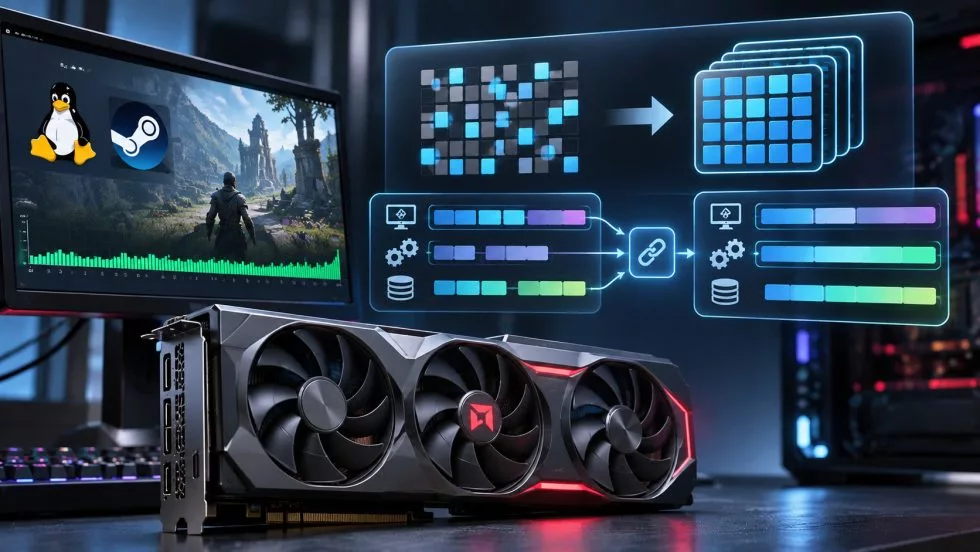
Valve is tackling a specific performance bottleneck in the Linux gaming stack by working on changes to the AMDGPU kernel driver. The goal is to reduce visible stuttering in certain Windows games running under Proton, specifically targeting issues related to how the driver manages virtual GPU memory regions.
The second version of a patch series, released on November 17, 2026, focuses on overhauling virtual GPU memory area management. The core of this update is the introduction of a new interface called `AMDGPU_GEM_VA2`. According to Valve developer Natalie Vock, the current synchronization model can unnecessarily block graphics and compute queues when handling memory operations, leading to degraded frametimes.
The overhead of Sparse Bindings
The issue stems from how modern games utilize Sparse Bindings. This technology allows applications to allocate large virtual GPU memory regions without immediately backing every part with physical VRAM. Instead, textures and other assets are only mapped to physical memory when they are actually needed. While this is excellent for modern asset streaming and memory efficiency, it generates a high volume of changes to the GPU's virtual memory tables.
Under the current AMDGPU path, graphics and compute tasks can compete with memory operations on the SDMA engine, even though many of these tasks could theoretically run in parallel. When a game places a heavy load on Sparse Bindings, independent queues may be forced to wait. This doesn't necessarily lower the average FPS, but it causes long individual frames, which players perceive as stuttering. Furthermore, each individual change to a Sparse Mapping currently requires a separate `ioctl` call, forcing the CPU to constantly switch between User and Kernel modes.
Batching and explicit synchronization
The new `AMDGPU_GEM_VA2` interface aims to solve this by allowing multiple virtual memory operations to be bundled into a single `ioctl` call, significantly reducing the number of kernel transitions. Additionally, Valve is implementing more explicit synchronization. Applications will be able to pass multiple Sync Objects—including Timeline Sync objects—for wait and signal operations. This provides the driver with a much clearer understanding of exactly which memory changes must wait for which specific GPU task.
This optimization is particularly critical for Proton. Since Windows games maintain their original Direct3D memory strategies, translation layers like DXVK or VKD3D-Proton must map these requests through Vulkan and finally to the Linux driver. A game with aggressive asset streaming can become bottlenecked at the kernel's memory management level, even if the Vulkan driver itself is highly efficient. While Valve notes that this patch series should significantly reduce stuttering in applications with high Sparse operation counts, it is not a general performance boost for all Radeon users; titles with static memory layouts will see little to no benefit.
This development highlights the depth of optimization currently required for Linux gaming. The bottleneck isn't necessarily in Proton, DXVK, or RADV, but deep within the kernel driver's memory management. Currently, the patch series is in version 2 and is not yet part of a released kernel. For `AMDGPU_GEM_VA2` to be used by userspace, the AMDGPU interface version must be upgraded from 3.66 to 3.67.