Unofficial WDDM Backport Brings RTX 50 and RX 9000 Support to Windows 7
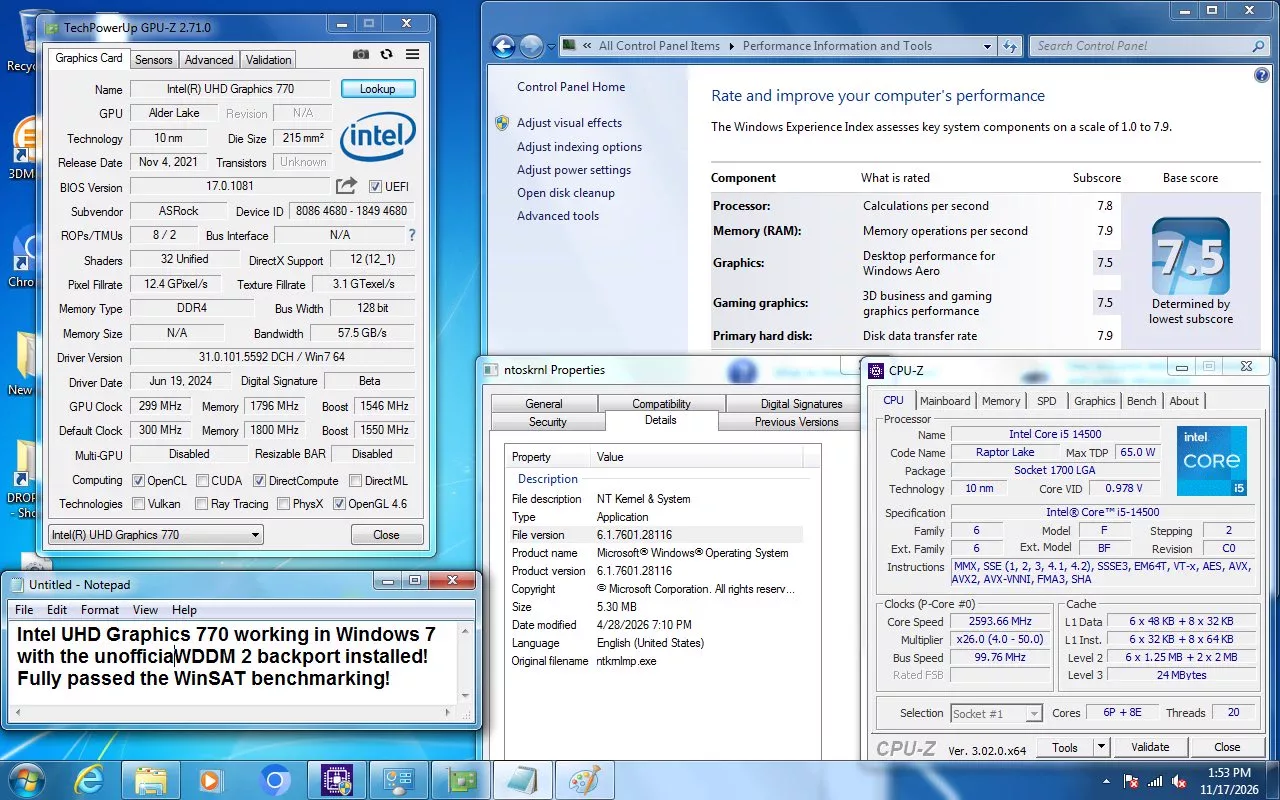
A community-driven project is attempting to breathe new life into Windows 7 by bringing modern graphics drivers and essential components of the Windows Display Driver Model (WDDM) 2.x back to the aging OS. The project, known as WDDM2Win7, aims to bridge the architectural gap that currently prevents modern hardware from being recognized by the 2009 operating system.
The core of the issue lies deep within the graphics stack. While Windows 7 natively uses WDDM 1.1, modern drivers from NVIDIA, AMD, and Intel are built around the features introduced with WDDM 2.0 and later in Windows 10. This architectural mismatch means that even if a physical card is plugged in, the OS simply lacks the language to communicate with it. The developers behind WDDM2Win7—EAZY BLACK, kryptik, and VisualEhrmanntraut—are working to port components of WDDM 2.2 back to Windows 7, effectively modifying the driver environment to allow current hardware to be recognized.
Demonstrations: RTX 50 and RX 9000 in Windows 7
Early demonstrations have already showcased significant results. According to reports and visual proofs shared by the developers, systems running Windows 7 have successfully identified hardware including Intel UHD Graphics 770, NVIDIA GeForce RTX 5060, and AMD Radeon RX 9060 XT. Further tests have even demonstrated a GeForce RTX 4090 paired with a Ryzen 9 7950X3D. Most notably, these setups have managed to run DirectX 12 applications and even enabled Raytracing in specific configurations.
However, it is crucial to distinguish between a functional proof-of-concept and full compatibility. While the backport allows the OS to 'see' the GPU and run certain D3D12 tasks, it does not guarantee that every modern game will work. Modern gaming relies on much more than just the DirectX 12 API; it requires updated kernel functions, modern Anti-Cheat systems, current Visual C++ libraries, and updated media components—all of which are increasingly moving away from Windows 7 support.
Experimental Nature and Security Risks
Even with the ability to run DirectX 12, the practical utility of this project remains experimental. There is currently a lack of wide-scale benchmarks comparing performance on Windows 7 against Windows 10 or 11, and it remains unclear which specific driver features (such as DLSS, FSR, or Vulkan implementations) might be limited or entirely unavailable due to the backport. Furthermore, using Windows 7 on a high-end modern system poses significant security risks, as the OS has not received security updates since January 2023, even under the Extended Security Updates (ESU) program.