Unity and OpenAI: Why AI is Redefining the Role of Developers
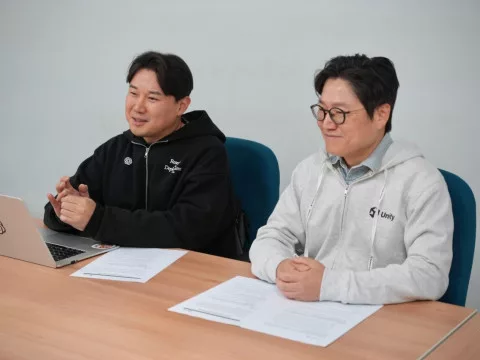
As artificial intelligence transitions from a speculative tool to an indispensable part of the production pipeline, the very nature of game development is shifting. At the recent Unity AI Game Jam held during G-STAR 2026, the industry witnessed a practical demonstration of this evolution. Supported by OpenAI, the event brought together developers to push the limits of what can be achieved in a 24-hour sprint using AI agents and automation. In this first part of our deep dive, we speak with Beom-joo Kim, APAC Advocacy Lead at Unity, and Tae-young Kim, Account Director at OpenAI, to understand why the industry is moving away from traditional seminars toward hands-on experimentation and how the role of the developer is being fundamentally reshaped.
The debate surrounding AI in game development is often polarized. While research indicates that over 90% of game studios are already integrating AI into their workflows, industry sentiment remains divided. Events like the Game Developers Conference (GDC) have highlighted a significant rift: more than half of developers express negative views toward AI, even as media reports showcase both massive successes and controversial implementations. This tension between rapid adoption and cultural resistance created a unique environment for Unity to test its theories on the ground.
Moving Beyond the Seminar: The Need for Practical Observation
For Unity, the decision to host an 'AI Game Jam' at G-STAR 2026 rather than a standard technical seminar was driven by a need for direct observation. Beom-joo Kim, APAC Advocacy Lead at Unity, explained that data alone cannot capture the nuances of how creators actually interact with emerging technologies. The goal was to see firsthand how developers combine the Unity engine with AI to generate new processes and ideas, and to identify where actual support is needed.
OpenAI joined the initiative as both a sponsor and a mentor, viewing the event as a vital opportunity to engage with the gaming ecosystem. Tae-young Kim, Account Director at OpenAI, noted that the company's headquarters views the gaming industry as a critical sector. For OpenAI, the value lay in the ability to provide on-site mentorship, helping participants solve real-world problems in real-time while gaining a tangible sense of the current state of game creation.
The Blurring of Professional Boundaries
The traditional structure of a game jam—where programmers, artists, and musicians work in silos before integrating their assets at the final hour—was noticeably absent during this event. Instead, the participants, a diverse group of 54 selected from 500 applicants, utilized AI agents and the Unity CLI to cross traditional professional boundaries. This shift allowed for a more integrated and efficient development cycle.
This new workflow resulted in a level of polish rarely seen in short-duration jams. Rather than struggling to finish basic mechanics, many teams were able to focus on presentation. More than half of the completed projects included cinematic elements, such as intro cutscenes or story explanation videos, allowing players to immediately engage with the game's world and narrative.
The 'Early Adopter' Advantage in Korea
A significant observation during the event was the rapid adoption of AI technology within the Korean development community. With Unity CLI usage ranking 3rd globally, the region has demonstrated a unique ability to embrace new platforms and technologies quickly. Beom-joo Kim attributed this to a historical trend where Korean creators have consistently pioneered new technologies to expand world-building and game quality.
Tae-young Kim from OpenAI echoed this sentiment, describing Korean developers as 'overwhelming' early adopters. While developers in other regions may remain conservative or even hostile toward AI, the Korean community was observed to be rapidly testing new tools, with a primary focus on how these technologies can tangibly benefit their specific projects and increase efficiency.
Beyond Coding: AI as a Tool for Novelty
During a recent game jam, the application of AI models moved beyond simple code generation. Beom-joo Kim, APAC Advocacy Lead, noted that participants are increasingly leveraging advanced tools like the Responses API for reasoning and the Decision API for rapid in-game actions. This shift indicates that developers are no longer just using AI to make existing game formats faster or more economical; instead, they are using diverse AI capabilities to discover entirely new 'fun factors' that were previously unexperienced.
However, the rapid pace of technological advancement presents a challenge: the tendency for developers to stick to familiar approaches. Tae-young Kim, Account Director, explained that even as new models and API products expand daily, a gap often forms between the existence of a new feature and its integration into actual development workflows. To combat this, on-site mentoring focused on practical use cases and situational best practices, ensuring developers could leverage these tools independently after the event.
The Shift from Implementation to Direction
One of the most significant observations from the event was the evolution of the developer's role. As the technical burden of implementation is lifted by AI, the focus of creators is shifting toward a 'director' perspective. Beom-joo Kim observed that instead of asking for technical troubleshooting, participants began asking sophisticated questions regarding art, design, balance, and user experience. The conversation has moved from "Congratulations on implementing it" to "Now that it's implemented, let's balance it and sharpen the UI readability."
This transition allows creators to engage in higher-level thinking. Tae-young Kim used an orchestra analogy to describe this new dynamic: while developers previously focused on mastering their specific domain, they can now act as conductors, using AI as a helper to rapidly turn complex ideas into tangible, polished results. This enables the pursuit of concepts that were previously impossible due to constraints in time or headcount.
Addressing the 'Homogenization' Concern
A common concern among students is whether AI will lead to a future where all games look and feel the same. The results from the game jam suggested otherwise. Despite using similar engines and APIs, the outcomes varied significantly—from cartoonish to realistic styles—depending on the specific prompts, genres, and the unique planning of each team. The diversity of the results confirmed that the creative approach remains the deciding factor in differentiation.
Enterprise Adoption and Future Synergies
For major studios, the primary challenge remains the gap in familiarity with newly released technology. Current industry efforts are focused on three pillars: AX (AI Transformation) for development environments, productivity (such as code migration and rapid concept drafting), and in-game applications. This includes exploring Audio APIs for seamless NPC interaction and the Decision API to create AI companions that act more like real human beings.
While concrete future collaboration plans between Unity and OpenAI are still being discussed, both companies expressed a shared vision to support the game creator ecosystem. The recent partnership demonstrated a high-quality synergy, producing results significantly different from previous hackathons that relied solely on tools like Codex.
The evolution of gaming technology often mirrors historical shifts in communication. Beom-joo Kim, APAC Advocacy Lead at Unity, compares the current integration of AI to the invention of the printing press. Just as the printing press expanded publishing from rigid religious texts to diverse forms like poetry and periodicals, new technologies in gaming are expected to unlock genres and interactions that were previously unthinkable. Rather than a crisis, Kim views this as an evolution toward building experiences on an entirely new plane, provided creativity is used to harness the technology.
The Shift from Execution to Intent
As AI tools become more capable, the nature of a developer's work is shifting from manual execution to high-level direction. Tae-young Kim, Account Director, argues that the core competency of a developer will increasingly lie in defining specific experiences, providing necessary context to AI, and judging whether the output aligns with the original intent. In this new landscape, AI serves as an assistant to enhance productivity—improving aspects like natural speech and photorealistic visuals—but the developer's ability to plan and prompt becomes the deciding factor in quality.
This shift is already lowering the barrier to entry for non-traditional creators. Kim notes that filmmakers and dancers are beginning to build games, suggesting that cross-disciplinary fusion will break existing genre molds and drive fresh attempts at advancing the medium.
Why Traditional Skills Still Matter
Despite the rise of generative tools, Unity's Beom-joo Kim warns against abandoning foundational development knowledge. He observes a common misconception that AI can create high-quality games from sparse, vague prompts like "make a running game." Without understanding technical concepts, developers cannot provide the specific instructions required for professional results.
- Understanding C# syntax and core programming concepts.
- Knowledge of color psychology and foundational graphics terms.
- Mastery of animation concepts and technical workflows.
- Ability to use specific engine systems (e.g., instructing AI to use the Unity VFX system rather than asking for generic 'explosions').
The most successful outcomes, according to Kim, occur when traditional game development expertise is combined with cutting-edge generative AI technology.
Strategy and the Long-Term Vision
As implementation becomes faster and easier, the challenge shifts from "how to build" to "what to build." Beom-joo Kim emphasizes the need for creators to establish a clear strategic goal. Simply wanting to make a "puzzle game" is insufficient in a market where AI can generate similar-looking content rapidly. To stand out, developers must focus on establishing unique genre conventions, distinct art styles, worldbuilding goals, and building dedicated communities.
Tae-young Kim adds that the approach to using AI should differ based on experience level. For aspiring developers, AI is a 'helper' to lower the barrier to entry for their first projects. For experienced professionals, it is a tool to expand their reach into new domains and unleash their accumulated expertise more broadly. He points to recent trends where solo developers have achieved significant revenue through 'vibe coding' as evidence of the new possibilities available when leveraging these technologies effectively.