

Tinybox with four Radeon RX 9070 XT: $11,000 for Deep Learning without Pro GPUs
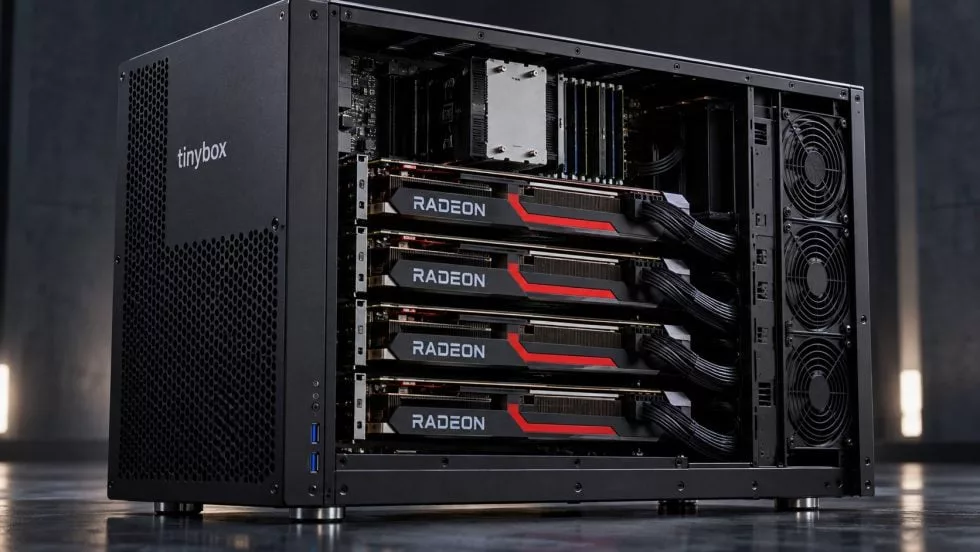
Tiny Corp is making its Tinybox significantly more modular. The more affordable G4 platform, featuring a 32-core AMD EPYC processor, DDR4 memory, and PCIe 4.0, starts at $7,000. Adding four AMD Radeon RX 9070 XT GPUs costs an additional $4,000, bringing the total price for a quad-GPU machine to $11,000. This setup targets users seeking high compute power without the five-figure price tag of professional AI accelerators.
Four Gaming GPUs vs. Two Professional Accelerators
The new Tinybox is no longer a rigid, pre-built product but a configurable server workstation. The G4 version is built around a 32-core AMD EPYC CPU. The base configuration includes 32 GB of DDR4 RAM and a 1 TB boot SSD. Users can upgrade to 128 GB of system memory for an additional $3,000. The most notable option is the addition of four Radeon RX 9070 XT graphics cards for $4,000, resulting in the $11,000 total system cost.
This configuration provides a total of 64 GB of VRAM, but it is important to note that this is not a single, coherent 64 GB memory pool. Each GPU maintains its own dedicated VRAM, meaning software and frameworks must be capable of distributing workloads across multiple cards. Consequently, this machine is not a direct substitute for a single professional GPU with 64 GB or 96 GB of unified memory.
Software Stack and Platform Strategy
Tiny Corp relies heavily on its proprietary tinygrad software. With RDNA 4 support and the custom AM driver, tinygrad can send compute tasks directly to "Radeon" GPUs, bypassing traditional HIP or ROCm paths. While this gives the company greater control over its software stack, it limits universality; users dependent on the NVIDIA CUDA ecosystem will still face the well-known compatibility challenges.
The choice of the G4 platform (utilizing DDR4 and PCIe 4.0) is a pragmatic one. In many GPU-centric deep learning workloads, the CPU primarily handles data orchestration and feeding the accelerators. If the four GPUs can be fully utilized, a more cost-effective host platform is more economical than a high-end modern server. For users requiring the latest standards, Tiny Corp offers a G5 version based on Genoa with DDR5 and PCIe 5.0, starting at $12,000.
The price gap between consumer-grade compute and professional AI ecosystems is stark. An NVIDIA RTX 6000 requires a $19,000 premium, and two such cards would cost an additional $38,000. The Radeon-based Tinybox offers a massive cost advantage, provided the workload is compatible with the AMD software stack.
Гика
