

SteamOS 3.9 on ASUS TUF Gaming A14: Strix Halo delivers high performance, but battery life is limited
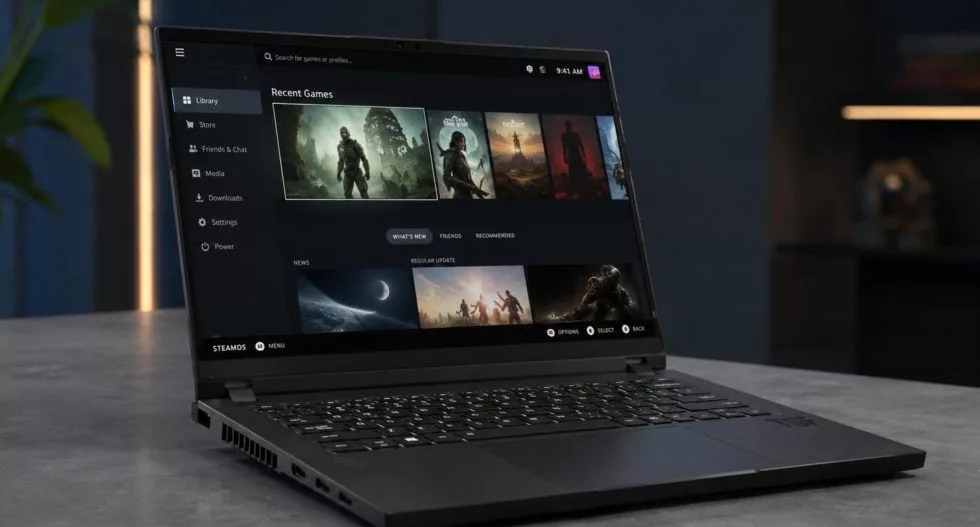
Valve continues to not release official laptops running SteamOS, but enthusiasts keep experimenting. Recently, VideoCardz published results from a practical test by ETA Prime, who installed SteamOS 3.9 on an ASUS TUF Gaming A14 with the Ryzen AI Max+ 392. The results look impressive, but require proper interpretation: the operating system is in the Main Channel and not a stable release, and the device does not have official support from Valve or ASUS.
Technical Base and Compatibility
The test used a laptop with a 14-inch display (16:10 aspect ratio, 2560 × 1600 pixels) and a 73 Wh battery. The system was equipped with 32 GB of LPDDR5X RAM, with 16 GB allocated to the graphics processor.
It is important to note that the Ryzen AI Max+ 392 operates on the Zen 5 architecture and contains 12 cores (24 threads), while the integrated Radeon 8060S graphics are built on RDNA 3.5 architecture with 40 compute units. All major functions — Wi-Fi, Bluetooth, USB, touchpad, and screen — worked without needing to install additional drivers.
Gaming Performance
Performance was evaluated across several titles at 1440p resolution. In Spider-Man 2, the system achieved over 80 FPS even without FSR, which is an excellent result. In Crimson Desert and Halo Campaign Evolved, performance was around 60–70 FPS using appropriate FSR modes (Quality and Medium respectively). In more demanding projects like Doom: The Dark Ages and Cyberpunk 2077, image scaling had to be activated to achieve stable 60 FPS.
It is worth remembering that stated performance figures depend heavily on graphics settings and used upscaling technologies. Without specifying specific parameters (e.g., internal render resolution or FSR mode), comparing results may be inaccurate.
Battery Life
Battery life varies significantly depending on workload and power-saving settings. In less demanding games like Hollow Knight: Silksong, the laptop ran for about 4–7 hours while consuming less than 16 watts. However, in heavy projects, the situation changes: in Cyberpunk 2077 (at 800p resolution and limiting FPS to 60), battery life was approximately 2 hours 25 minutes, and increasing resolution to 1200p reduced it to about 1 hour 40 minutes.
It is important to note that the test did not use special TDP limits or optimized power-saving profiles, so real-world figures may vary depending on system settings.
Conclusion
The test demonstrates that SteamOS 3.9 on a modern laptop with the Ryzen AI Max+ 392 is already practically ready for use. The integrated Radeon 8060S graphics provide sufficient performance for mobile gaming, but the limited battery makes the device more of a portable gaming PC than a full-fledged handheld console.
Although the potential of the technology is obvious, this is not yet a finished product from Valve or ASUS, but rather a successful experiment by enthusiasts.
Гика
