

RTX Remix and Project G-Assist: how NVIDIA builds AI tools around RTX PCs
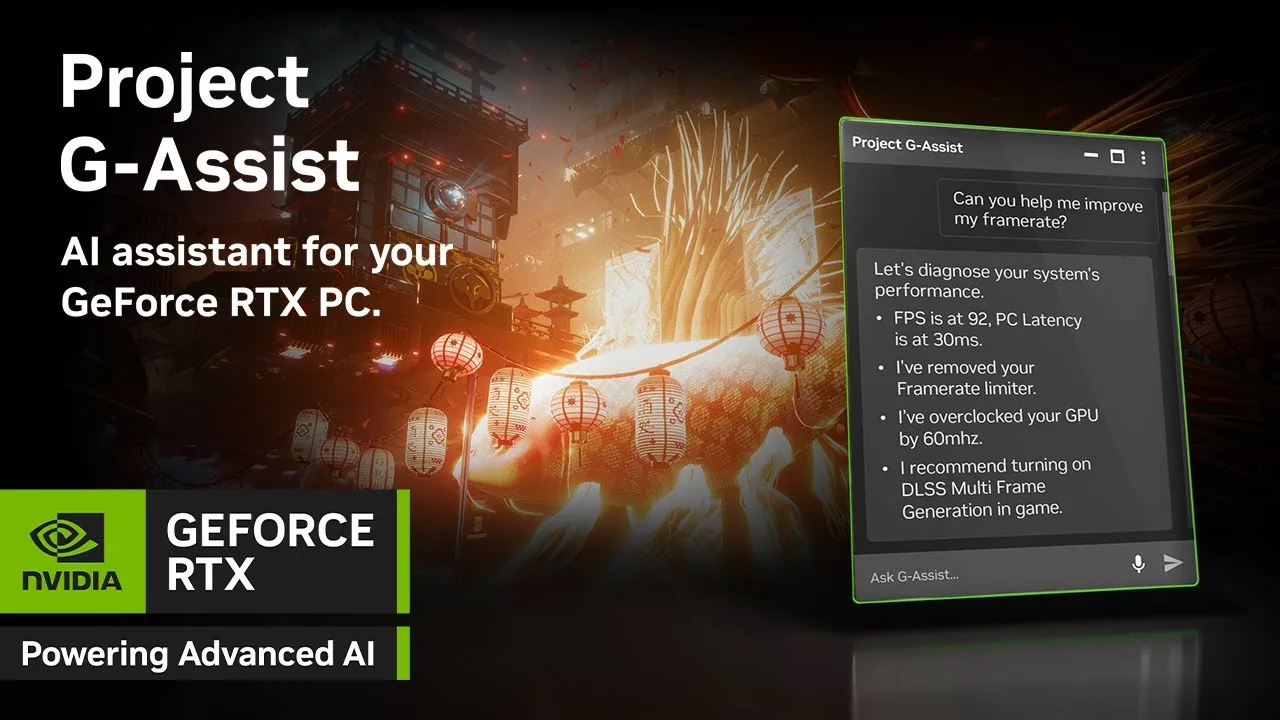
NVIDIA is positioning the RTX PC not only as a gaming machine, but as a local AI station for modding, generation and system control.
RTX is increasingly becoming a platform for tools, not only a way to get more FPS.
RTX Remix as the other half of the strategy
Alongside Project G-Assist, NVIDIA is pushing RTX Remix: a platform for remastering classic PC games. For players it looks like modding, but for the industry it is a test of how AI tools and path tracing can accelerate old-catalog upgrades.
NVIDIA describes a path-traced particle system with physically simulated particles, dynamic shadows and realistic reflections. That is not just cosmetic: particles often break lighting consistency in older games when they are not tied into the new tracing model.
What modders gain
Modders get tools that once required specialist teams: material updates, lighting, assets and visual effects. The better the automation, the more projects can move from experiments to full releases.
But automation does not replace art direction. The best RTX Remix projects will not be the most technical ones, but the ones whose authors understand the original game's aesthetic.
The local AI connection
G-Assist, the plug-in hub, NIM microservices and RTX Remix are parts of one strategy: an RTX PC should be an environment for playing, creating and running local AI tools.
If users can play, generate assets, control the system and extend an assistant through plug-ins, the GPU becomes a platform rather than only a frame-rate accelerator.
Редакция MBG
