

RTX 3080 Experiment: Moving GPU Position Drops Hotspot Temperature by 19°C
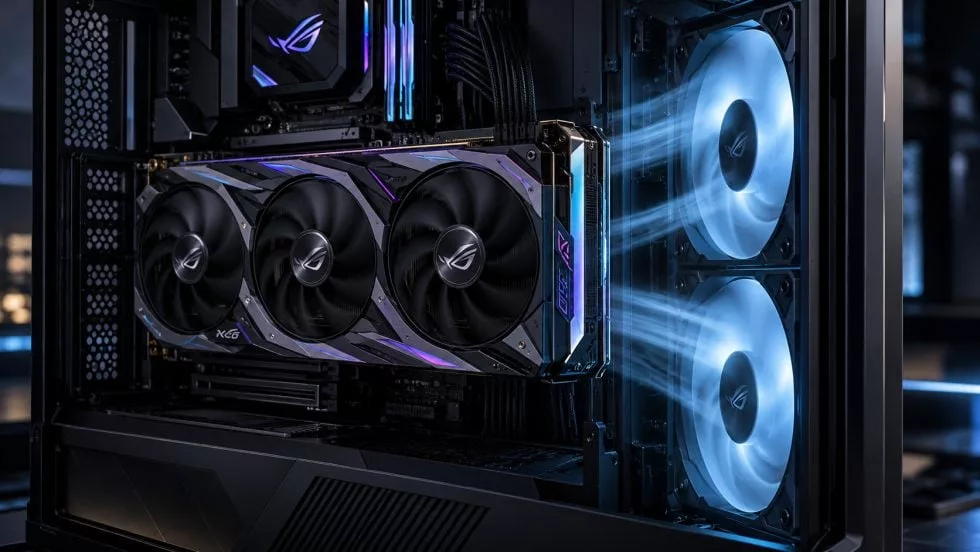
A simple question about PC mounting led to a surprising discovery. YouTuber TrashBench used a PCIe riser cable to move an ASUS ROG Strix GeForce RTX 3080 from its standard slot to various positions within a dual-chamber case, testing the impact on thermal performance.
The Impact of Direct Airflow
In a standard top PCIe slot configuration, the ASUS ROG Strix RTX 3080 reached temperatures typical for sustained loads: a GPU-Core temperature of 70.9 °C, a Hotspot of 87.1 °C, and VRAM at 95.4 °C. In this position, the card often recirculates air that has already been warmed by other internal components.
The results changed significantly when the card was mounted directly in front of three side intake fans. By providing the cooler with fresh, unheated air from outside the case, the following improvements were recorded:
- **Hotspot** temperature dropped by **19.3 °C**;
- **GPU-Core** temperature fell by **16,7 °C**;
- **VRAM** temperature decreased by approximately **14 °C**.
However, thermal management is a zero-sum game within a chassis. In the most GPU-optimized setup, the CPU temperature rose by about 1.1 °C due to the altered airflow patterns inside the case.
Finding the Thermal Balance
The experimenter eventually achieved a more balanced configuration by adjusting both the GPU position and the radiator setup. In this optimized state, the Hotspot remained 14 °C cooler than the standard position, while the CPU actually ran 3.3 °C cooler than in the baseline test. This suggests that the primary driver of the improvement is the increased airflow through the heatsink rather than the specific orientation of the vapor chamber.
The findings highlight how conservative PC case design remains. While modern GPUs demand significantly more power and cooling than the components of previous decades, the physical layout of PCIe slots remains largely dictated by historical ATX standards, which may not always provide the most thermally efficient environment for high-TDP hardware.
Гика
