

Nvidia GeForce RTX 5090 doesn't need a 16-pin cable, as this custom 8-pin card proves
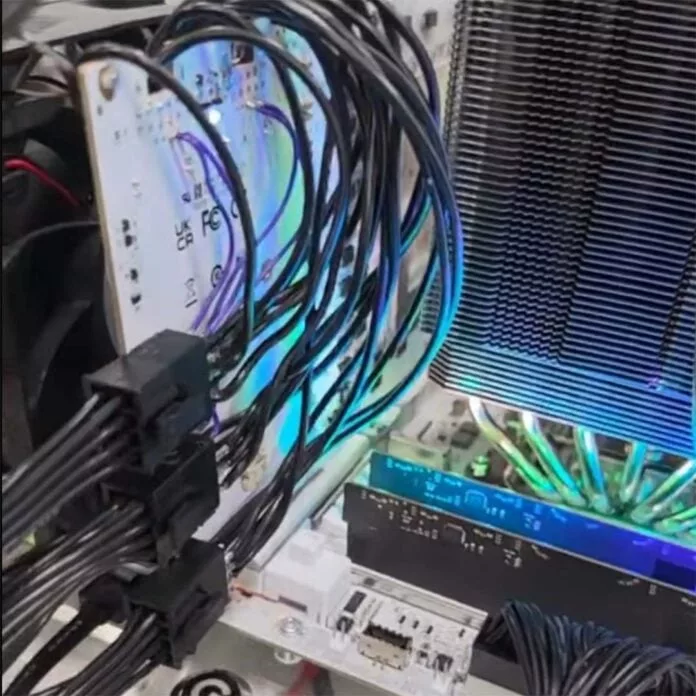
Nvidia GeForce RTX 5090 doesn't strictly require a proprietary 16-pin power connector, as demonstrated by a custom build from the Brazilian tech team TecLab. By modifying a high-end Galax HOF OC LAB XOC card, they successfully replaced the standard 16-pin design with three 8-pin connectors, proving that the Blackwell flagship can run reliably without the controversial new cable.
The modification was no small feat. TecLab stripped the original PCB and soldered three 8-pin connections directly to the board. They also rewired the on-board sense pins to ensure maximum power load handling and installed a custom GPU die-cooling system. While this Frankenstein's monster certainly wouldn't fit into a standard PC case, it serves as a functional proof-of-concept for ditching the 16-pin connector entirely.
Performance tests revealed that 8-pin cables carry an official limit of 150W, but their actual capacity is much higher. During a one-hour livestream, TecLab pushed the peak power draw up to 900W—double the expected 450W maximum for this array—using just three wires. Crucially, there were no alarming deviations in current or temperature typically seen with faulty 16-pin cables. Temperatures across the 8-pin wires peaked at a reasonable 35°C, despite the card pulling a whopping 120A and running at 3,400MHz.
To further demonstrate the resilience of 8-pin connectors, TecLab ran the RTX 5090 with just two cables. Power draw and clock speeds fell to 66A and 3,200MHz respectively, but the card continued to work without issue. They went a step further with a single connection, pushing these values to 65A and 3,100MHz, with wire temperatures peaking at 65°C.
While this custom build isn't ready for mass adoption in standard cases, the design highlights that there is potentially room for 8-pin designs across the GeForce RTX 50 series lineup. Following experiences with melting 16-pin connectors, many enthusiasts would certainly be up for trading convenience for reliability.
Гика
