

Modder Soldered RTX 5090 Power Cables Directly to PCB
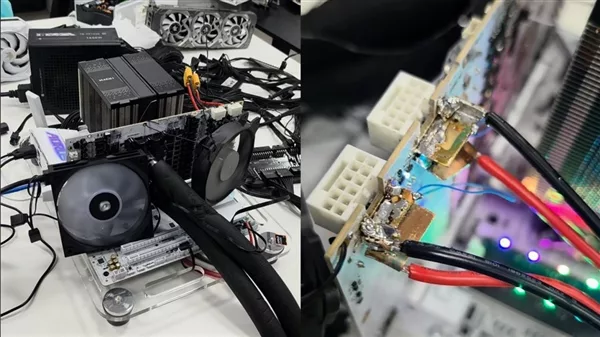
TecLab, a Brazilian hardware development team, has engineered an extreme modification for the NVIDIA GeForce RTX 5090 to address concerns regarding the physical integrity of its 16-pin power connectors. The solution involves bypassing standard plug-in interfaces entirely by soldering the power cable conductors directly onto the printed circuit board (PCB) of the graphics card, effectively eliminating the risk of connector melting or damage under high load.
The modification was performed on a Galax RTX 5090 D HOF OC LAB XOC, a non-reference model specifically designed to maximize overclocking performance. This particular card features dual 16-pin power connectors and is built to handle extremely high instantaneous power consumption, making it an ideal candidate for testing stability under extreme conditions. The TecLab team identified that the physical contact inherent in plug-in interfaces poses a significant risk; under high current loads, contact resistance can lead to heat accumulation and thermal runaway.
To mitigate this, the team discarded standard adapter plugs in favor of a direct connection solution. They integrated the power cable conductors directly into the system and soldered them onto the power input terminals located on the rear side of the graphics card's PCB. This approach physically removes the weak point where heat typically builds up at the connector interface.
Initial testing confirmed that the modified RTX 5090 powers on correctly and boots into the operating system without issues. During high-intensity stress tests using 3DMark and extended high-load scenarios, the card demonstrated stable operation with no frame drops, stuttering, crashes, or system reboats. The direct soldering method successfully proved its ability to maintain power supply stability under heavy load.
However, significant caveats remain. It is currently unclear whether this direct soldering method negatively impacts the graphics card's electromagnetic compatibility (EMC) certification. Furthermore, such a modification constitutes a severe violation of the manufacturer's warranty terms. Consequently, TecLab and industry standards strongly advise against attempting to replicate this procedure; it is intended solely as an experimental demonstration rather than a viable upgrade path for general users.
The news was originally reported by mydrivers and translated by Quasar Zone, which notes that the content reflects the technical findings of the Brazilian team without adding subjective editorial opinions. While the engineering feat is impressive, it serves as a stark reminder of the thermal limits inherent in high-end GPU power delivery systems.
Гика
