

Intel Nova Lake Leak: 52-Core CPU Timeline
A leaked vendor presentation slide suggests that Intel's Nova Lake-S processors will enter mass production at the end of 2026, with the first models reaching retail in Q1 2027. The leak, shared by user Алексей (@wxnod) on X, outlines a release cadence that prioritizes single-compute-tile chips before introducing the dual-tile, 52-core variants later in 2027. This staggered approach marks a significant departure from Intel's historical strategy of launching its highest-performance SKUs first, driven by the manufacturing complexities of integrating two compute tiles into a single consumer desktop package.
The DIY PC community has long held that high-framerate gaming and poorly optimized engines benefit significantly from large last-level cache (BLLC). While this necessity is often exaggerated at standard resolutions where the GPU remains the bottleneck, the performance uplift from substantial cache is well-documented in competitive esports titles. Intel's response to this market demand is the Nova Lake series, which has been anticipated for some time. Recent leaks indicate that consumers will not see these processors before the end of the current year, pushing the primary launch window into early 2027.
Release Timeline and Production Cadence
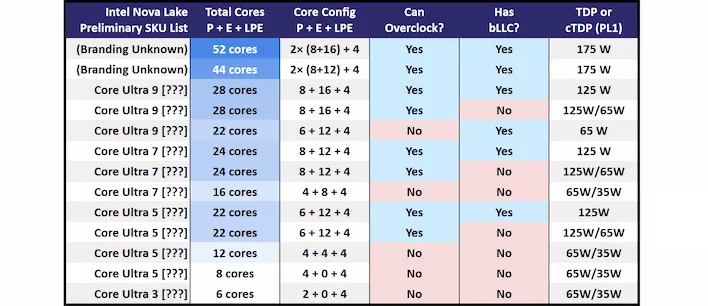
The leaked slide, reportedly from a vendor presentation in mainland China, provides a clear timeline for the Nova Lake-S rollout. The document indicates that mass production will commence at the end of 2026. The first models are scheduled to go on sale in the first quarter of 2027. Throughout 2027, additional models are expected to release, with the potential launch of the Razor Lake series occurring in late 2027. This timeline aligns with previous reports that Intel will initially launch 28-core processors, with the dual-compute-tile models featuring up to 52 cores arriving later in the year.
Most of the technical details in the leak are not new. It was already known that the LGA 1954 platform would support multiple generations of upgrades and continue to use LPDDR5 memory. However, the specific sequencing of the product launches offers new insight into Intel's strategic positioning against AMD.
Strategic Shift in SKU Launch Order
Historically, Intel has led with its fastest SKUs and then backfilled the lower-end parts. The Nova Lake launch represents a notable exception to this pattern. The company is not coming out of the gate with its biggest guns for the Core Ultra 400 series. Instead, it is prioritizing single-tile chips first. This decision is attributed to the manufacturing challenges associated with the top-end Nova Lake CPUs.

To achieve 52 cores on the top-end models, Intel is equipping those parts with two compute tiles. This is a first for consumer desktop CPUs from the company. Launching the single-tile chips first allows Intel to present credible competition for AMD in the gaming arena. These initial models are expected to compete well against AMD's extant Zen 5 chips in multi-core workloads as well.
Once AMD launches its Zen 6 desktop CPUs, which are expected to feature up to 24 cores, Intel plans to introduce the dual-compute-tile variants. These 52-core processors are expected to outpace the new AMD chips in multi-core workloads, primarily due to the sheer advantage in core count. This staggered release strategy allows Intel to maintain a competitive edge in gaming performance immediately while saving its highest core-count offerings for a later counter-move against AMD's next-generation architecture.
Performance Considerations and Memory Bottlenecks
While core count is a primary driver of multi-core performance, it is not the sole determinant. Even with current AMD chips featuring 16 cores and current Intel parts with 24 cores, strong multi-core scaling is observed in some workloads due to increasing memory transfer rates. There is a possibility that Intel's 52-core processors could face significant bottlenecks from their DDR5 memory interfaces. The high core count may demand more bandwidth than the memory subsystem can provide, potentially limiting the theoretical performance gains expected from such a high core density.

The interaction between the dual-compute-tile architecture and the memory subsystem will be a critical factor in determining the real-world performance of the top-end Nova Lake CPUs. While the core count advantage is substantial, the efficiency of data transfer between the compute tiles and the memory will dictate how well these processors perform in bandwidth-sensitive workloads. This aspect of the design remains to be fully understood until the products are available for testing.
Market Context and Competitive Landscape
The timing of the Nova Lake launch places it in direct competition with AMD's upcoming Zen 6 desktop CPUs. AMD has confirmed an upgrade path for its AM5 platform to Zen 6, which is expected to bring significant performance improvements. Intel's decision to stagger its releases suggests a calculated approach to maintaining market share in both the gaming and productivity segments.
By launching single-tile chips first, Intel can address the immediate demand for high-performance gaming CPUs without waiting for the more complex dual-tile designs to reach production maturity. This strategy also allows Intel to refine its manufacturing processes and yield rates for the dual-tile packages before committing to a full-scale launch of the 52-core models. The result is a more controlled and potentially more reliable product rollout for the high-end segment.
The Nova Lake series is expected to be a significant milestone for Intel in the consumer desktop market. The introduction of dual-compute-tile technology in a consumer package represents a major architectural shift. While the initial single-tile models will likely be competitive with current AMD offerings, the 52-core variants have the potential to redefine the upper limits of consumer CPU performance. The success of this strategy will depend on Intel's ability to manage the manufacturing challenges and ensure that the memory subsystem can keep up with the demands of such a high core count.
As the release date approaches, more details about the specific SKUs, pricing, and performance benchmarks are expected to emerge. The leaked timeline provides a clear roadmap for the Nova Lake rollout, but the actual performance and market reception will ultimately determine the success of Intel's latest desktop CPU strategy. The staggered launch approach offers a balanced strategy that addresses both immediate competitive pressures and long-term technological leadership.
Цифра
