
Intel Larrabee Prototype Found: Rare GPU Boots and Runs Crysis
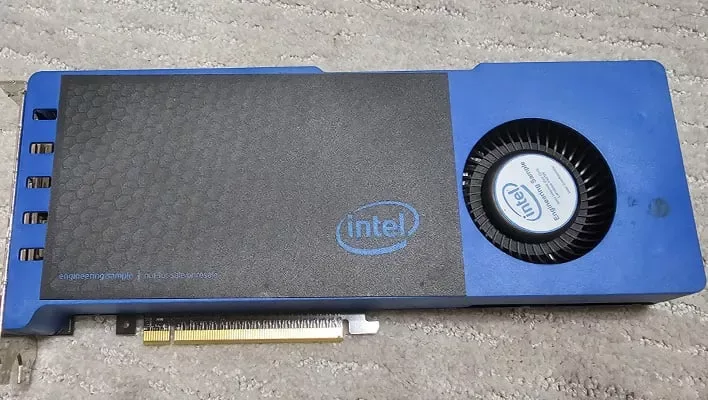
Project Larrabee was Intel's ambitious attempt to challenge NVIDIA and AMD in the discrete graphics market. Ultimately, the company pivoted toward High-Performance Computing (HPC) and canceled the consumer-facing project, leaving its prototypes as rare collector's items. Recently, one such prototype was discovered intact and functional, proving it can do more than just boot—it can actually run games.
The discovery was made by Reddit user pkellythompson, who purchased a dusty blue PC from a storage unit auction. The system contained a motherboard labeled Intel DX58S0. While the unit initially failed to display anything via HDMI, a tech-savvy friend eventually managed to get the prototype to boot into Windows 7 with Direct3D graphics acceleration enabled.
Crysis Performance
The most striking evidence of the hardware's capability came from running Crysis. Screenshots shared by the user show the development kit achieving approximately 36 FPS at 1280x720 resolution on Medium settings. While this performance wouldn't have challenged the flagships of the era, such as the NVIDIA GeForce GTX 285 or AMD Radeon HD 5870, it is a notable result for a prototype that never saw a retail release.
While Intel eventually returned to the consumer GPU space with the Arc series, this find is a significant piece of hardware history. Seeing a Larrabee dev kit successfully render 3D gameplay after all these years offers a rare glimpse into a technology that was abandoned before it could ever reach the hands of gamers.
Гика
