Intel GPU D270: Bridging the Gap Between HPC and Agentic AI
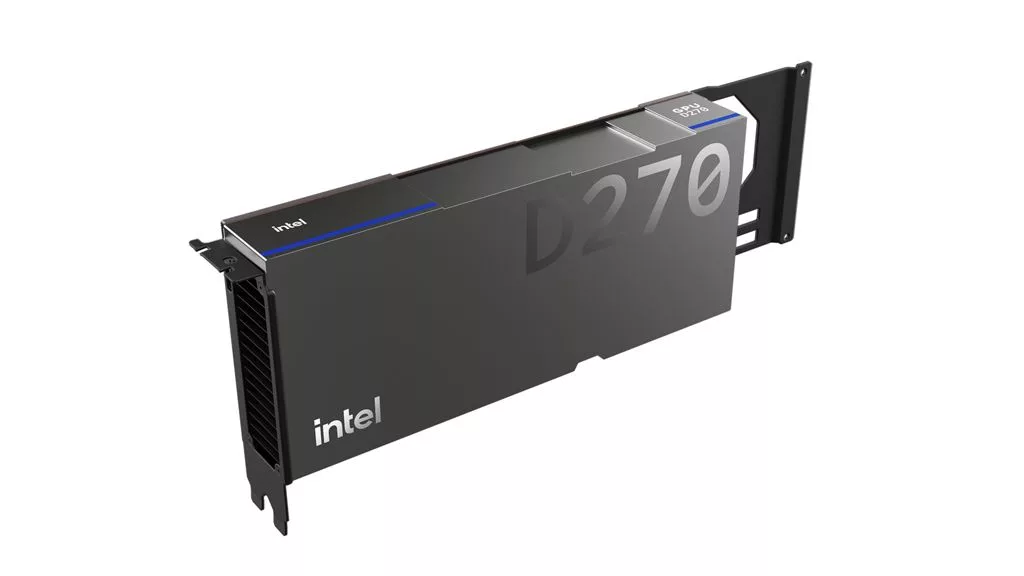
As high-performance computing (HPC) evolves from isolated numerical simulations into continuous, AI-integrated workflows, the demand for hardware that can handle both extreme mathematical precision and rapid AI inference has never been higher. Intel is positioning its GPU D270 (formerly codenamed Crescent Island) as a versatile solution for this convergence, combining the high-precision requirements of scientific modeling with the throughput needed for emerging agentic AI architectures.
The shift toward 'agentic AI'—where autonomous models evaluate simulation outputs and dynamically steer the next computational step—requires a heterogeneous infrastructure. In these environments, different compute engines must execute specific phases of a workflow. Intel’s D270 is designed to sit at this intersection, offering the high-precision math and massive memory capacity required by traditional HPC, while maintaining the efficiency needed for high-throughput AI inference.
Precision and Memory: The Architecture of D270
Scientific and financial simulations rely heavily on double-precision arithmetic to prevent rounding errors from compounding over massive datasets. Built on the Xe 3P architecture, the Intel GPU D270 features 32 Xe cores and 256 Xe Matrix Extensions (XMX) engines. This setup provides developers with significant precision flexibility: they can utilize lower precision (FP4 to FP8) to maximize inference throughput or leverage full-rate, native FP64 compute for applications where mathematical accuracy is non-negotiable.
To manage the massive working sets typical of these workloads, the D270 utilizes a high-capacity memory subsystem. The standard Intel-branded card is equipped with 160 GB of LPDDR5X memory, providing 1.5 TB/s of bandwidth. For more demanding environments, partner-designed configurations can scale this capacity up to 480 GB. This large memory footprint is intended to keep extensive datasets and wavefields resident on the GPU, reducing the need for costly data movement across the host bus. Despite this density, the card maintains a standard 350W, air-cooled PCIe form factor suitable for existing enterprise server racks.
Real-World Performance: Financial and Seismic Workloads
Preliminary benchmarks based on pre-production silicon suggest that the D270's balanced architecture offers distinct advantages in compute-heavy sectors. In financial services, specifically in options-pricing benchmarks, the D270 reportedly achieved up to 5.9× higher application throughput compared to the NVIDIA RTX PRO 6000 Blackwell Server Edition. Notably, this performance was achieved at a 350W power envelope, whereas the NVIDIA counterpart operates at 600W.
- European Monte Carlo: 5.9× throughput vs RTX PRO 6000 (Blackwell)
- Black-Scholes (European): 5.6× throughput vs RTX PRO 6000 (Blackwell)
- Binomial: 4.6× throughput vs RTX PRO 6000 (Blackwell)
- Black-Scholes (American): 1.92× throughput vs RTX PRO 6000 (Blackwell)
In seismic exploration—a critical workload for the Oil and Gas industry—the D270 utilizes FP32 compute to handle 3D acoustic wave-propagation calculations. By combining high memory capacity with cache-aware stencil optimizations, the architecture aims to keep large wavefield arrays resident directly on the card, maximizing data reuse and minimizing latency.
Disaggregated Inference and the AI-HPC Loop
Modern scientific discovery is increasingly seeing AI inference integrated directly into the simulation loop. Rather than running AI as a post-processing step, pre-trained surrogate models act as physics emulators to screen parameters, while agentic models monitor telemetry in real time to refine mesh boundaries. To prevent the bottlenecks caused by monolithic computing nodes, Intel is promoting a disaggregated architecture.
In this proposed blueprint, the Intel GPU D270 handles the compute-intensive 'prefill' stage, processing high-dimensional datasets and large context windows. This is paired with SambaNova SN50 Reconfigurable Dataflow Units (RDUs) to accelerate the memory-bound 'decode' stage, while Intel Xeon 6 processors manage orchestration. This heterogeneous approach aims to accelerate the entire agentic loop without requiring massive new power or cooling infrastructure, as the total power remains within standard air-cooled rack limits.
Software: Avoiding the Proprietary Trap
Intel's strategy for the D270 focuses on minimizing 'software friction' by supporting an open software stack. The goal is to allow researchers to leverage existing investments in standards like Intel MPI, Fortran, and high-performance C++ compilers. By integrating with standard AI frameworks and open SYCL programming models, Intel aims to provide 'Day 0' performance for existing toolchains, avoiding the need for developers to rewrite algorithms for proprietary ecosystems.
Early performance data from pre-production silicon suggests that the Intel GPU D270 is positioning itself for more than just standard inference. In the emerging category of 'decision-making' models—where AI agents perform reasoning rather than just generating text—the D270 has demonstrated up to 29% lower latency than the NVIDIA RTX PRO 6000 Blackwell server edition when running the Drex 2.0 workload. Additionally, in LLM throughput tests using Qwen 3 30B-A3B, the D270 achieved 1.12x the throughput of the same NVIDIA competitor while operating at a power cap of 350W.
Simplified migration for HPC workloads
Beyond AI, the D270 is showing versatility in High-Performance Computing (HPC). In a seismic imaging mini-application demo (Veridien), the transition from HIP/CUDA to the open SYCL programming model required minimal developer effort. By utilizing ahead-of-time (AOT) compilation and kernel bundles, the team was able to reuse existing compute kernels with no host-side code modifications. Notably, 90% of the kernels performed effectively without Intel-specific optimizations, and even complex kernels reached up to 70% of theoretical peak performance immediately upon the first unoptimized port. This allowed the entire workload to be ported in less than a month while maintaining numerical accuracy.
A balanced accelerator for converging workloads
While the D270 has largely been viewed as an inference-optimized solution, its combination of native FP64 precision, high-capacity memory, and an open software stack suggests a different role. As AI and HPC workloads continue to converge, the D270 is being presented as a balanced accelerator capable of handling both high-precision scientific computing and high-throughput AI tasks.
As the demands of high-performance computing (HPC) shift toward increasingly complex, data-intensive workloads, the hardware requirements for modern data centers are undergoing a fundamental transformation. Intel is positioning its D270 GPU as a key player in this evolving ecosystem, arguing that the architecture is specifically designed to address the nuances of modern computational science and large-scale data processing.
Addressing the Data-Centric Shift
The traditional HPC model, often focused on massive floating-point operations for simulation and modeling, is being augmented by a need for rapid data movement and specialized processing. Intel suggests that the D270 is built to bridge this gap. Rather than just providing raw throughput, the focus is on how the GPU handles the massive datasets required for modern AI-integrated scientific research and complex analytical models.
A significant part of the argument for the D270 lies in its ability to integrate into existing high-performance infrastructures. Intel emphasizes that the utility of the D270 is not just in its standalone performance, but in its capacity to accelerate specific, high-value workloads that are currently bottlenecked by traditional CPU-only or general-purpose GPU configurations.
Workload Optimization and Efficiency
In the context of large-scale deployments, efficiency is no longer a secondary metric—it is a primary constraint. Intel’s positioning for the D270 highlights its role in optimizing the performance-per-watt ratio for specialized computational tasks. This is particularly relevant for research institutions and enterprise data centers where power density and thermal management are critical limiting factors in scaling up supercomputing capabilities.
The company notes that while performance varies based on specific configurations and software stacks, the D270 is architected to provide a predictable and scalable path for researchers moving from small-scale prototyping to massive-scale production environments. This scalability is intended to reduce the friction typically associated with migrating complex scientific codebases to new hardware architectures.
The Role of Software and Ecosystem
Hardware alone does not define the success of an HPC solution; the software ecosystem is equally vital. Intel asserts that the D270’s value proposition is heavily tied to its compatibility with established programming models and libraries. By ensuring that the GPU can leverage existing software frameworks, Intel aims to lower the barrier to entry for organizations looking to integrate specialized GPU acceleration into their established HPC workflows.
Ultimately, the case for the D270 in the HPC market is built on the premise that the next generation of scientific discovery will be driven by the ability to process, move, and analyze data with unprecedented speed and efficiency, and that Intel's hardware is purpose-built to meet these specific, evolving demands.